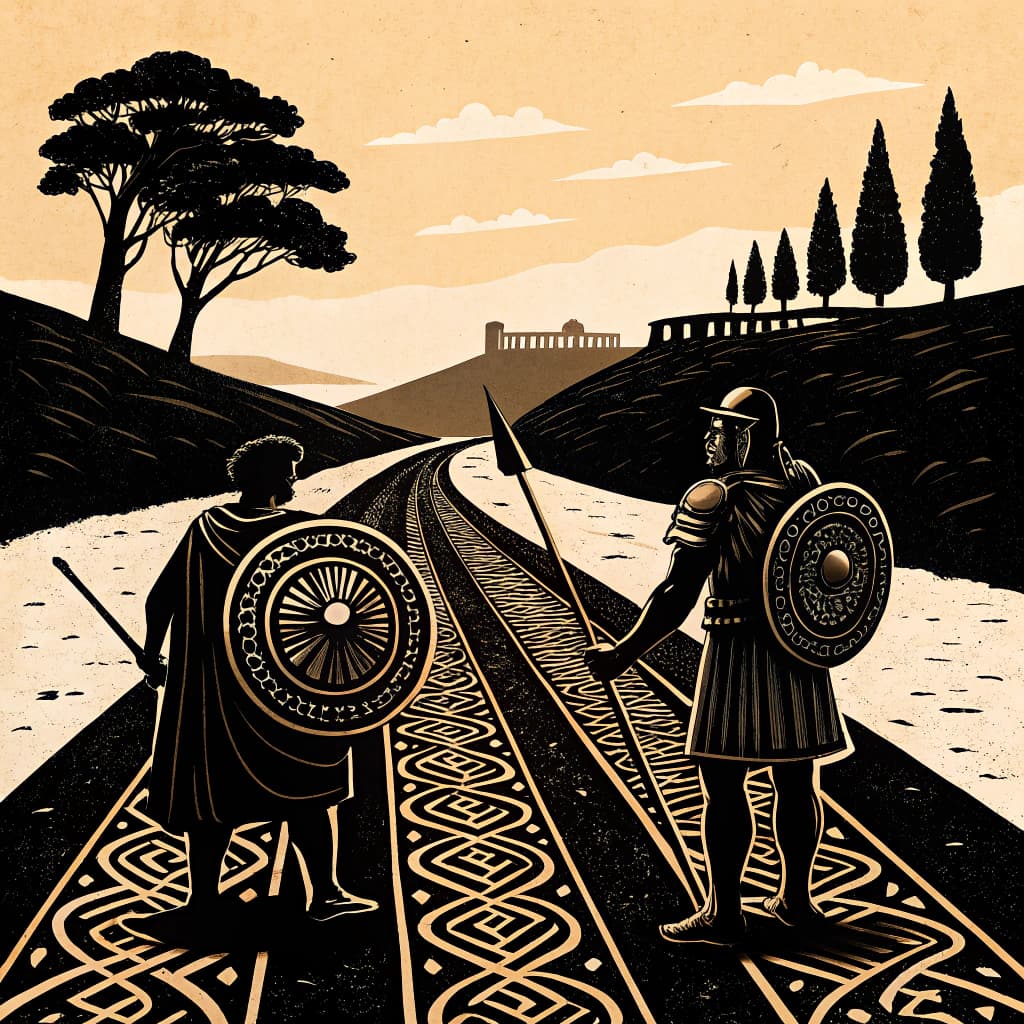
The Druids and the Massacre at Mona
Understanding the religious leaders of the Celts and why the Romans feared and targeted them.
About This Topic
Druids held central roles in Celtic society as priests, judges, teachers, and political advisors. They led rituals in sacred groves, preserved knowledge through oral traditions, and influenced tribal decisions on war and alliances. In Year 4, students examine how Druids embodied Celtic resistance to Roman invasion, uniting tribes spiritually and politically against conquest.
Romans viewed Druids as dangerous threats due to their power to rally opposition and practices like human sacrifice, which Roman writers such as Tacitus condemned. The massacre at Mona (Anglesey) in AD 60 marked a pivotal Roman assault on the Druid stronghold. Under Suetonius Paulinus, troops destroyed the holy island, killing Druids, priestesses, and followers in brutal fighting. This weakened Celtic cohesion temporarily, advancing Roman control in Britain, yet it connects to broader KS2 themes of empire impact and resistance, including Boudicca's later revolt.
Active learning excels here because the topic involves dramatic clashes of cultures and power. Role-plays, source analysis, and mapping let students embody perspectives, debate motivations, and visualize events, fostering empathy, chronological understanding, and critical evaluation of biased Roman accounts.
Key Questions
- Explain the significant role Druids played in Celtic society and religion.
- Analyze why the Romans viewed the Druids as a political and military threat.
- Assess how the attack on Anglesey (Mona) changed the course of the Roman conquest.
Learning Objectives
- Explain the multifaceted roles of Druids within Celtic society, including their religious, judicial, and advisory functions.
- Analyze Roman accounts to identify specific reasons why Roman leaders perceived Druids as a political and military threat.
- Evaluate the impact of the Roman attack on Anglesey (Mona) on the cohesion of Celtic resistance and the progress of the Roman conquest.
- Compare and contrast the perspectives of Roman historians and Celtic society regarding the Druids and their practices.
Before You Start
Why: Students need a basic understanding of who the Celts were and their way of life before learning about their religious leaders and resistance.
Why: Familiarity with the initial Roman incursions provides context for understanding the ongoing conflict and the reasons for Roman efforts to suppress resistance.
Key Vocabulary
| Druid | Religious leaders, teachers, and judges in Celtic societies who held significant influence over tribal decisions and spiritual practices. |
| Sacred Grove | A natural area, often a forest, considered holy by the Celts and used by Druids for religious rituals and ceremonies. |
| Oral Tradition | The method by which knowledge, history, and laws were passed down through generations by speaking, rather than writing, a primary method for Druids. |
| Anglesey (Mona) | An island off the coast of Wales, considered a major stronghold and spiritual center for the Druids, targeted by the Romans. |
| Suetonius Paulinus | The Roman governor who led the military campaign that resulted in the destruction of the Druid stronghold on Anglesey. |
Watch Out for These Misconceptions
Common MisconceptionDruids were magical wizards like in modern stories.
What to Teach Instead
Druids were real historical figures as priests and leaders, not fantasy enchanters. Hands-on role-play helps students distinguish myth from evidence by acting out rituals from sources, building source evaluation skills.
Common MisconceptionRomans easily defeated Druids without resistance.
What to Teach Instead
Celts fought fiercely at Mona, with women warriors joining Druids. Mapping activities reveal geography's role in defence, while debates on accounts correct views of one-sided victory, promoting balanced historical analysis.
Common MisconceptionDruids had no political power, only religious.
What to Teach Instead
They advised kings and united tribes politically. Group discussions of Celtic society structures clarify this, as students collaboratively list influences, countering oversimplified views through peer teaching.
Active Learning Ideas
See all activities→Gallery Walk
Role-Play: Druid Council Meeting
Assign roles as Druids, tribal leaders, and Roman spies. Groups discuss resistance strategies based on simplified Tacitus sources, then present decisions to the class. Conclude with a vote on alliance against Rome.
Concept Mapping
Roman Assault on Mona
Provide outline maps of Britain. Students mark Celtic territories, Mona location, and Roman advance routes using coloured pencils. Add annotations on Druid roles and battle outcomes from class notes.
Gallery Walk
Source Debate: Roman vs Celtic Views
Distribute adapted excerpts from Tacitus and Celtic legends. Pairs analyse bias, then debate in whole class: 'Were Druids heroes or threats?' Teacher facilitates with prompt cards.
Real-World Connections
- Historians today analyze ancient texts, such as those by Tacitus, to understand past conflicts and the motivations of different groups, similar to how students analyze Roman accounts of the Druids.
- Archaeologists excavate sites like those on Anglesey, searching for physical evidence to corroborate or challenge written historical records, helping to piece together the lives of ancient peoples and their leaders.
Assessment Ideas
Students write two sentences explaining why the Romans feared the Druids and one sentence describing the significance of the attack on Anglesey.
Pose the question: 'If you were a Celtic tribal leader in AD 60, would you trust the Druids to lead resistance against Rome, or would you fear their influence?' Students share their reasoning, considering the Druids' roles and the Roman threat.
Present students with three short statements about Druids and Roman actions. Ask them to label each statement as 'True' or 'False' and provide a brief justification based on the lesson content.
Frequently Asked Questions
Why did Romans target Druids in Britain?
How can active learning engage Year 4 students with Druids?
What role did Anglesey play in Roman conquest?
How to link Druids to Boudicca's revolt?
Planning templates for History
5E Model
The 5E Model structures lessons through five phases (Engage, Explore, Explain, Elaborate, and Evaluate), guiding students from curiosity to deep understanding through inquiry-based learning.
Unit PlannerThematic Unit
Organize a multi-week unit around a central theme or essential question that cuts across topics, texts, and disciplines, helping students see connections and build deeper understanding.
RubricSingle-Point Rubric
Build a single-point rubric that defines only the "meets standard" level, leaving space for teachers to document what exceeded and what fell short. Simple to create, easy for students to understand.
More in Roman Britain: Invasion and Resistance
Iron Age Britain: Celtic Tribes
Understanding the society, culture, and daily life of the Celtic tribes in Britain before the Roman arrival.
3 methodologies
Caesar's First Contact
The story of Julius Caesar's early expeditions to Britain and the British reaction.
3 methodologies
The Claudian Invasion of AD 43
How Emperor Claudius succeeded where Caesar failed and the establishment of the province of Britannia.
3 methodologies
Boudicca: The Warrior Queen
A deep dive into the Iceni revolt and the destruction of Roman Londinium, Camulodunum, and Verulamium.
3 methodologies
Caractacus: The Fugitive King
The long resistance of the Catuvellauni and the Silures against the Roman advance into Wales.
3 methodologies
Hadrian's Wall: A Frontier of Empire
Studying the construction and purpose of Hadrian's Wall as a defensive barrier and cultural boundary.
3 methodologies