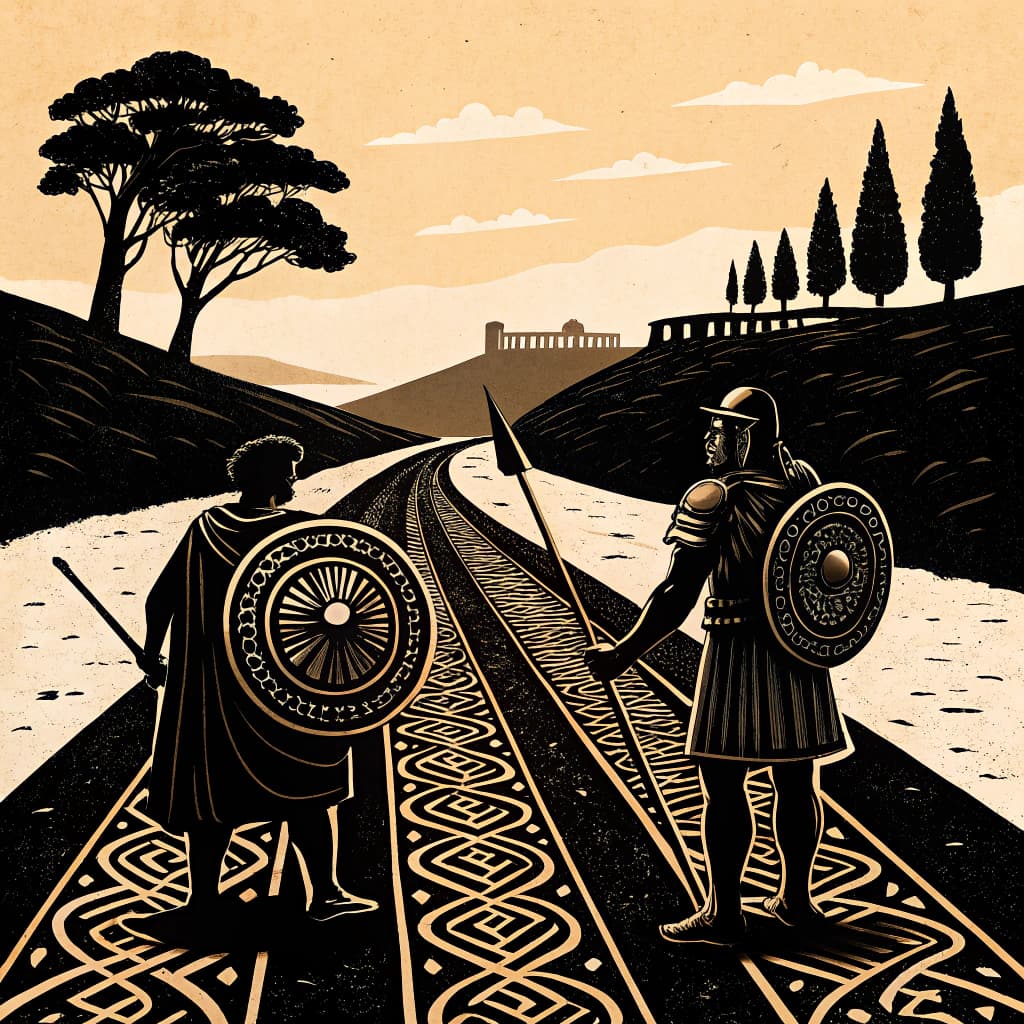
Caesar's First Contact
The story of Julius Caesar's early expeditions to Britain and the British reaction.
About This Topic
Julius Caesar's expeditions to Britain in 55 and 54 BC mark the initial Roman contact with the island, setting the stage for later conquests. Year 4 pupils explore Caesar's motivations: Britain supplied warriors and grain to Gallic tribes resisting Roman rule in Gaul, making it a strategic threat. They assess the Romans' challenges, including treacherous Channel crossings battered by storms, fierce resistance from tribes led by figures like Cassivellaunus, and severe supply shortages that prevented a lasting foothold. Pupils evaluate why Caesar withdrew after extracting nominal tribute, without establishing control.
This content aligns with KS2 History requirements on the Roman Empire and its impact on Britain, particularly the invasion narrative. It develops skills in causation, source evaluation using Caesar's Commentaries, and judging historical significance, while linking to broader themes of resistance and empire-building.
Active learning excels with this topic due to its vivid story of ambition and setback. Role-plays of tribal councils or Roman war meetings, combined with mapping landings, make remote events immediate and personal, helping pupils grasp causation through decision-making and spatial challenges through hands-on models.
Key Questions
- Explain why Caesar considered Britain a threat to Roman Gaul.
- Analyze the difficulties the Romans faced during their landings in Britain.
- Justify why Caesar eventually left without establishing a permanent base.
Learning Objectives
- Analyze primary source excerpts from Caesar's Commentaries to identify his stated reasons for invading Britain.
- Compare the logistical challenges faced by Caesar's legions during the 55 BC and 54 BC expeditions.
- Evaluate the effectiveness of British tribal resistance against the Roman invasion based on historical accounts.
- Explain the strategic and economic factors that influenced Caesar's decision to withdraw from Britain without establishing permanent control.
Before You Start
Why: Students need a basic understanding of who Julius Caesar was and the context of the Roman Republic before studying his actions in Britain.
Why: Familiarity with the locations of Britain and Gaul, and the presence of the English Channel, is essential for understanding Caesar's movements and strategic considerations.
Key Vocabulary
| Expedition | A journey undertaken by a group of people with a particular purpose, especially exploration or a military campaign. Caesar's trips to Britain were military expeditions. |
| Gallic Wars | A series of military campaigns waged by Julius Caesar against various Gallic tribes. Britain's involvement in these wars influenced Caesar's actions. |
| Tribute | An act, statement, or gift that is intended to show gratitude, respect, or admiration. Caesar demanded tribute from British tribes. |
| Logistics | The detailed coordination of a complex operation involving many people, facilities, or supplies. The Romans faced significant logistical challenges crossing the English Channel. |
Watch Out for These Misconceptions
Common MisconceptionCaesar conquered and settled Britain during these expeditions.
What to Teach Instead
These were brief raids for prestige and tribute; no bases were built. Role-play activities where pupils reenact Caesar's hasty retreats highlight logistical limits and build accurate timelines through peer negotiation.
Common MisconceptionAll Britons united against the Romans as one nation.
What to Teach Instead
Tribes like the Trinovantes allied with Caesar amid rivalries. Group negotiation simulations reveal divisions, as pupils role-play shifting loyalties and discover unity's absence through collaborative decision-making.
Common MisconceptionRoman landings succeeded easily due to superior technology.
What to Teach Instead
Storms wrecked ships, and beaches favoured defenders. Hands-on boat flotation tests with wind fans demonstrate weather perils, prompting pupils to revise ideas via shared observations and model adjustments.
Active Learning Ideas
See all activities→Document Mystery
Role-Play: Tribal Resistance Council
Divide pupils into small groups as British chieftains facing Caesar's arrival. They discuss alliances, defenses, and negotiations using simplified source extracts. Groups present strategies to the class as a mock assembly.
Document Mystery
Mapping Stations: Expedition Paths
Set up stations with blank maps of Gaul and Britain. Pupils in pairs plot Caesar's routes, mark storm-hit fleets, and note landing sites. They annotate difficulties like tides and terrain using coloured markers.
Document Mystery
Debate Carousel: Invasion Decisions
Pupils rotate in small groups through three prompts: 'Why invade?', 'What went wrong?', 'Was withdrawal wise?'. Each group debates and records arguments on chart paper for a whole-class share-out.
Real-World Connections
- Military historians analyze historical invasion routes and tactics, such as those used by Caesar, to understand strategic planning and the impact of terrain and weather on troop movements.
- Archaeologists working in Kent, England, uncover evidence of Roman camps and artifacts, providing tangible links to the events described in Caesar's writings and helping to verify historical accounts.
Assessment Ideas
Provide students with a map showing Britain and Gaul. Ask them to draw arrows indicating Caesar's invasion routes and label two reasons why Britain was a strategic concern for Rome, based on the lesson.
Pose the question: 'Was Caesar's invasion of Britain a success or a failure?' Facilitate a class discussion, encouraging students to use evidence from the lesson to support their arguments, considering both Roman and British perspectives.
Ask students to write down three specific difficulties the Roman soldiers encountered during their landings in Britain. Review their answers to gauge understanding of the challenges faced.
Frequently Asked Questions
What motivated Caesar's expeditions to Britain?
How to teach Roman difficulties during Caesar's landings Year 4?
How can active learning benefit teaching Caesar's first contact with Britain?
Why did Caesar withdraw from Britain without conquest?
Planning templates for History
5E Model
The 5E Model structures lessons through five phases (Engage, Explore, Explain, Elaborate, and Evaluate), guiding students from curiosity to deep understanding through inquiry-based learning.
Unit PlannerThematic Unit
Organize a multi-week unit around a central theme or essential question that cuts across topics, texts, and disciplines, helping students see connections and build deeper understanding.
RubricSingle-Point Rubric
Build a single-point rubric that defines only the "meets standard" level, leaving space for teachers to document what exceeded and what fell short. Simple to create, easy for students to understand.
More in Roman Britain: Invasion and Resistance
Iron Age Britain: Celtic Tribes
Understanding the society, culture, and daily life of the Celtic tribes in Britain before the Roman arrival.
3 methodologies
The Claudian Invasion of AD 43
How Emperor Claudius succeeded where Caesar failed and the establishment of the province of Britannia.
3 methodologies
Boudicca: The Warrior Queen
A deep dive into the Iceni revolt and the destruction of Roman Londinium, Camulodunum, and Verulamium.
3 methodologies
Caractacus: The Fugitive King
The long resistance of the Catuvellauni and the Silures against the Roman advance into Wales.
3 methodologies
The Druids and the Massacre at Mona
Understanding the religious leaders of the Celts and why the Romans feared and targeted them.
3 methodologies
Hadrian's Wall: A Frontier of Empire
Studying the construction and purpose of Hadrian's Wall as a defensive barrier and cultural boundary.
3 methodologies