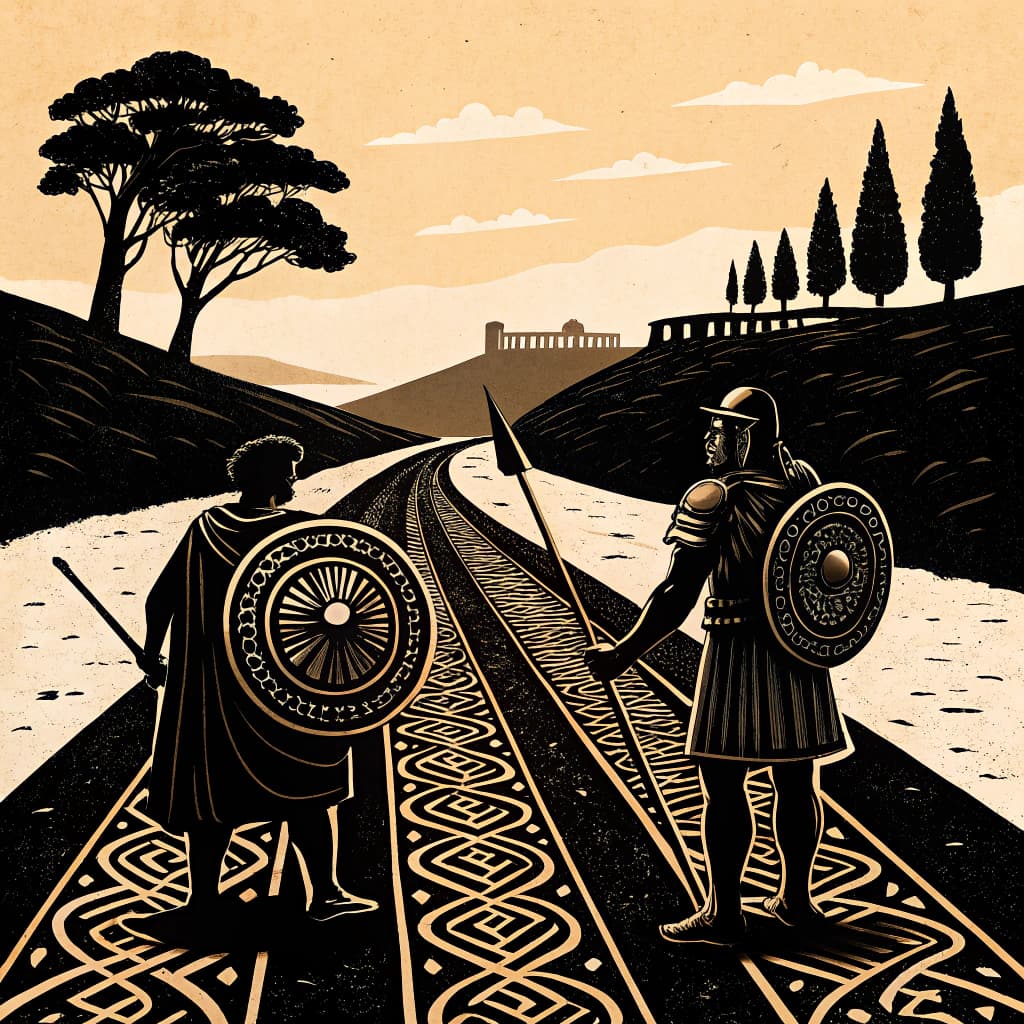
Boudicca: The Warrior Queen
A deep dive into the Iceni revolt and the destruction of Roman Londinium, Camulodunum, and Verulamium.
About This Topic
Caractacus was a prince of the Catuvellauni tribe and one of the most persistent leaders of the British resistance. For Year 4 students, this topic focuses on his nine-year guerrilla war against the Roman legions. Unlike Boudicca's sudden explosion of violence, Caractacus used the difficult terrain of the Welsh mountains to frustrate the Roman army, showing a different side of military leadership.
Students will follow his journey from the south-east to the west, his eventual betrayal by Queen Cartimandua of the Brigantes, and his famous speech in Rome that saved his life. This topic highlights the diversity of British responses to Rome, from total war to strategic retreat. It connects to the KS2 History theme of 'British resistance'. This topic comes alive when students can use collaborative problem-solving to explore guerrilla tactics and the importance of geography in warfare.
Key Questions
- Analyze what caused the Iceni to turn against their Roman allies.
- Explain how Boudicca managed to defeat the Ninth Legion.
- Evaluate why the rebellion ultimately failed at the Battle of Watling Street.
Learning Objectives
- Analyze the primary grievances of the Iceni tribe against Roman rule that led to the revolt.
- Explain the military strategies Boudicca employed to achieve initial victories against Roman forces.
- Evaluate the key factors contributing to the ultimate defeat of Boudicca's rebellion.
- Compare the destructive impact of Boudicca's revolt on Roman settlements with the established Roman presence in Britain.
Before You Start
Why: Students need a basic understanding of the Roman presence in Britain before learning about the resistance to it.
Why: Familiarity with tribal structures and leadership roles in pre-Roman Britain provides context for understanding Boudicca's position.
Key Vocabulary
| Iceni | An ancient Celtic tribe who inhabited the area of modern-day East Anglia, led by Boudicca during the revolt against Rome. |
| Roman Londinium | The Roman name for the settlement that grew into modern London, a major port and administrative center that was destroyed during Boudicca's revolt. |
| Camulodunum | The first Roman capital of Britain, located at modern-day Colchester, which was a primary target and was razed by Boudicca's forces. |
| Ninth Legion | A Roman army legion stationed in Britain that suffered a significant defeat at the hands of Boudicca's army. |
| Battle of Watling Street | The decisive battle where Roman forces under Suetonius Paulinus defeated Boudicca's army, ending the major revolt. |
Watch Out for These Misconceptions
Common MisconceptionCaractacus was just a 'loser' because he was captured.
What to Teach Instead
The Romans actually respected him immensely for his bravery and skill. Peer discussion about the 'speech in Rome' helps students see that even the winners can admire the courage of the losers.
Common MisconceptionResistance was always about big battles.
What to Teach Instead
Caractacus mostly used 'guerrilla' warfare, small, quick attacks. Using a 'tactics comparison' chart helps students see the difference between his style and Boudicca's massive army.
Active Learning Ideas
See all activities→Inquiry Circle
Guerrilla Tactics
In small groups, students are given a map of the Welsh mountains. They must plan where Caractacus should hide and how he could ambush a Roman column, considering the slow movement of the legions in the hills.
Role Play
Caractacus in Rome
Students act out the scene where a captured Caractacus is brought before Emperor Claudius. One student delivers a speech arguing why he fought for his freedom, while others act as the Roman crowd deciding his fate.
Think-Pair-Share
The Betrayal
Students discuss why Queen Cartimandua might have chosen to hand Caractacus over to the Romans instead of helping him. They weigh up the risks of helping a rebel versus the rewards of being a Roman ally.
Real-World Connections
- Archaeologists at the Museum of London use evidence from excavations to reconstruct the layout and destruction layers of Roman Londinium, helping us understand the impact of the revolt.
- Historians studying ancient warfare analyze Roman military tactics and formations, like those used at Watling Street, to understand how they achieved victory against larger, less organized forces.
Assessment Ideas
Pose the question: 'Imagine you are an Iceni villager. What would be your biggest complaint about Roman rule that might make you join Boudicca's rebellion?' Allow students to share their ideas and justify them based on what they've learned about Roman actions.
Provide students with a map showing Roman Britain. Ask them to label the three cities destroyed by Boudicca and draw a line representing the likely route of her army between them. This checks their understanding of the geographical scope of the revolt.
Ask students to write down two reasons why Boudicca's rebellion was initially successful and one reason why it ultimately failed. This assesses their grasp of both the military successes and the final defeat.
Frequently Asked Questions
Who was Caractacus?
Why did the Romans spare his life?
How does active learning help students understand Caractacus?
What is guerrilla warfare?
Planning templates for History
5E Model
The 5E Model structures lessons through five phases (Engage, Explore, Explain, Elaborate, and Evaluate), guiding students from curiosity to deep understanding through inquiry-based learning.
Unit PlannerThematic Unit
Organize a multi-week unit around a central theme or essential question that cuts across topics, texts, and disciplines, helping students see connections and build deeper understanding.
RubricSingle-Point Rubric
Build a single-point rubric that defines only the "meets standard" level, leaving space for teachers to document what exceeded and what fell short. Simple to create, easy for students to understand.
More in Roman Britain: Invasion and Resistance
Iron Age Britain: Celtic Tribes
Understanding the society, culture, and daily life of the Celtic tribes in Britain before the Roman arrival.
3 methodologies
Caesar's First Contact
The story of Julius Caesar's early expeditions to Britain and the British reaction.
3 methodologies
The Claudian Invasion of AD 43
How Emperor Claudius succeeded where Caesar failed and the establishment of the province of Britannia.
3 methodologies
Caractacus: The Fugitive King
The long resistance of the Catuvellauni and the Silures against the Roman advance into Wales.
3 methodologies
The Druids and the Massacre at Mona
Understanding the religious leaders of the Celts and why the Romans feared and targeted them.
3 methodologies
Hadrian's Wall: A Frontier of Empire
Studying the construction and purpose of Hadrian's Wall as a defensive barrier and cultural boundary.
3 methodologies