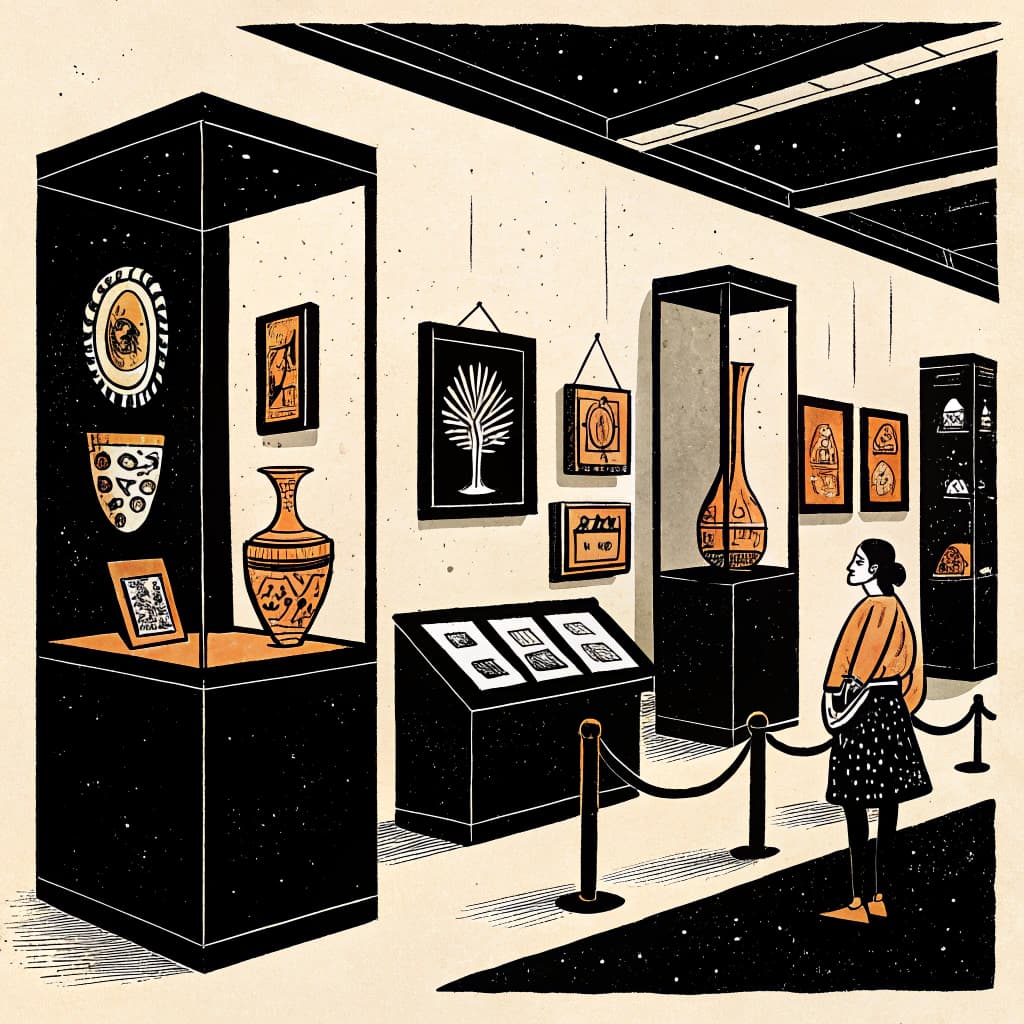
Groups create interactive exhibits with docent presentations
Museum Exhibit
Each group designs a museum exhibit about their assigned topic, complete with artifacts (real or recreated), labels, an exhibit title, and a docent script. Half the class sets up their exhibits while the other half tours as visitors, then they switch. Visitors can ask questions; docents must answer knowledgeably.
What is Museum Exhibit?
Museum Exhibit as a classroom methodology draws on the communicative theory of museum education: the idea that the design and curation of an exhibit is itself an intellectual act, not just a display of information. When a museum designer creates an exhibit on the causes of World War I, they are making dozens of decisions about what to include and exclude, how to sequence information for a visitor who knows nothing, what visual elements will carry meaning that text cannot, and how to create an experience that changes what the visitor understands. Students creating classroom exhibits face these same decisions, and the intellectual work of making those decisions is where the learning happens.
The shift from audience to author, from student who receives information to student who curates and presents it, is one of the method's most powerful pedagogical features. Students who know they will be explaining their exhibit to peers who actually want to understand it, who will ask genuine questions and notice if something is unclear or inaccurate, prepare differently than students writing for a teacher. The authentic audience accountability that the museum format creates is a motivating force that purely teacher-directed assignments rarely generate.
The docent role, explaining the exhibit to visitors in real time, is where the museum format produces learning that neither the creation phase nor a traditional presentation can replicate. A docent who encounters a visitor with a specific question they hadn't anticipated must draw on their understanding of the content, not their memory of what they wrote. This distinction, knowledge versus information memorized, is what makes the docent experience revelatory for students who think they understand content until they're asked to explain it on the spot.
The visitor experience design is as important as the exhibit itself. Visitors without a specific task drift, look at surfaces, and leave without retaining much. Visitors with a structured gallery guide, questions to answer at each exhibit, space to note the most important thing they encountered, a synthesis question to complete after touring, engage actively and leave with integrated understanding rather than fragmentary impressions. Designing the visitor experience is itself a learning task worth assigning to student planning teams.
The choice of exhibit formats, whether a timeline, an artifact display with labels, an interactive component, a video, a physical model, or a traditional poster, is not merely aesthetic. Different formats communicate different kinds of information effectively. A timeline communicates sequence and causation. A physical model communicates spatial relationships and scale. An artifact display communicates the material texture of a period. Asking students to choose a format that fits their specific content, and justify their choice, develops media literacy alongside content understanding.
The feedback mechanism that closes the learning loop is frequently overlooked in classroom museum exhibits. When a student creates an exhibit, presents it as a docent, and receives feedback only from the teacher, they know whether the teacher found it clear and accurate. When they receive structured feedback from peers who visited the exhibit, what was clear, what was confusing, what question the exhibit raised that it didn't answer, they receive information about communication quality that is more immediately useful for revision and future learning.
How to Run Museum Exhibit: Step-by-Step
Define Learning Objectives and Topics
7 min
Identify the core concepts to be covered and divide them into distinct, manageable sub-topics for student groups to research.
Establish Curation Criteria
7 min
Provide a rubric that outlines requirements for the exhibit, such as a mandatory visual aid, three key facts, and a hands-on element or interactive question.
Facilitate Research and Creation
7 min
Allow students time to gather evidence and design their physical or digital display, ensuring they focus on how to teach the concept to a novice.
Set Up the Gallery Space
8 min
Arrange the classroom so that exhibits are spaced out, allowing for clear traffic flow and enough room for a small group of 'visitors' to gather at each station.
Execute the Museum Opening
7 min
Split the class into 'Docents' (presenters) and 'Patrons' (visitors); have patrons rotate through stations every 5-7 minutes while docents present their findings.
Switch Roles and Repeat
7 min
Reverse the groups so that the previous presenters become the visitors, ensuring every student has the opportunity to both teach and learn.
Conduct a Synthesis Debrief
7 min
Lead a whole-class discussion to connect the different exhibits and clarify any misconceptions observed during the rotations.
BEFORE YOU TEACH THIS
Read the Teacher's Guide first.
Flip Education's Teacher's Guide walks you through how to facilitate any active learning lesson: mindset, pre-class checklist, phase-by-phase facilitation, and a Quick Reference Card you can print and bring to class.
Read the Teacher's Guide →Common variants
Curated exhibit
Students choose what to include from a larger source set and justify their curation in a wall-label. The curation is where the thinking happens.
Competing-exhibits format
Two groups design exhibits making opposing arguments about the same topic. Visitors vote, and the vote is followed by a debrief on what persuaded them.
Research Evidence for Museum Exhibit
Prince, M. (2004, Journal of Engineering Education, 93(3), 223-231)
This literature review confirms that active learning strategies, including those involving peer teaching and collaborative activities, significantly improve student engagement and learning outcomes compared to traditional lecturing.
Hmelo-Silver, C. E. (2004, Educational Psychology Review, 16(3), 235-266)
The research highlights that student-centered learning environments, such as curated exhibits, help students develop flexible knowledge, effective problem-solving skills, and self-directed learning strategies.
Chi, M. T. H., Wylie, R. (2014, Educational Psychologist, 49(4), 219-243)
This study demonstrates that 'Constructive' and 'Interactive' activities, like creating and explaining exhibits, lead to better learning outcomes than 'Passive' or 'Active' (simple doing) activities.
Common Museum Exhibit Mistakes and How to Avoid Them
Exhibit labels that are just copied text
Students who transcribe from a textbook or website haven't made meaning; they've just produced a display. Require all exhibit text to be paraphrased, explained to a specific audience (younger students, a skeptic, a visitor from another country), or connected to a contemporary example.
Docents who memorize scripts
A memorized script falls apart the moment a visitor asks an unexpected question. Train docents to understand their exhibit deeply enough to explain it conversationally, not recite. Require them to answer three 'challenge questions' you pose during their preparation phase.
Visitors who don't engage meaningfully
Visitors drifting from exhibit to exhibit without a task learn little. Give every visitor a structured gallery guide: questions to ask at each exhibit, a space to note the most interesting idea, and a synthesis question to answer after visiting all exhibits.
Exhibits that are too similar in format
When every exhibit is a poster with bullet points, the gallery feels monotonous. Encourage diverse formats: timelines, artifacts with labels, diagrams, brief videos, physical models, interactive components. Variety sustains visitor attention and challenges creators to think differently.
Insufficient peer feedback
Students often don't know how their exhibit landed with visitors. Build in structured peer feedback: a sticky note system where visitors leave one insight and one question at each exhibit. Creators review feedback after the gallery closes.
How Flip Education Helps
Printable exhibit briefs and docent guides
Receive a set of printable exhibit briefs that students use to create 'displays' and docent guides for those explaining the exhibits. These materials provide the content and structure for a classroom museum experience. Everything is formatted for easy printing and setup.
Curriculum-aligned exhibits for visual learning
Flip generates exhibit content that is directly mapped to your lesson topic and grade level. Each exhibit focuses on a different aspect of the curriculum standard, ensuring a comprehensive look at the subject in one session. The AI tailors the information to be engaging and educational.
Facilitation script and numbered tour steps
The generation includes a briefing script to set the stage and numbered action steps with teacher tips for managing the museum tour. You receive intervention tips for helping students who struggle to present their exhibit or engage with the displays. This structure keeps the activity focused and productive.
Synthesis debrief and individual exit tickets
End the museum experience with debrief questions that help students connect the different exhibits they visited. The printable exit ticket provides a way to assess individual learning from the visual displays. A final note links the activity to your next curriculum goal.
Tools and Materials Checklist for Museum Exhibit
- Poster boards or large paper
- Markers, colored pencils, crayons
- Construction paper
- Scissors and glue
- Index cards for labels
- Realia or found objects for 'artifacts'
- Access to research materials (books, internet)
- Digital presentation software (Google Slides, PowerPoint) (optional)
- Camera or smartphone for documenting exhibits (optional)
- Timer for exhibit rotations
Frequently Asked Questions About Museum Exhibit
What is the Museum Exhibit teaching strategy?
The Museum Exhibit strategy is an active learning technique where students create visual displays to teach specific concepts to their peers. It transforms the classroom into a gallery space, promoting student agency and peer-to-peer instruction through curated artifacts and explanations.
How do I use Museum Exhibit in my classroom?
Start by assigning specific topics to small groups and providing clear criteria for their visual and oral presentations. During the 'opening,' half the students stand by their exhibits to present while the other half rotates through as 'visitors' before switching roles.
What are the benefits of the Museum Exhibit method?
This method increases student accountability and deepens conceptual understanding through the act of teaching others. It also supports diverse learning styles by incorporating visual, auditory, and kinesthetic elements into a single lesson.
How do you assess a Museum Exhibit activity?
Assessment should focus on both the accuracy of the displayed content and the student's ability to answer peer questions during the rotation. Use a rubric that evaluates visual clarity, factual correctness, and the quality of the verbal explanation provided to visitors.
What is the difference between a Museum Exhibit and a Gallery Walk?
While a Gallery Walk often involves students reacting to pre-placed prompts, a Museum Exhibit requires students to be the creators and 'docents' of the content. The Museum Exhibit emphasizes student curation and live presentation rather than just passive observation.
Classroom Resources for Museum Exhibit
Free printable resources designed for Museum Exhibit. Download, print, and use in your classroom.
Museum Exhibit Design Planner
Students plan their exhibit by organizing the central theme, key artifacts or visuals, explanatory text, and visitor engagement questions.
Download PDFMuseum Exhibit Reflection
Students reflect on the experience of designing an exhibit and serving as a docent who explains their work to visiting classmates.
Download PDFMuseum Exhibit Role Cards
Assign roles for both exhibit creators and exhibit visitors to ensure deep engagement during the gallery walk.
Download PDFMuseum Exhibit Prompts
Ready-to-use prompts for exhibit design, docent conversations, and visitor engagement.
Download PDFSEL Focus: Self-Awareness in Museum Exhibit
A card focused on understanding one's own strengths as a communicator and designer through the exhibit creation process.
Download PDFRelated
Methodologies Similar to Museum Exhibit
Ready to try this?
- Read the Teacher's Guide →
- Generate a mission with Museum Exhibit →
- Print the toolkit after generating
Generate a Mission with Museum Exhibit
A complete lesson plan, aligned to your curriculum.