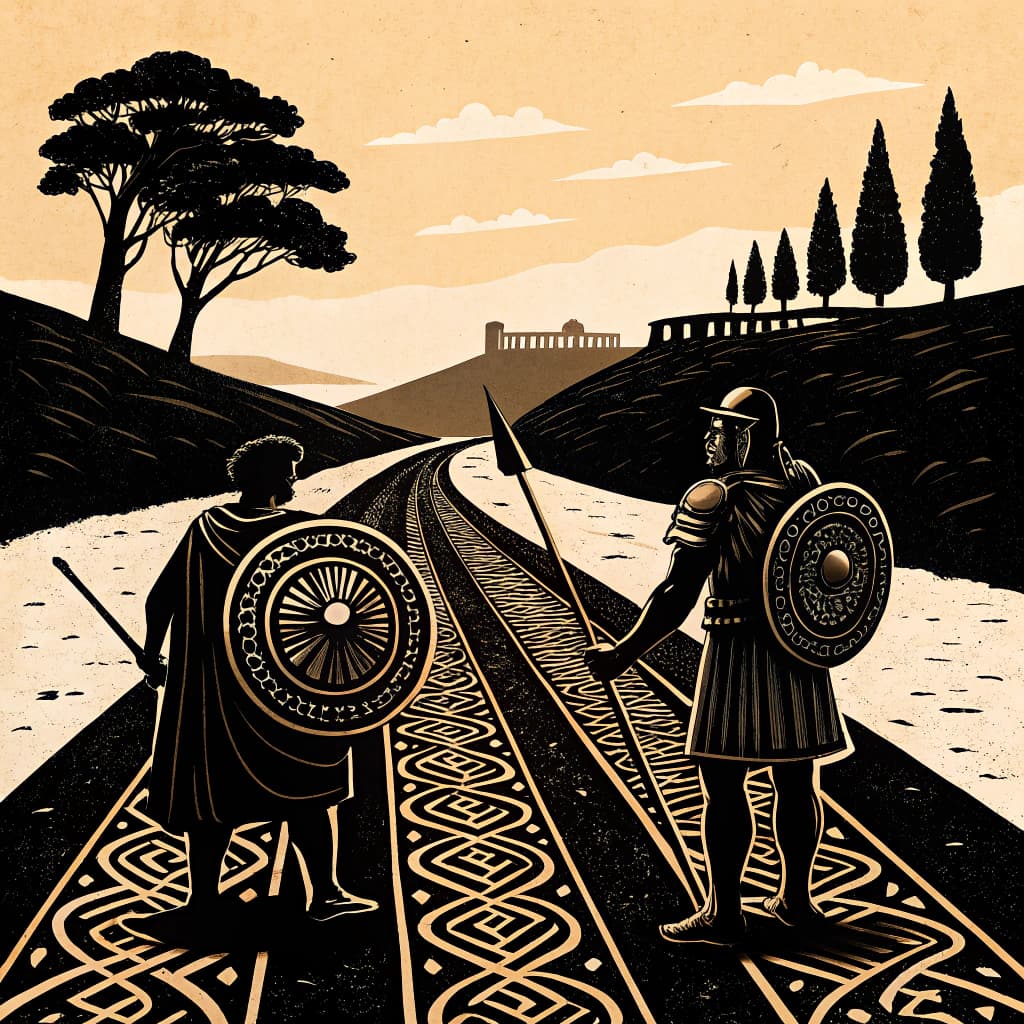
Hadrian's Wall: A Frontier of Empire
Studying the construction and purpose of Hadrian's Wall as a defensive barrier and cultural boundary.
TL;DR:Active learning deepens student understanding when they can manipulate materials and perspectives, especially for complex historical topics like frontier defenses. When students build, map, and role-play with Hadrian’s Wall, they move from passive listeners to active constructors of knowledge about its purpose and challenges.
About This Topic
Hadrian's Wall, ordered by Emperor Hadrian in AD 122, formed a 73-mile barrier across northern Britain from the Solway Firth to the Tyne. Year 4 students examine its purpose as a defensive structure against Pictish tribes, a symbol of Roman control, and a boundary for trade and customs. They study construction methods, including stone bases, turf walls in places, milecastles for garrisons, and forts like Housesteads, using local materials despite remote terrain.
This topic fits the KS2 History curriculum on the Roman Empire's impact upon Britain, linking to units on invasion and resistance. Students analyze causation through Hadrian's decision amid empire-wide pressures, evaluate building challenges like transporting supplies over hills, and assess effectiveness via archaeological evidence of repairs and breaches. Skills in source interpretation grow as they compare Roman accounts with modern digs.
Active learning suits this topic well. When students construct scale models with stones and clay or map the wall's route on large charts, they grasp engineering feats firsthand. Role-playing soldiers at checkpoints fosters empathy for daily life, while debating its success sharpens critical thinking and makes abstract history concrete and engaging.
Key Questions
- Explain why Emperor Hadrian decided to build a wall across Britain.
- Analyze the challenges of building such a massive structure in ancient times.
- Evaluate the effectiveness of Hadrian's Wall as a military and economic frontier.
Learning Objectives
- Explain the primary reasons Emperor Hadrian ordered the construction of a wall across northern Britain.
- Analyze the logistical and engineering challenges faced by Roman soldiers and laborers in building Hadrian's Wall.
- Compare the military functions of milecastles and forts along Hadrian's Wall.
- Evaluate the wall's effectiveness as a border for controlling trade and movement of people.
- Classify different types of archaeological evidence used to understand life on Hadrian's Wall.
Before You Start
Why: Students need a basic understanding of what the Roman Empire was and its vastness to comprehend why Hadrian built a wall to define its edge.
Why: Familiarity with Roman settlements and their impact on Britain provides context for the wall's role as a frontier.
Key Vocabulary
| Legionary | A soldier belonging to the main unit of the Roman army, responsible for building and defending the wall. |
| Milecastle | A small fort built at intervals of one Roman mile along Hadrian's Wall, housing a small garrison. |
| Vallum | A large ditch and mound system built to the south of Hadrian's Wall, likely for controlling movement and trade. |
| Picts | The tribal peoples who lived in northern Britain beyond the Roman frontier, often in conflict with the Romans. |
| Turf Wall | A section of Hadrian's Wall in the western part, constructed primarily from earth and turf rather than stone. |
Watch Out for These Misconceptions
Common MisconceptionHadrian's Wall completely stopped all invasions.
What to Teach Instead
The wall deterred many raids but suffered breaches, as archaeology shows repairs and abandoned sections. Active mapping and source analysis help students see it as part of a system with patrols, not invincible.
Common MisconceptionThe wall was built quickly by a single legion.
What to Teach Instead
Construction took six years with three legions, facing supply issues in rugged land. Model-building activities reveal logistical challenges, correcting views of easy Roman engineering.
Common MisconceptionIt was just a simple wall with no additional features.
What to Teach Instead
Milecastles, forts, and turrets formed a complex network. Role-play at checkpoints demonstrates surveillance role, helping students appreciate multifaceted design.
Active Learning Ideas
See all activities→Maker Learning
Model Building: Mini Hadrian's Wall
Provide stones, clay, and cardboard for groups to build a 1-metre wall section with milecastle. Discuss terrain challenges first, then add turf simulation with green paper. Groups present designs, explaining defensive features.
Maker Learning
Mapping Activity: Plot the Frontier
Distribute outline maps of Britain. Students mark the wall's route, add forts, and note terrain using atlases. Pairs research and label northern tribes, then share how geography influenced placement.
Maker Learning
Debate Stations: Wall Effectiveness
Set up stations with sources on invasions, trade, and costs. Groups rotate, gather evidence, then debate in whole class: 'Was the wall worth it?' Vote and justify positions.
Real-World Connections
- Archaeologists at English Heritage use ground-penetrating radar and excavation techniques to uncover details about Roman settlements and fortifications, similar to how they study Hadrian's Wall today.
- Border patrol agents in modern countries, like the U.S. Customs and Border Protection, manage checkpoints and monitor movement across national boundaries, a task with parallels to the wall's original purpose.
Assessment Ideas
Students receive a card with a picture of either a milecastle or a fort. They must write two sentences explaining its purpose and one difference between it and the other structure.
Pose the question: 'Was Hadrian's Wall more successful as a military barrier or a symbol of Roman power?' Facilitate a class discussion, encouraging students to use evidence from their studies to support their arguments.
Show students images of different building materials (stone, turf, timber). Ask them to identify which were used for Hadrian's Wall and briefly explain why the Romans might have chosen different materials in different locations.
Frequently Asked Questions
Why did Emperor Hadrian build the wall across Britain?
What challenges did Romans face building Hadrian's Wall?
How effective was Hadrian's Wall as a frontier?
How does active learning enhance teaching Hadrian's Wall?
Planning templates for History
5E Model
The 5E Model structures lessons through five phases (Engage, Explore, Explain, Elaborate, and Evaluate), guiding students from curiosity to deep understanding through inquiry-based learning.
Unit PlannerThematic Unit
Organize a multi-week unit around a central theme or essential question that cuts across topics, texts, and disciplines, helping students see connections and build deeper understanding.
RubricSingle-Point Rubric
Build a single-point rubric that defines only the "meets standard" level, leaving space for teachers to document what exceeded and what fell short. Simple to create, easy for students to understand.
More in Roman Britain: Invasion and Resistance
Iron Age Britain: Celtic Tribes
Understanding the society, culture, and daily life of the Celtic tribes in Britain before the Roman arrival.
8 methodologies
Caesar's First Contact
The story of Julius Caesar's early expeditions to Britain and the British reaction.
8 methodologies
The Claudian Invasion of AD 43
How Emperor Claudius succeeded where Caesar failed and the establishment of the province of Britannia.
8 methodologies
Boudicca: The Warrior Queen
A deep dive into the Iceni revolt and the destruction of Roman Londinium, Camulodunum, and Verulamium.
8 methodologies
Caractacus: The Fugitive King
The long resistance of the Catuvellauni and the Silures against the Roman advance into Wales.
8 methodologies
The Druids and the Massacre at Mona
Understanding the religious leaders of the Celts and why the Romans feared and targeted them.
8 methodologies