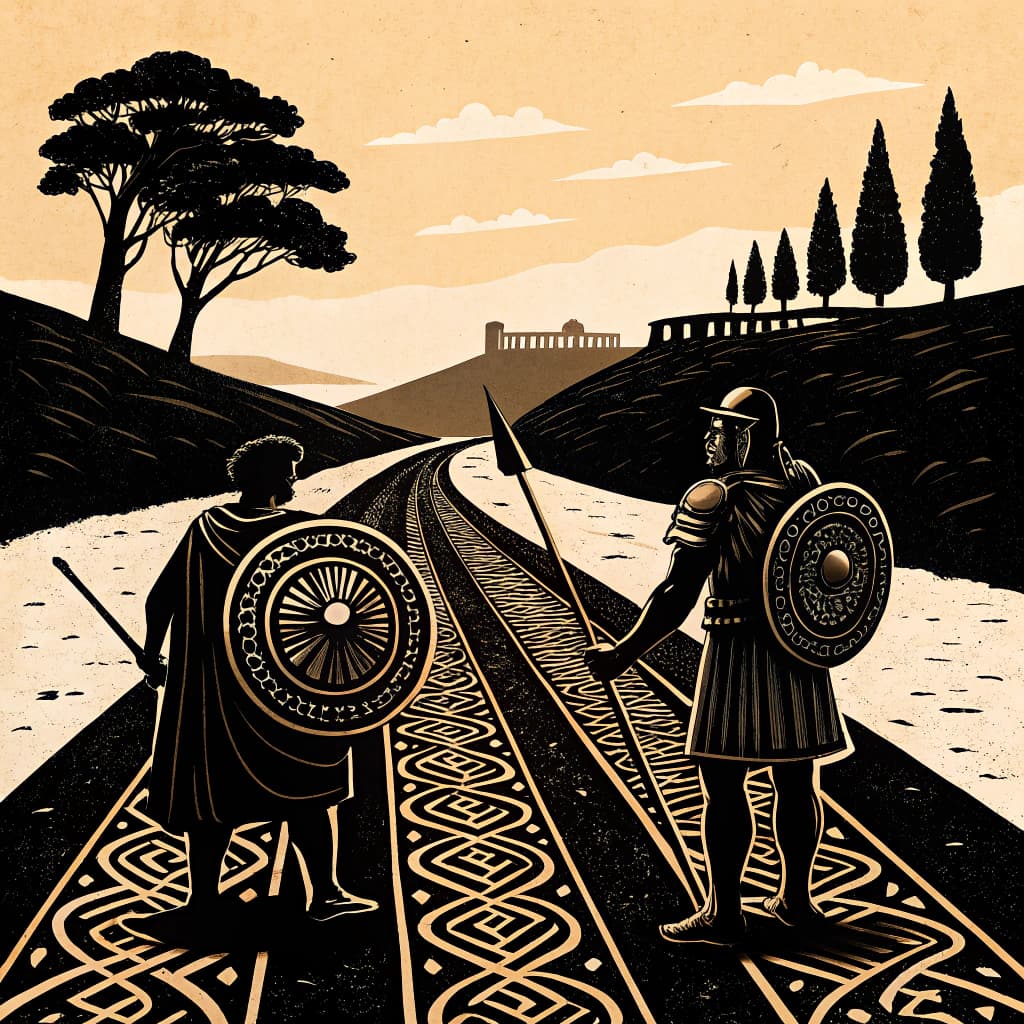
Edward the Confessor and the Succession Crisis
Exploring the events leading up to the Battle of Hastings, focusing on the contenders for the English throne.
TL;DR:Active learning works for this topic because Year 4 students need to engage with the complexity of the succession crisis through multiple perspectives. By analyzing visual sources, simulating events, and discussing claims, students move beyond memorizing dates to understanding cause and consequence in history.
About This Topic
The Battle of Hastings in 1066 is perhaps the most famous date in English history, marking the end of the Anglo-Saxon era and the start of Norman rule. For Year 4 students, this topic explores the 'succession crisis' that followed the death of Edward the Confessor and the three-way fight for the throne between Harold Godwinson, Harald Hardrada, and William of Normandy.
Students will analyse the tactics of the battle itself, the famous Anglo-Saxon 'shield wall' on Senlac Hill and how the Normans eventually broke it using 'feigned retreats' and archers. This topic aligns with the KS2 History focus on the 'Norman Conquest'. It introduces the idea of a 'turning point' where a single day changed the language, laws, and landscape of England forever. This topic benefits from active learning where students can 'read' the Bayeux Tapestry and simulate the tactical shifts of the battle.
Key Questions
- Explain why there was a succession crisis in 1066 after Edward the Confessor's death.
- Compare the claims of the three main contenders for the English throne.
- Predict how different outcomes of the succession crisis might have changed English history.
Learning Objectives
- Explain the reasons for the succession crisis following Edward the Confessor's death in 1066.
- Compare the claims to the English throne made by Harold Godwinson, Harald Hardrada, and William of Normandy.
- Analyze the key events and figures leading up to the Battle of Hastings.
- Predict potential alternative historical outcomes if a different contender had won the English throne.
Before You Start
Why: Students need a basic understanding of how Anglo-Saxon England was governed and the role of the king before exploring disputes over succession.
Why: Familiarity with Viking presence in England is important for understanding Harald Hardrada's claim and background.
Key Vocabulary
| Succession Crisis | A situation where there is uncertainty or dispute over who should inherit a throne or position of power, often leading to conflict. |
| Contender | A person or group who is competing with others for a prize, position, or power, in this case, the English throne. |
| Heir | A person legally entitled to the property or rank of another on that person's death. |
| Claim | An assertion of a right to something, such as ownership or inheritance, in this context, the right to be king. |
| Witan | A council of leading men in Anglo-Saxon England, who advised the king and played a role in electing a successor. |
Watch Out for These Misconceptions
Common MisconceptionHarold was killed by an arrow in his eye.
What to Teach Instead
The Bayeux Tapestry is unclear; it might show him being cut down by a knight. Peer 'visual analysis' of the tapestry helps students see that historical evidence can often be interpreted in different ways.
Common MisconceptionThe Normans won because they were 'better' fighters.
What to Teach Instead
The Anglo-Saxons were exhausted after fighting another battle in the North just days before. Using a 'fatigue meter' on a map of 1066 helps students understand the role of timing and luck in history.
Active Learning Ideas
See all activities→Inquiry Circle
The Bayeux Tapestry
In small groups, students are given sections of the tapestry. They must act as 'detectives' to find clues about the weapons used, the importance of horses, and the moment King Harold was killed. They then present their 'scene' to the class.
Simulation Game
The Shield Wall at Hastings
The class forms a tight shield wall at the top of a 'hill' (a designated area). A few 'Norman' students try to tempt them to break the line by pretending to run away. They discuss why the wall was so hard to beat and why breaking it was a fatal mistake.
Think-Pair-Share
The Three Claimants
Students are given the 'CVs' of Harold, William, and Harald Hardrada. They pair up to decide who had the strongest claim to the throne and who they would have supported if they were on the Witan in 1066.
Real-World Connections
- Historians and historical consultants working on films or documentaries about medieval Britain, such as 'The Last Kingdom', use their knowledge of succession disputes to ensure accuracy in storytelling.
- Genealogists trace family lines and historical claims to inheritance, a process similar to how contenders in 1066 argued for their right to rule England based on lineage and promises.
Assessment Ideas
Give students three slips of paper. On the first, they write one reason why Edward the Confessor's death caused a crisis. On the second, they name one contender and their main claim. On the third, they write one question they still have about the events of 1066.
Pose the question: 'If you were a member of the Witan in 1066, whose claim would you have supported and why?' Encourage students to use evidence from their learning about each contender's background and arguments.
Display images of the three main contenders (Harold, Hardrada, William). Ask students to write down the most important reason each person believed they should be king. Review their answers to identify any misconceptions about their claims.
Frequently Asked Questions
Why did the Battle of Hastings happen?
How did the Normans win the battle?
How can active learning help students understand 1066?
What was the Bayeux Tapestry?
Planning templates for History
5E Model
The 5E Model structures lessons through five phases (Engage, Explore, Explain, Elaborate, and Evaluate), guiding students from curiosity to deep understanding through inquiry-based learning.
Unit PlannerThematic Unit
Organize a multi-week unit around a central theme or essential question that cuts across topics, texts, and disciplines, helping students see connections and build deeper understanding.
RubricSingle-Point Rubric
Build a single-point rubric that defines only the "meets standard" level, leaving space for teachers to document what exceeded and what fell short. Simple to create, easy for students to understand.
More in The Making of England
Athelstan: The First King of All England
The grandson of Alfred who finally unified the various kingdoms into one England.
8 methodologies
Anglo-Saxon Justice and Law
Understanding the Tithing, the Witan, and the use of 'Wergild' in Anglo-Saxon legal systems.
8 methodologies
The Conversion to Christianity
The mission of St Augustine and the blending of pagan and Christian traditions in Anglo-Saxon England.
8 methodologies
The Battle of Hastings: A Turning Point
The end of the Anglo-Saxon era and the beginning of Norman rule in England.
8 methodologies
Legacy: What Did They Leave Us?
A review of how Romans, Saxons, and Vikings shaped modern Britain, focusing on language, place names, and culture.
8 methodologies