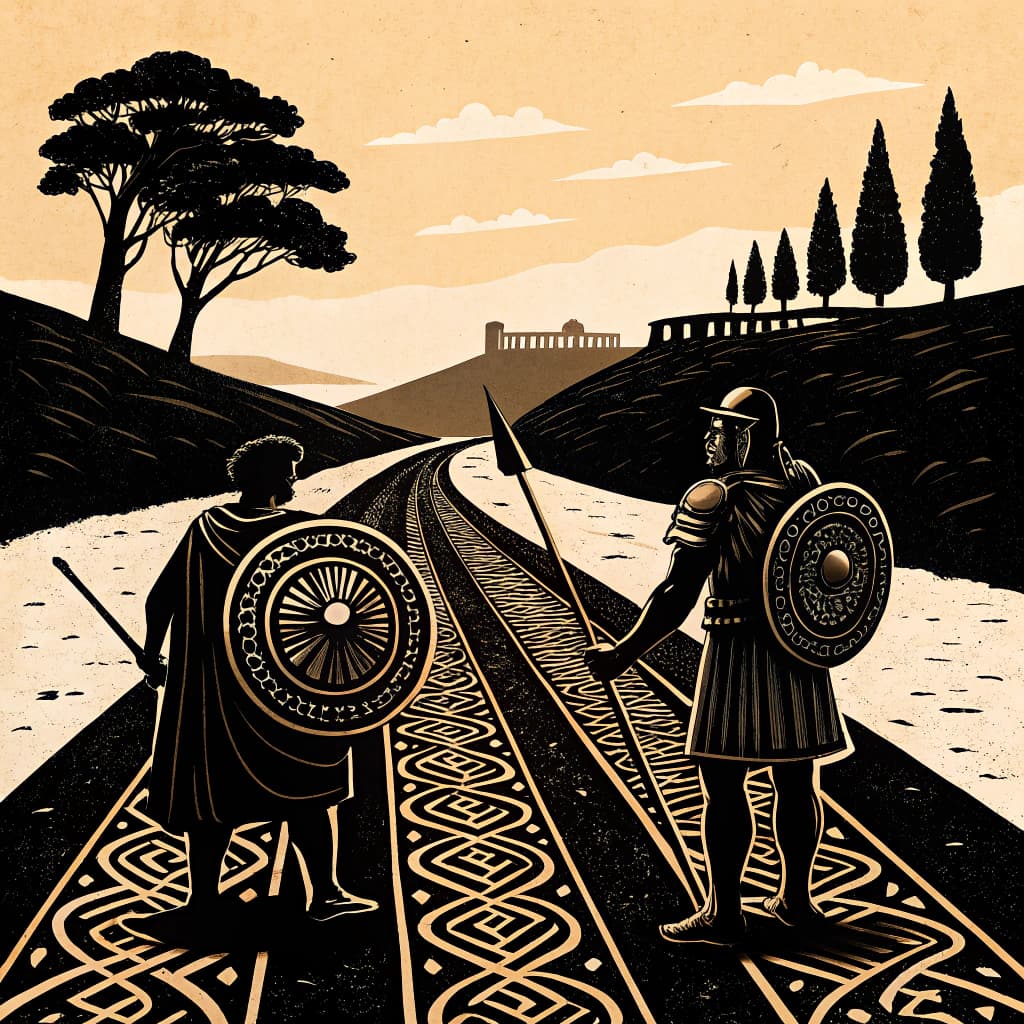
Athelstan: The First King of All England
The grandson of Alfred who finally unified the various kingdoms into one England.
About This Topic
Athelstan, the grandson of Alfred the Great, is often considered the first true King of all England. For Year 4 students, this topic explores his military and political journey to unify the various Anglo-Saxon and Viking kingdoms. The climax of his reign was the Battle of Brunanburh in AD 937, where he defeated a massive alliance of Vikings, Scots, and Strathclyde Britons, securing his position as the most powerful man in Britain.
Students will examine how Athelstan used more than just swords to unite the country; he created a single currency, established national laws, and built strong links with leaders in Europe. This topic aligns with the KS2 History focus on the 'unification of England'. It helps students understand how the map of modern England began to take shape. This topic benefits from active learning where students can analyse coins and role-play the 'King of all Britain' at a grand assembly.
Key Questions
- Analyze how the Battle of Brunanburh changed British history.
- Explain what it meant to be 'King of all Britain' in Athelstan's time.
- Assess how Athelstan used law and coinage to unite the people.
Learning Objectives
- Analyze the significance of the Battle of Brunanburh in consolidating Anglo-Saxon rule.
- Explain the responsibilities and powers associated with the title 'King of all Britain' in the 10th century.
- Assess how Athelstan's implementation of a unified currency and legal system contributed to national cohesion.
- Compare the political landscape of Britain before and after Athelstan's unification efforts.
Before You Start
Why: Students need to understand the context of Viking settlement and Anglo-Saxon resistance established by Alfred to appreciate Athelstan's achievement of unification.
Why: Familiarity with the existence of separate Anglo-Saxon kingdoms like Wessex, Mercia, and Northumbria is necessary to grasp the concept of unification.
Key Vocabulary
| Witan | A council of leading men, advisors to the Anglo-Saxon kings. Athelstan would have consulted his Witan on important matters of state. |
| Danelaw | The area of northern and eastern England under Viking control. Athelstan's reign saw the final integration of these territories into a single kingdom. |
| Coinage | Metal money used for trade and payment. Athelstan standardized coinage across England, making trade easier and asserting royal authority. |
| Reeve | An official appointed to supervise local administration and collect taxes. Athelstan's laws established the role of reeves to help govern the unified kingdom. |
Watch Out for These Misconceptions
Common MisconceptionAlfred the Great was the first King of England.
What to Teach Instead
Alfred was only King of Wessex. It was his grandson Athelstan who first ruled over the whole territory we now call England. Using a 'family tree' and 'territory maps' helps students see the progression over three generations.
Common MisconceptionUniting England was only about winning one battle.
What to Teach Instead
It required years of making laws, coins, and alliances. Peer discussion about 'what makes a country' helps students see that government is just as important as war.
Active Learning Ideas
See all activities→Inquiry Circle
The First English Coins
In small groups, students examine images of Athelstan's coins. They must find the Latin words for 'King of all Britain' and discuss why having the same money in every town helped to make people feel like they belonged to one country.
Role Play
The Assembly of Kings
Students act as Athelstan and the various sub-kings (from Wales, Scotland, and the North) who came to pay him 'homage'. They must negotiate what they will give the King (like gold or soldiers) in exchange for his protection.
Think-Pair-Share
The Battle of Brunanburh
Show a list of all the different groups who fought against Athelstan. Students pair up to discuss why so many different people were afraid of him and why his victory was such a 'turning point' for England.
Real-World Connections
- Museum curators, like those at the British Museum, study and display Anglo-Saxon coins similar to those minted under Athelstan. These artifacts provide tangible evidence of trade, royal power, and artistic styles from that period.
- Historians specializing in early medieval Britain analyze legal charters and chronicles to reconstruct the political and social structures of Athelstan's time, similar to how modern legal scholars examine historical documents.
Assessment Ideas
Provide students with a map of Britain circa AD 900. Ask them to label areas controlled by Anglo-Saxons, Vikings, and other groups. Then, have them draw a line showing the approximate extent of Athelstan's unified kingdom by AD 937, explaining their reasoning.
Pose the question: 'Was Athelstan a king or a conqueror?' Facilitate a class discussion where students use evidence from the lesson, such as his laws, battles, and coinage, to support their arguments for either perspective.
Ask students to write two sentences explaining one way Athelstan used something other than military force to unite England, and one sentence describing the main outcome of the Battle of Brunanburh.
Frequently Asked Questions
Who was Athelstan?
What happened at the Battle of Brunanburh?
How does active learning help students understand the unification of England?
Why were coins so important to Athelstan?
Planning templates for History
5E Model
The 5E Model structures lessons through five phases (Engage, Explore, Explain, Elaborate, and Evaluate), guiding students from curiosity to deep understanding through inquiry-based learning.
Unit PlannerThematic Unit
Organize a multi-week unit around a central theme or essential question that cuts across topics, texts, and disciplines, helping students see connections and build deeper understanding.
RubricSingle-Point Rubric
Build a single-point rubric that defines only the "meets standard" level, leaving space for teachers to document what exceeded and what fell short. Simple to create, easy for students to understand.
More in The Making of England
Anglo-Saxon Justice and Law
Understanding the Tithing, the Witan, and the use of 'Wergild' in Anglo-Saxon legal systems.
3 methodologies
The Conversion to Christianity
The mission of St Augustine and the blending of pagan and Christian traditions in Anglo-Saxon England.
3 methodologies
Edward the Confessor and the Succession Crisis
Exploring the events leading up to the Battle of Hastings, focusing on the contenders for the English throne.
3 methodologies
The Battle of Hastings: A Turning Point
The end of the Anglo-Saxon era and the beginning of Norman rule in England.
3 methodologies
Legacy: What Did They Leave Us?
A review of how Romans, Saxons, and Vikings shaped modern Britain, focusing on language, place names, and culture.
3 methodologies