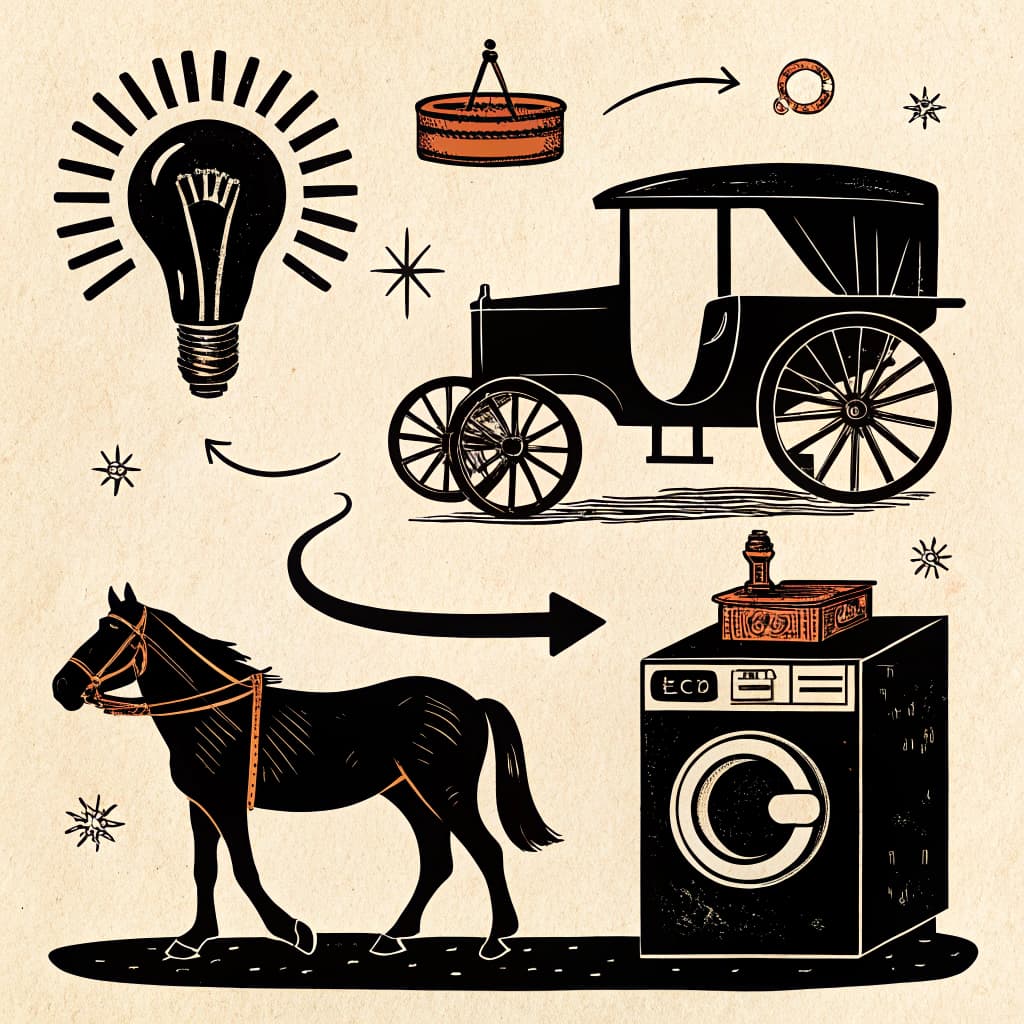
Everyday Technology at Home
Students will identify and discuss the various technologies used in their homes, considering their purpose and impact on family routines.
TL;DR:Active learning helps students grasp how everyday technology shapes daily life by connecting abstract ideas to tangible experiences. When students debate, simulate, and investigate, they move beyond memorization to see cause-and-effect relationships in technology’s broader impact.
About This Topic
Some inventions are so significant they change the course of human history. This topic explores 'game-changers' like the wheel, the printing press, electricity, and the internet. Students investigate how these breakthroughs didn't just change one task, but transformed how whole societies function, moving people faster, sharing ideas wider, and powering entire cities. This aligns with AC9HASS2K02, looking at the broader impact of technology over time.
In an Australian context, this includes looking at how these global inventions reached the continent and how they interacted with existing First Nations technologies. Students also get to think like inventors themselves, identifying problems in their own lives that need a 'big idea' to solve. Students grasp this concept faster through structured discussion and peer explanation where they rank inventions by their impact on the world.
Key Questions
- How do the different technologies in your home help make everyday tasks easier?
- How is a kitchen today different from a kitchen that people used long ago?
- What are the good things and the not-so-good things about using technology to help with household chores?
Learning Objectives
- Identify at least five different technologies commonly found in an Australian home.
- Explain the primary purpose of at least three household technologies in making daily tasks easier.
- Compare and contrast a modern Australian kitchen with a historical kitchen, citing at least two specific technological differences.
- Evaluate the positive and negative impacts of using technology for household chores on family routines.
Before You Start
Why: Students need to be able to identify and name common objects before they can classify them as technology.
Why: Understanding the difference between needs and wants helps students consider the purpose and value of different technologies.
Key Vocabulary
| Appliance | A device or piece of equipment designed to perform a specific task, typically a domestic one, such as a washing machine or refrigerator. |
| Automation | The use of technology to carry out tasks with minimal human intervention, like a robot vacuum cleaner. |
| Convenience | The state of being able to do things easily and without problems, often thanks to technology. |
| Efficiency | Achieving maximum productivity with minimum wasted effort or expense, often through the use of technology. |
Watch Out for These Misconceptions
Common MisconceptionInventions happen by accident or by one 'genius'.
What to Teach Instead
Students often think a lightbulb just appeared. Discussing how inventions are usually built on older ideas (like the wheel leading to gears) helps them understand the collaborative nature of progress.
Common MisconceptionThe 'best' inventions are the newest ones.
What to Teach Instead
Children often overlook the wheel or fire. Ranking activities help them realize that modern tech like the internet couldn't exist without the 'ancient' inventions that came first.
Active Learning Ideas
See all activities→Formal Debate
The Most Important Invention
Divide the class into four groups: Team Wheel, Team Electricity, Team Printing Press, and Team Internet. Each group must come up with two reasons why their invention is the 'best' and present it to the 'Judge' (the teacher).
Inquiry Circle
The Problem Solvers
Students work in pairs to identify a 'daily annoyance' (e.g., losing socks, getting wet in the rain). They must sketch a 'Big Invention' to solve it and explain to the class how it would change people's lives.
Simulation Game
The Assembly Line
Students try to draw five identical complex pictures individually. Then, they form a 'line' where each person only draws one part of the picture. They discuss how the 'invention' of the assembly line changed how things are made.
Real-World Connections
- Consider the role of a domestic appliance repair technician who fixes items like dishwashers and ovens, ensuring homes continue to function smoothly.
- Think about how smart home technology, such as programmable thermostats or voice-activated lights, is changing the way families manage their homes in suburban Australia.
- Explore the historical development of the washing machine, from early hand-cranked models to modern, water-saving front-loaders, and how this changed domestic labour.
Assessment Ideas
Provide students with pictures of various household items. Ask them to sort the pictures into two categories: 'Technology' and 'Not Technology'. Then, ask them to select two 'Technology' items and write one sentence about what each item does.
Pose the question: 'What is one piece of technology in your home that you think is very helpful, and why?' Allow students to share their answers, encouraging them to explain the specific task the technology makes easier. Follow up with: 'What is one thing that might be not so good about using this technology?'
On a small card, ask students to draw one piece of technology they use at home. Below the drawing, they should write one sentence explaining its purpose and one sentence about how it helps their family.
Frequently Asked Questions
Which inventions are most relevant for Year 2?
How do I explain that inventions can have 'bad' sides?
How can active learning help students understand 'impact'?
How do I include First Nations inventions here?
More in Technology Changes Our Lives
Simple Tools: Past and Present
Students will compare simple tools from the past (e.g., hand tools) with their modern equivalents, focusing on efficiency and design.
8 methodologies
Impact of Electricity on Daily Life
Students will explore how the invention and widespread use of electricity transformed homes, work, and leisure activities.
8 methodologies
Technology in the Classroom
Students will explore how technology is used in their school for learning, communication, and administrative tasks, and its evolution.
8 methodologies
The Wheel: A Transformative Invention
Students will investigate the invention of the wheel and its profound impact on transport, agriculture, and other aspects of human civilization.
8 methodologies
The Printing Press and Knowledge Sharing
Students will learn about the invention of the printing press and its role in spreading information, education, and new ideas.
8 methodologies
Evolution of Road Transport
Students will trace the development of road vehicles from horse-drawn carriages to early automobiles and modern cars, noting key innovations.
8 methodologies