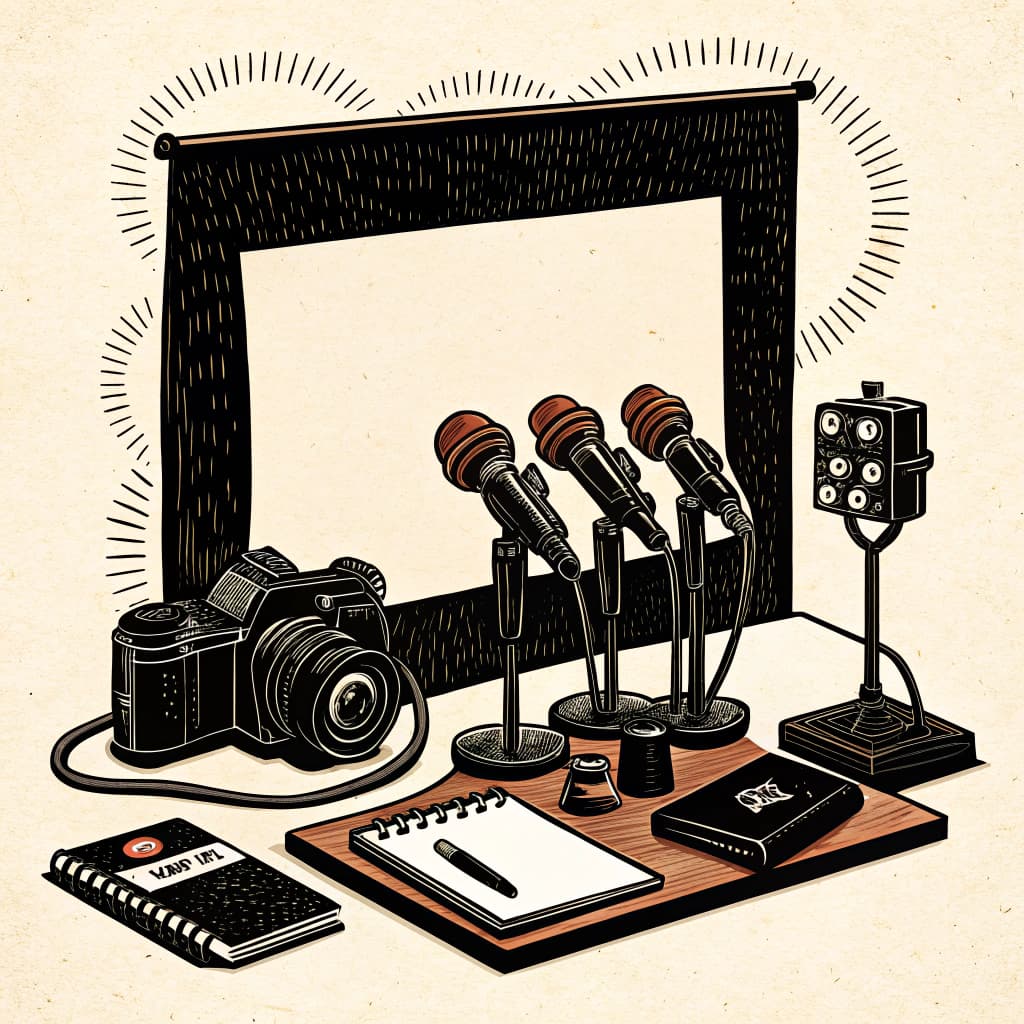
Historical figures face reporter questions
Press Conference
A panel of students takes on roles as historical figures, while the rest of the class acts as journalists from different news outlets (with different biases or perspectives). Journalists prepare pointed questions; the panel must answer in character. The "press" can follow up and challenge answers. Creates accountability, depth, and drama.
What is Press Conference?
The Press Conference activity adapts one of journalism's most important institutional formats for educational use. In professional life, press conferences are the primary mechanism by which institutions communicate with the public, by which journalists hold powerful entities accountable, and by which multiple parties attempt to frame a narrative in ways favorable to their interests. Each of these dimensions, communication, accountability, and competing framings, has direct pedagogical parallels in classroom learning.
The format requires a specific division of cognitive labor that makes it educationally productive. The "speaker" role requires students to develop genuine mastery, not just familiarity, with the content they'll represent, because they must be prepared to respond to questions they haven't anticipated. The "reporter" role requires students to develop evaluative capacity, the ability to assess whether an answer is complete, accurate, and appropriately responsive to the question asked. These are different intellectual skills, and the press conference format develops both simultaneously.
The speaker preparation phase is as important as the press conference itself. A speaker who arrives knowing only the material they've prepared, and who is unprepared for probing follow-up questions, will struggle when a reporter asks something outside their prepared notes. Anticipating questions, not just the easy ones but the challenging, skeptical, or unexpected ones, requires a comprehensive and deeply integrated understanding of the content. Students who have genuinely anticipated difficult questions emerge from the preparation phase with a more thorough mastery than students who have simply learned the content to be presented.
The accountability dimension, the reporter's capacity to notice when an answer is evasive, incomplete, or inaccurate, and to ask follow-up questions that press for precision, is one of the most valuable skills the press conference format develops. In many academic contexts, students accept answers at face value without evaluating their accuracy or completeness. The press conference creates a context where skeptical follow-up is not just permitted but required, where asking "But how do you know that?" or "What about the evidence that contradicts that?" is good journalism, not rudeness.
The fact-checking mechanism, assigning students to verify the accuracy of specific claims made during the press conference against provided evidence, introduces a crucial third role beyond speaker and reporter. Fact-checkers must compare what was said against what the evidence actually shows, identify discrepancies, and report them to the class. This verification role develops media literacy alongside content learning: the habit of checking claims against evidence, not just accepting them because they were stated confidently.
Post-press-conference reflection, where speakers examine how well they communicated, what questions caught them off guard, and what they would prepare differently, closes the learning loop in a way that simple performance and assessment cannot. The metacognitive question "How well did I know this content, and how do I know?" is one that the press conference format makes uniquely visible. Speakers who struggled with a particular line of questioning know exactly where their understanding was thin, and can direct their subsequent learning accordingly.
How to Run Press Conference: Step-by-Step
Assign Roles and Topics
6 min
Divide the class into 'Expert Panels' (3-4 students) and 'Press Corps' (the remaining students), assigning each panel a specific perspective or historical figure.
Conduct Research Phase
6 min
Provide 15-20 minutes for experts to master their content and for journalists to draft investigative questions based on the lesson's learning objectives.
Set the Stage
5 min
Arrange the classroom with the Expert Panel at the front behind a table and the Press Corps in rows facing them to simulate a professional media briefing.
Deliver Opening Statements
6 min
Allow the Expert Panel to give a brief, 2-minute prepared statement outlining their position or key findings before opening the floor.
Facilitate the Q&A Session
6 min
Moderate the session as the Press Corps asks questions, ensuring that the experts rotate who answers and that follow-up questions are permitted.
Conduct a Fact-Check Debrief
6 min
Lead a whole-class discussion to verify the accuracy of the answers provided and clarify any misconceptions that arose during the role-play.
BEFORE YOU TEACH THIS
Read the Teacher's Guide first.
Flip Education's Teacher's Guide walks you through how to facilitate any active learning lesson: mindset, pre-class checklist, phase-by-phase facilitation, and a Quick Reference Card you can print and bring to class.
Read the Teacher's Guide →When to Use Press Conference in the Classroom
- Understanding historical figures' decisions
- Developing questioning and interviewing skills
- Exploring media bias and framing
- Making historical events feel urgent and newsworthy
Subject Fit
Common variants
Single-subject press conference
One student (or pair) in character fields questions from the rest of the class acting as press. Works for historical figures, scientists, authors.
Biased-outlets press conference
Each press outlet has a different editorial angle assigned. Questions reflect those angles; debrief compares the coverage. Surfaces media framing.
Research Evidence for Press Conference
Barkley, E. F., Cross, K. P., & Major, C. H. (2004, Jossey-Bass, 2nd Edition, 182-187)
The authors categorize role-play activities like the Press Conference as essential for developing perspective-taking and the ability to apply abstract theories to concrete, real-world scenarios.
Prince, M. (2004, Journal of Engineering Education, 93(3), 223-231)
This literature review confirms that introducing activity into the classroom, such as interactive questioning and student-led discourse, significantly improves student engagement and long-term knowledge retention compared to traditional lecturing.
Common Press Conference Mistakes and How to Avoid Them
Subjects (speakers) who haven't prepared substantively
Press conference speakers who give vague or invented answers don't demonstrate content mastery, and they mislead classmates. Require written preparation: factual summary, 5 anticipated questions with answers, and at least 3 pieces of evidence to cite during the conference.
Reporters who ask the same questions everyone else asked
Unprepared reporters default to surface-level questions that produce surface-level answers. Require each reporter to prepare unique questions before the conference begins. A visible 'question board' where reporters register their question topic avoids redundancy.
No evaluation of accuracy
In a press conference, incorrect answers go unchallenged unless there's a fact-checking mechanism. Assign 2-3 students as 'fact-checkers' who evaluate speaker claims against provided evidence and report discrepancies after the conference.
Sessions that go too long
After 15-20 minutes, reporter questions and speaker answers begin to repeat. Keep press conferences to 10-15 minutes and plan for multiple conferences if you have several speakers: fresh reporters, fresh questions, tighter content.
No reflection from the speaker after the conference
Speakers who simply answer questions and sit down haven't closed their learning loop. Require a brief post-conference reflection: What did I handle well? What question caught me off guard? What would I prepare differently? This metacognitive step deepens the learning value.
How Flip Education Helps
Printable speaker prep cards and reporter question cards
Flip generates printable preparation cards for the 'speakers' and question cards for the 'reporters' to use during the press conference. These materials provide the background and structure needed for a formal Q&A session. Everything is formatted for quick printing and immediate use.
Curriculum-aligned roles for any subject area
The AI creates roles and scenarios that are directly mapped to your curriculum standards and lesson topic, whether exploring a historical event, a scientific discovery, or a literary theme. The activity is designed for a single session, focusing on deep understanding through questioning. This alignment keeps the focus on your learning goals.
Facilitation script and numbered conference steps
Use the provided script to brief students on the press conference format and follow numbered action steps for managing the presentations and the Q&A period. The plan includes teacher tips for coaching the speakers and intervention tips for encouraging reporters to ask probing questions. This guide helps you maintain a professional atmosphere.
Reflection debrief and exit tickets for closure
Wrap up the press conference with debrief questions that ask students to reflect on the most important information revealed during the session. A printable exit ticket is included to assess individual understanding of the topic. The generation concludes with a link to your next classroom lesson.
Tools and Materials Checklist for Press Conference
- Panel table or designated front seating
- Microphone (real or prop)
- Name tags or placards for panelists
- Index cards or notebooks for journalists
- Timer or stopwatch
- Whiteboard or projector for agenda/rules
- Costume elements or simple props (optional) (optional)
- Digital document for shared resources/links (optional)
- Recording device (audio/video for reflection) (optional)
Frequently Asked Questions About Press Conference
What is the Press Conference teaching strategy?
The Press Conference is an active learning strategy where students act as subject matter experts or historical figures to answer questions from their peers. It promotes deep inquiry and requires students to synthesize complex information into concise, verbal responses.
How do I use Press Conference in my classroom?
Assign a specific topic or persona to a small group of students and allow them time to research and prepare their 'platform.' The rest of the class acts as journalists, researching the topic to prepare challenging, open-ended questions for the live event.
What are the benefits of the Press Conference method?
This method increases student agency and improves public speaking skills while ensuring high levels of cognitive engagement. It forces students to think on their feet and view content from multiple, often conflicting, perspectives.
How do you assess a student Press Conference?
Use a rubric that evaluates both the 'experts' on their factual accuracy and professional delivery, and the 'journalists' on the quality and depth of their questions. Peer feedback forms can also be used to assess how well the experts handled difficult or unexpected inquiries.
Is the Press Conference strategy effective for shy students?
Yes, because it provides a structured role and a 'shield' of a persona, which often reduces the anxiety associated with traditional public speaking. Teachers can also place shy students in small expert panels to provide a supportive group environment.
Classroom Resources for Press Conference
Free printable resources designed for Press Conference. Download, print, and use in your classroom.
Press Conference Preparation Sheet
Students organize their expert knowledge, anticipate reporter questions, and prepare evidence-based responses.
Download PDFPress Conference Reflection
Students reflect on their experience as experts or reporters and what the activity revealed about the topic.
Download PDFPress Conference Role Cards
Define the roles for the experts and reporters in the press conference simulation.
Download PDFPress Conference Question Bank
Ready-to-use questions for reporters and experts, organized by the flow of a press conference.
Download PDFSEL Focus: Self-Management
A card focused on managing nerves, staying composed, and thinking on your feet during the press conference.
Download PDFRelated
Methodologies Similar to Press Conference
Ready to try this?
- Read the Teacher's Guide →
- Generate a mission with Press Conference →
- Print the toolkit after generating
Generate a Mission with Press Conference
A complete lesson plan, aligned to your curriculum.