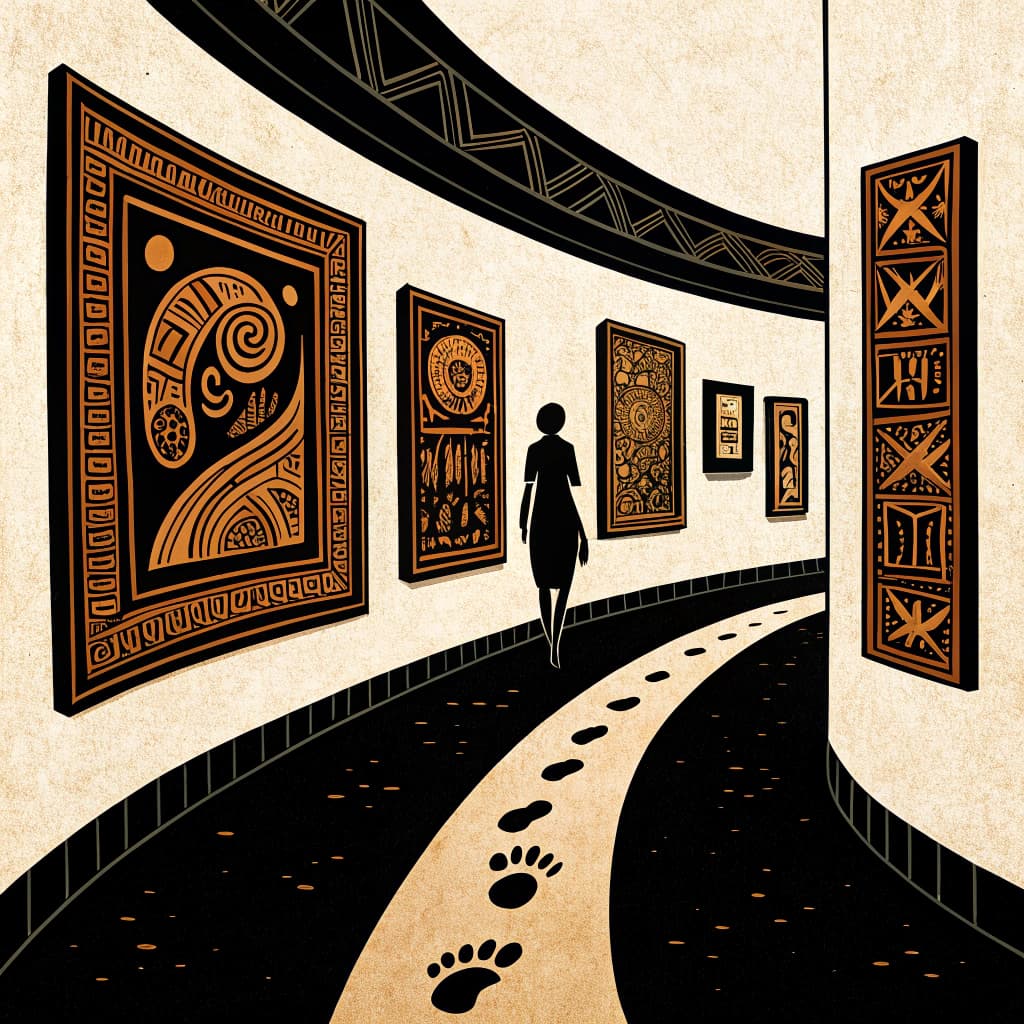
Students rotate through stations posted around the classroom, analysing prompts and building on each other's written responses, a high-engagement format that works across CBSE, ICSE, and state board contexts.
Gallery Walk
Gallery Walk transforms any classroom into a collaborative thinking space by having students move between stations, each containing a prompt, image, data set, or peer-generated response, and contribute their analysis in writing. In the Indian context, it is one of the most effective ways to develop the higher-order analytical skills that board examinations test, while addressing the passivity that large class sizes and lecture-dominant traditions tend to produce. Aligned with NEP 2020's emphasis on experiential learning, it works within a standard 45-minute period and requires only chart paper or printed A4 sheets.
What Is Gallery Walk? Definition, Origins, and Why It Works
Gallery Walk fits naturally into the spirit of NEP 2020's call for experiential, learner-centred pedagogy, offering a practical route away from the chalk-and-talk tradition that has long dominated Indian classrooms. Where a conventional 45-minute period in a CBSE, ICSE, or state board school might involve a teacher explaining concepts at the board while 40 students copy into notebooks, a Gallery Walk redistributes that same period into simultaneous, active engagement , every student reading, writing, and discussing at the same time.
The method is particularly well-suited to the Indian classroom's social texture. Students in Classes 6 through 12 are accustomed to working in tight proximity, and the peer-learning instinct is strong. Gallery Walk formalises that instinct: rather than whispering answers to a neighbour during a lecture, students are explicitly asked to read their peers' thinking, critique it, and build on it. This shifts peer interaction from a discipline problem into a pedagogical resource.
For teachers navigating the NCERT framework, Gallery Walk maps cleanly onto the 'activity' and 'project' components that appear in most NCERT textbooks but often go unrealised in practice due to time pressure. A well-designed Gallery Walk can cover the analytical or discussion objectives of a textbook activity in 20 minutes, leaving time for consolidation and board-focused note-taking that students and parents expect. It is not a replacement for content coverage , it is a higher-density format for it.
The board exam culture creates a specific challenge: students are highly motivated by marks and suspicious of activities that don't feel 'productive.' The solution is to make the Gallery Walk visibly generative. When students can see that their sticky-note responses are being compiled into class notes, that the debrief is producing the exact kind of analytical vocabulary that appears in long-answer questions, and that the teacher is using their responses to identify what will appear on a class test, engagement follows quickly. In the Indian context, linking Gallery Walk explicitly to board-style question practice , 'this station asks you to analyse the causes, which is exactly how a 5-mark question is worded' , removes resistance.
With classes of 35 to 50 students, the simultaneity advantage of Gallery Walk is amplified. A traditional discussion with 45 students means 44 are passive at any given moment. A Gallery Walk with eight stations and six groups means all 45 are active simultaneously. The management challenge is real, but the pedagogical return is proportionally large. Schools that have integrated Gallery Walk into their weekly timetable , particularly in Humanities, Science, and Environmental Studies , report measurable improvements in the quality of written responses, because students have practised articulating ideas in writing many more times than a lecture format allows.
How to Facilitate Gallery Walk: Step-by-Step Implementation Guide
Prepare Stations
7 min
Post prompts, images, or student work at different locations around the room, ensuring enough space between them to prevent crowding.
Assign Groups and Roles
6 min
Divide the class into small groups of 3-5 students and assign roles such as 'Recorder,' 'Timekeeper,' or 'Facilitator' to ensure accountability.
Provide Clear Instructions
6 min
Distribute a graphic organizer or response sheet and explain exactly what students must do at each station, such as 'Identify one error' or 'Ask one question.'
Execute Rotations
7 min
Signal groups to move to their first station and set a timer for 3-5 minutes, using a consistent sound or visual cue to indicate when it is time to rotate.
Monitor and Facilitate
7 min
Circulate throughout the room to listen to group discussions, clarify misunderstandings, and prompt deeper thinking with open-ended questions.
Conduct Whole-Class Debrief
7 min
Bring the class back together to discuss common themes, address frequent misconceptions, and allow groups to share their most significant findings.
BEFORE YOU TEACH THIS
Read the Teacher's Guide first.
Flip Education's Teacher's Guide walks you through how to facilitate any active learning lesson: mindset, pre-class checklist, phase-by-phase facilitation, and a Quick Reference Card you can print and bring to class.
Read the Teacher's Guide →When to Use Gallery Walk: Best Classes, Subjects, and Group Sizes
- Classes 6–12 in CBSE, ICSE, and state board schools studying Humanities, Sciences, or Languages
- Topics in NCERT textbooks that include 'activity' or 'think and discuss' sections
- Formative assessment without a formal test
- Building analytical writing skills for long-answer board questions
Common variants
Silent gallery walk
No speaking. Students write feedback on sticky notes at each station, then debrief together at the end. The silence raises the quality of what gets written.
Rotating-host gallery walk
One group member stays at each station to present to incoming visitors while the rest rotate. Everyone takes a turn hosting. Builds presentation stamina.
Critique-only gallery walk
Visitors leave only one glow and one grow at each station, using a shared rubric. Disciplines the feedback and makes revision tractable.
Why Gallery Walk Works: Research and Impact on Student Learning
Francek, M. (2006, The journal of college science teaching)
The study demonstrates that Gallery Walks foster active student engagement, encourage collaborative team building, and provide instructors with a clear visual method to identify and address student misconceptions.
Common Mistakes Teachers Make with Gallery Walk (and How to Avoid Them)
Students treating stations like dictation exercises
In classrooms where copying from the board is the dominant mode of learning, students often respond to Gallery Walk stations by faithfully transcribing whatever is already written there rather than adding their own thinking. Counter this explicitly before starting: tell students their response must add something not yet on the paper, and model what that looks like with a sample station. Framing it as 'analysis practice for board long-answers' helps shift the mindset from transcription to interpretation.
Noise spillover into adjacent classrooms
Indian school buildings , particularly older ones , often have open corridors, thin partition walls, or classes separated only by a curtain. A Gallery Walk with 40 students moving and discussing can disturb neighbouring classes and draw the attention of the school administration. Set clear 'library voice' norms before starting, use a hand signal rather than a whistle or bell to signal rotations, and brief the adjacent teacher in advance. In schools with a strict silence culture, a silent Gallery Walk , where students only write, never speak , is a legitimate adaptation that preserves the activity's benefits.
Physical space collapsing with 40+ students
A Gallery Walk designed for a 25-student Western classroom becomes a crowd problem with 45 students in a standard Indian classroom with fixed benches or bolted furniture. Plan for this specifically: use windows, doors, the back of the teacher's desk, the corridor outside the room, and the tops of desks as station surfaces. With eight stations and groups of five to six, the density per station is manageable. Never place two stations adjacent to each other , they will merge into a single crowd.
Competitive dynamics undermining constructive feedback
In high-stakes academic environments , particularly in Classes 9 through 12 in competitive schools , students may use peer feedback as an opportunity to identify errors in rivals' work rather than engage constructively. Reframe the task: 'Your job is not to find mistakes but to strengthen this argument , add the best evidence you can think of.' Assign groups across friendship lines deliberately and remind students that the quality of their written contribution, not the weaknesses they find in others', is what you will be assessing.
Multilingual classrooms where English-only stations exclude students
In state board schools and many CBSE schools outside metropolitan areas, students think and reason more fluently in their regional language even when instruction is nominally in English. If station content or response prompts are English-only, students who struggle with English expression will disengage or copy rather than contribute original thinking. Where possible, allow responses in any language, or provide key vocabulary in both English and the regional medium. The Gallery Walk's value is in the thinking, not the language.
How Flip Education Helps
CBSE, ICSE, and state board-aligned station content
Flip generates station prompts mapped to the specific chapter, unit, or learning objective you are teaching , whether that is a Class 8 NCERT History chapter, an ICSE Class 10 Geography case study, or a state board Science topic. Each station is designed to develop the analytical and evaluative thinking that higher-order board questions require, so the activity builds directly towards examination readiness rather than feeling like a detour from the syllabus.
Large-class rotation plan with group management scripts
Flip's Gallery Walk plans are designed for Indian class sizes of 35 to 50 students, with group configurations, rotation sequences, and timing guidance calibrated for a standard 45-minute period. The facilitation script includes specific language for setting norms, managing noise, and keeping groups on task , addressing the classroom management realities that make many Indian teachers hesitant to attempt movement-based activities for the first time.
NEP 2020 competency mapping and formative assessment tools
Each generated Gallery Walk includes a mapping to the relevant NEP 2020 core competencies , critical thinking, communication, collaboration , alongside a simple observation checklist for the teacher to use while circulating. The included exit ticket is structured as a short written response in the style of a board exam analytical question, giving students immediate practice and giving you usable formative data without adding assessment load.
Printable materials sized for Indian classroom conditions
Station prompts are formatted for A4 printing and designed to remain legible when posted on a wall or board at a distance of 1 to 2 metres. Response templates are included for students to record observations across stations, reducing the need for sticky notes in classrooms where stationery budgets are limited. All materials are printer-friendly and require no special equipment beyond a standard school photocopier.
Tools and Materials Checklist for Gallery Walk
- Chart paper or A3 sheets for exhibits
- Markers (multiple colours)
- Sticky notes for feedback
- Wall tape or display space
- Optional: gallery walk observation sheet (optional)
Gallery Walk FAQs: Questions Teachers Actually Ask
What is a Gallery Walk in teaching?
A Gallery Walk is a discussion technique that gets students out of their seats to interact with content posted around the room. It functions as a mobile seminar where students analyze, discuss, and respond to different prompts at various stations. This movement helps sustain attention and encourages collaborative problem-solving.
How do I use Gallery Walk in my classroom?
To use a Gallery Walk, place different prompts or student projects at designated 'stations' around the room and have small groups rotate through them on a timer. Provide students with a specific task at each stop, such as writing a comment on a sticky note or filling out a graphic organizer. The teacher should circulate to facilitate discussions and monitor progress.
What are the benefits of Gallery Walk for students?
The primary benefits include increased physical engagement, improved communication skills, and the opportunity to see multiple perspectives on a single topic. It allows students to practice giving and receiving constructive feedback in a low-stakes environment. Additionally, it helps kinesthetic learners process information more effectively through movement.
How do you assess students during a Gallery Walk?
Assessment is best handled through formative observation and the collection of 'artifacts' like exit tickets or annotated sticky notes left at stations. Teachers can use a simple rubric to grade the quality of peer feedback or the completeness of a reflection sheet. This provides immediate data on student understanding without a formal quiz.
How do you manage behavior during a Gallery Walk?
Effective management relies on clear rotation signals, defined roles within groups, and specific time limits for each station. Using a digital timer and providing a structured recording sheet keeps students focused on the task rather than the novelty of moving. Establishing 'norms' for movement and volume before starting is essential for success.
Classroom Resources for Gallery Walk
Free printable resources designed for Gallery Walk. Download, print, and use in your classroom.
Gallery Walk Observation Sheet
Students record their observations, questions, and feedback as they rotate through each station during the gallery walk.
Download PDFGallery Walk Reflection
Students reflect on what they learned from viewing peer work and how it shapes their own thinking.
Download PDFGallery Walk Station Roles
Assign roles to make each rotation focused and productive during the gallery walk.
Download PDFGallery Walk Feedback & Discussion Prompts
Prompts organized by gallery walk phase, from initial observation through whole-class synthesis.
Download PDFSEL Focus: Social Awareness in Gallery Walk
A card focused on giving and receiving constructive feedback with empathy and respect during the gallery walk.
Download PDFRelated
Methodologies Similar to Gallery Walk
Carousel Brainstorm
A rotation-based group activity where students move between stations to build a shared map of ideas, practical for large Indian classes and aligned with NEP 2020 collaborative learning goals.
Graffiti Wall
A collaborative visual brainstorming strategy where students simultaneously write responses to prompts posted around the classroom, surfacing collective understanding across the full range of learners.
Museum Exhibit
Students curate classroom exhibits and present as 'docents' to peers, transforming NCERT and board syllabus content into a gallery of live, explained understanding.
Ready to try this?
- Read the Teacher's Guide →
- Generate a mission with Gallery Walk →
- Print the toolkit after generating
Generate a Mission with Gallery Walk
A complete lesson plan, aligned to your curriculum.