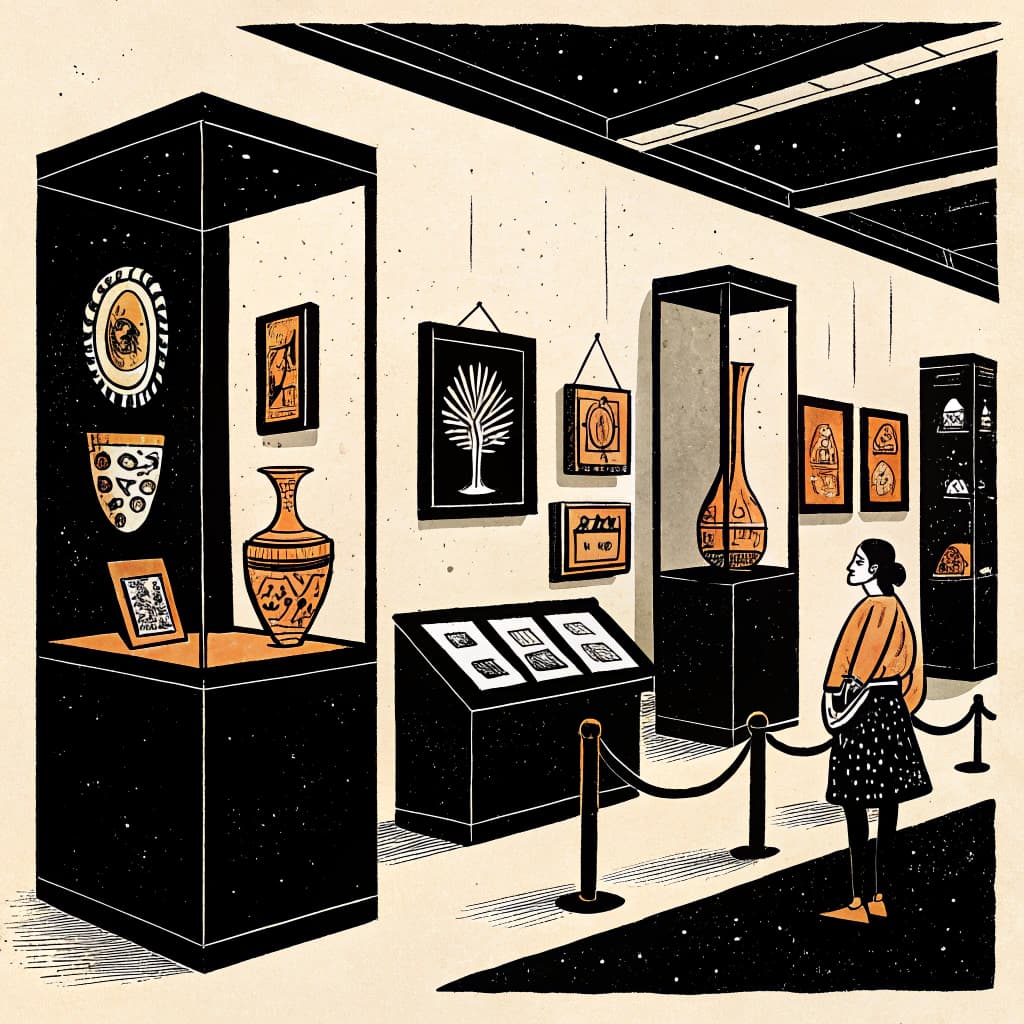
Students curate classroom exhibits and present as 'docents' to peers, transforming NCERT and board syllabus content into a gallery of live, explained understanding.
Museum Exhibit
In the Museum Exhibit methodology, small groups research a sub-topic and design a display, poster, model, timeline, or artefact, then present it live to rotating classmates. Every student alternates between docent and visitor roles, ensuring active participation regardless of class size. The approach directly supports NEP 2020 competency goals and gives board-exam-focused students practice in the extended-answer and analytical explanation skills that HOTS questions demand.
What Is Museum Exhibit? Definition, Origins, and Why It Works
The Museum Exhibit methodology finds particularly fertile ground in Indian classrooms precisely because it addresses one of the most persistent tensions in Indian education: the gap between information retention for board examinations and genuine conceptual understanding. In a system where students across CBSE, ICSE, and state board schools have traditionally been assessed on their ability to reproduce textbook content accurately, the exhibit format introduces a fundamentally different demand , the ability to communicate understanding to someone who does not already know it.
When a Class 9 student studying the French Revolution creates an exhibit for the CBSE Social Science curriculum, they face a decision that no examination preparation equips them for: what does a visitor who knows nothing about this event actually need to understand first? This sequencing problem, which museum curators call narrative architecture, forces students to organise their knowledge rather than merely accumulate it. Students who can sequence their knowledge for a naive visitor have understood the content structurally , and this structural understanding is precisely what NEP 2020's competency-based progression is designed to build across all boards and frameworks.
The method is particularly well-suited to the Indian classroom's characteristic size constraint. In classes of 35 to 50 students, traditional discussion methods inevitably concentrate speaking time among the most vocal students. The exhibit rotation format addresses this directly: by dividing the class into docent and visitor groups, every student holds a defined role with a defined task. The docent must explain; the visitor must enquire. Neither role is passive, and the teacher can move through the gallery assessing individual understanding in brief, purposeful interactions rather than managing a large-group discussion where many students observe without contributing.
NEP 2020's emphasis on experiential learning and its explicit move away from rote-based assessment creates an institutional opening for this methodology that earlier frameworks did not provide. Schools implementing the National Curriculum Framework for School Education (NCF-SE 2023) will find the Museum Exhibit methodology directly aligned with its competency-based progression model, particularly for the Foundational and Preparatory stages. For secondary and senior secondary students operating under board exam pressures, the methodology works best when teachers explicitly connect the exhibit experience to examination outcomes , demonstrating how the ability to explain a concept from multiple angles to a live audience is the same cognitive capacity tested in long-answer questions, case studies, and HOTS questions on CBSE and ICSE papers.
Across subjects, the methodology adapts naturally to NCERT chapter structures. Science exhibits on topics such as the carbon cycle, human body systems, or chemical reactions lend themselves to physical models and labelled diagrams , formats that push students beyond the textbook diagrams they would normally trace. History and Civics exhibits on chapters from the Class 10 CBSE curriculum work particularly well because they require students to synthesise across multiple chapters rather than treating each as isolated content. For ICSE students managing the depth of their History and Civics or Geography syllabi, the exhibit format provides a structured way to distribute content volume across groups while ensuring whole-class exposure through the gallery rotation. State board teachers will find the methodology equally adaptable: the exhibit structure is content-agnostic and can be mapped to any prescribed textbook.
The docent experience , explaining the exhibit to visitors who ask genuine, unscripted questions in real time , produces learning that written examination preparation cannot replicate. Indian students who have learned to write detailed board exam answers frequently discover, when faced with a live question they had not anticipated, that they understood the words of the textbook without fully grasping the meaning. This discovery, uncomfortable as it may be, is the most valuable outcome the methodology can produce, and it arrives not through assessment but through an authentic communicative encounter between peers.
How to Facilitate Museum Exhibit: Step-by-Step Implementation Guide
Define Learning Objectives and Topics
7 min
Identify the core concepts to be covered and divide them into distinct, manageable sub-topics for student groups to research.
Establish Curation Criteria
7 min
Provide a rubric that outlines requirements for the exhibit, such as a mandatory visual aid, three key facts, and a hands-on element or interactive question.
Facilitate Research and Creation
7 min
Allow students time to gather evidence and design their physical or digital display, ensuring they focus on how to teach the concept to a novice.
Set Up the Gallery Space
8 min
Arrange the classroom so that exhibits are spaced out, allowing for clear traffic flow and enough room for a small group of 'visitors' to gather at each station.
Execute the Museum Opening
7 min
Split the class into 'Docents' (presenters) and 'Patrons' (visitors); have patrons rotate through stations every 5-7 minutes while docents present their findings.
Switch Roles and Repeat
7 min
Reverse the groups so that the previous presenters become the visitors, ensuring every student has the opportunity to both teach and learn.
Conduct a Synthesis Debrief
7 min
Lead a whole-class discussion to connect the different exhibits and clarify any misconceptions observed during the rotations.
BEFORE YOU TEACH THIS
Read the Teacher's Guide first.
Flip Education's Teacher's Guide walks you through how to facilitate any active learning lesson: mindset, pre-class checklist, phase-by-phase facilitation, and a Quick Reference Card you can print and bring to class.
Read the Teacher's Guide →When to Use Museum Exhibit: Best Classes, Subjects, and Group Sizes
- CBSE and ICSE Social Science, History, and Geography chapters requiring synthesis across multiple topics
- Class 6 to 12 Science units where physical models and labelled diagrams deepen understanding beyond textbook illustrations
- EVS and Environmental Studies at the primary level for Foundational and Preparatory stage learners
- Any unit where the prescribed syllabus distributes well across four to six distinct sub-topics
Common variants
Curated exhibit
Students choose what to include from a larger source set and justify their curation in a wall-label. The curation is where the thinking happens.
Competing-exhibits format
Two groups design exhibits making opposing arguments about the same topic. Visitors vote, and the vote is followed by a debrief on what persuaded them.
Why Museum Exhibit Works: Research and Impact on Student Learning
Prince, M. (2004, Journal of Engineering Education, 93(3), 223-231)
This literature review confirms that active learning strategies, including those involving peer teaching and collaborative activities, significantly improve student engagement and learning outcomes compared to traditional lecturing.
Hmelo-Silver, C. E. (2004, Educational Psychology Review, 16(3), 235-266)
The research highlights that student-centered learning environments, such as curated exhibits, help students develop flexible knowledge, effective problem-solving skills, and self-directed learning strategies.
Chi, M. T. H., Wylie, R. (2014, Educational Psychologist, 49(4), 219-243)
This study demonstrates that 'Constructive' and 'Interactive' activities, like creating and explaining exhibits, lead to better learning outcomes than 'Passive' or 'Active' (simple doing) activities.
Common Mistakes Teachers Make with Museum Exhibit (and How to Avoid Them)
Copying NCERT or textbook text verbatim onto exhibits
Students conditioned by board exam preparation often transcribe directly from prescribed textbooks, treating the exhibit as a neat copy rather than a curated communication. Require that all exhibit text be paraphrased in the student's own words and explained as if addressing a visitor who has never opened the textbook. Explicitly ban direct quotation from NCERT or any prescribed text except when used as a cited evidence point.
Board exam anxiety dismissing the activity as 'not in the syllabus'
In Classes 9 to 12 especially, students and sometimes parents perceive activity-based learning as time away from examination preparation. Address this directly during the setup: show students how explaining a concept to a live visitor maps to the extended-answer, case-study, and HOTS question formats that appear on CBSE, ICSE, and state board papers. When students see the exhibit as examination practice in a different form, resistance drops significantly.
Managing a 45-minute period with large classes and multiple rotations
Indian school periods are typically 40 to 45 minutes, and with 35 to 50 students the rotation logistics can consume more time than the learning itself. Plan rotation timing in advance: with four exhibit stations and two groups, three-minute rotations allow a full gallery pass within 15 minutes, leaving adequate time for the role switch and a brief debrief. Assign a student timekeeper to call each rotation so the teacher can remain focused on observation and assessment.
High-achievers monopolising exhibit creation while others copy
In group-oriented Indian classrooms where academic hierarchy is often well-established, dominant students may produce the entire exhibit while quieter group members contribute little. Assign specific, non-overlapping roles within each group , researcher, scribe, visual designer, and docent planner , and hold each student accountable for their section during the gallery opening. Individual exit tickets assessing content from exhibits the student did not create also close the accountability gap.
Docents treating presentation as a memorisation performance
Students who prepare by memorising a script perform fluently until the first unexpected visitor question, then lose composure entirely. This is especially common in Indian classrooms where oral performance has traditionally meant recitation rather than conversation. During the preparation phase, pose two or three challenge questions to each docent group that do not appear on their exhibit , questions a curious visitor might naturally ask. If students cannot answer conversationally, they are not yet ready to present, and that is the most useful feedback the teacher can give before the gallery opens.
How Flip Education Helps
NCERT and board-mapped exhibit briefs with chapter references
Flip generates exhibit briefs that are directly cross-referenced to specific NCERT chapters, CBSE learning outcomes, and ICSE syllabus points, so teachers do not need to build the content scaffolding from scratch. Each brief specifies what the exhibit must communicate and which prescribed learning outcome it addresses, making it straightforward to justify the activity to department heads and parents as curriculum-aligned rather than supplementary.
Large-class rotation planner for 40–45 minute periods
The Flip mission includes a rotation schedule calibrated for Indian class sizes and period lengths, with suggested station counts, rotation durations, and a printable timekeeper card. The facilitation guide includes a tight opening script that sets up roles and expectations in under five minutes, leaving the maximum possible time for the gallery itself. Teacher tips flag the most common disruptions in large-class rotations and how to address them without stopping the session.
HOTS-linked visitor question banks
For each exhibit topic, Flip provides a bank of Higher Order Thinking Skills (HOTS) visitor questions that mirror the analytical question types appearing on CBSE, ICSE, and many state board papers. Teachers distribute these to visitor groups so that the gallery experience doubles as oral examination practice. Docents who can handle these questions fluently have demonstrated the depth of understanding that extended-answer questions require , making the connection between activity and examination preparation explicit and credible.
Structured peer feedback slips and individual exit tickets
The printable materials include visitor feedback slips where students note one strength and one clarifying question for each exhibit they visit, giving docent groups actionable input after the gallery closes. Individual exit tickets assess each student's learning from exhibits they did not create, providing the teacher with a formative assessment signal that is independent of group performance and suitable for record-keeping under continuous and comprehensive evaluation (CCE) frameworks.
Tools and Materials Checklist for Museum Exhibit
- Display space per exhibit (desk cluster or wall section)
- Exhibit label cards
- Visitor observation sheet
- Optional: artefact replicas or printed images (optional)
Museum Exhibit FAQs: Questions Teachers Actually Ask
What is the Museum Exhibit teaching strategy?
The Museum Exhibit strategy is an active learning technique where students create visual displays to teach specific concepts to their peers. It transforms the classroom into a gallery space, promoting student agency and peer-to-peer instruction through curated artifacts and explanations.
How do I use Museum Exhibit in my classroom?
Start by assigning specific topics to small groups and providing clear criteria for their visual and oral presentations. During the 'opening,' half the students stand by their exhibits to present while the other half rotates through as 'visitors' before switching roles.
What are the benefits of the Museum Exhibit method?
This method increases student accountability and deepens conceptual understanding through the act of teaching others. It also supports diverse learning styles by incorporating visual, auditory, and kinesthetic elements into a single lesson.
How do you assess a Museum Exhibit activity?
Assessment should focus on both the accuracy of the displayed content and the student's ability to answer peer questions during the rotation. Use a rubric that evaluates visual clarity, factual correctness, and the quality of the verbal explanation provided to visitors.
What is the difference between a Museum Exhibit and a Gallery Walk?
While a Gallery Walk often involves students reacting to pre-placed prompts, a Museum Exhibit requires students to be the creators and 'docents' of the content. The Museum Exhibit emphasizes student curation and live presentation rather than just passive observation.
Classroom Resources for Museum Exhibit
Free printable resources designed for Museum Exhibit. Download, print, and use in your classroom.
Museum Exhibit Design Planner
Students plan their exhibit by organizing the central theme, key artifacts or visuals, explanatory text, and visitor engagement questions.
Download PDFMuseum Exhibit Reflection
Students reflect on the experience of designing an exhibit and serving as a docent who explains their work to visiting classmates.
Download PDFMuseum Exhibit Role Cards
Assign roles for both exhibit creators and exhibit visitors to ensure deep engagement during the gallery walk.
Download PDFMuseum Exhibit Prompts
Ready-to-use prompts for exhibit design, docent conversations, and visitor engagement.
Download PDFSEL Focus: Self-Awareness in Museum Exhibit
A card focused on understanding one's own strengths as a communicator and designer through the exhibit creation process.
Download PDFRelated
Methodologies Similar to Museum Exhibit
Gallery Walk
Students rotate through stations posted around the classroom, analysing prompts and building on each other's written responses, a high-engagement format that works across CBSE, ICSE, and state board contexts.
Project-Based Learning
Student-led inquiry into real-world challenges, mapped to your board syllabus and NEP 2020 competency goals.
Trading Cards
Students create and exchange knowledge cards to synthesise curriculum content, effective across CBSE, ICSE, and state board classrooms from Class 4 upwards.
Ready to try this?
- Read the Teacher's Guide →
- Generate a mission with Museum Exhibit →
- Print the toolkit after generating
Generate a Mission with Museum Exhibit
A complete lesson plan, aligned to your curriculum.