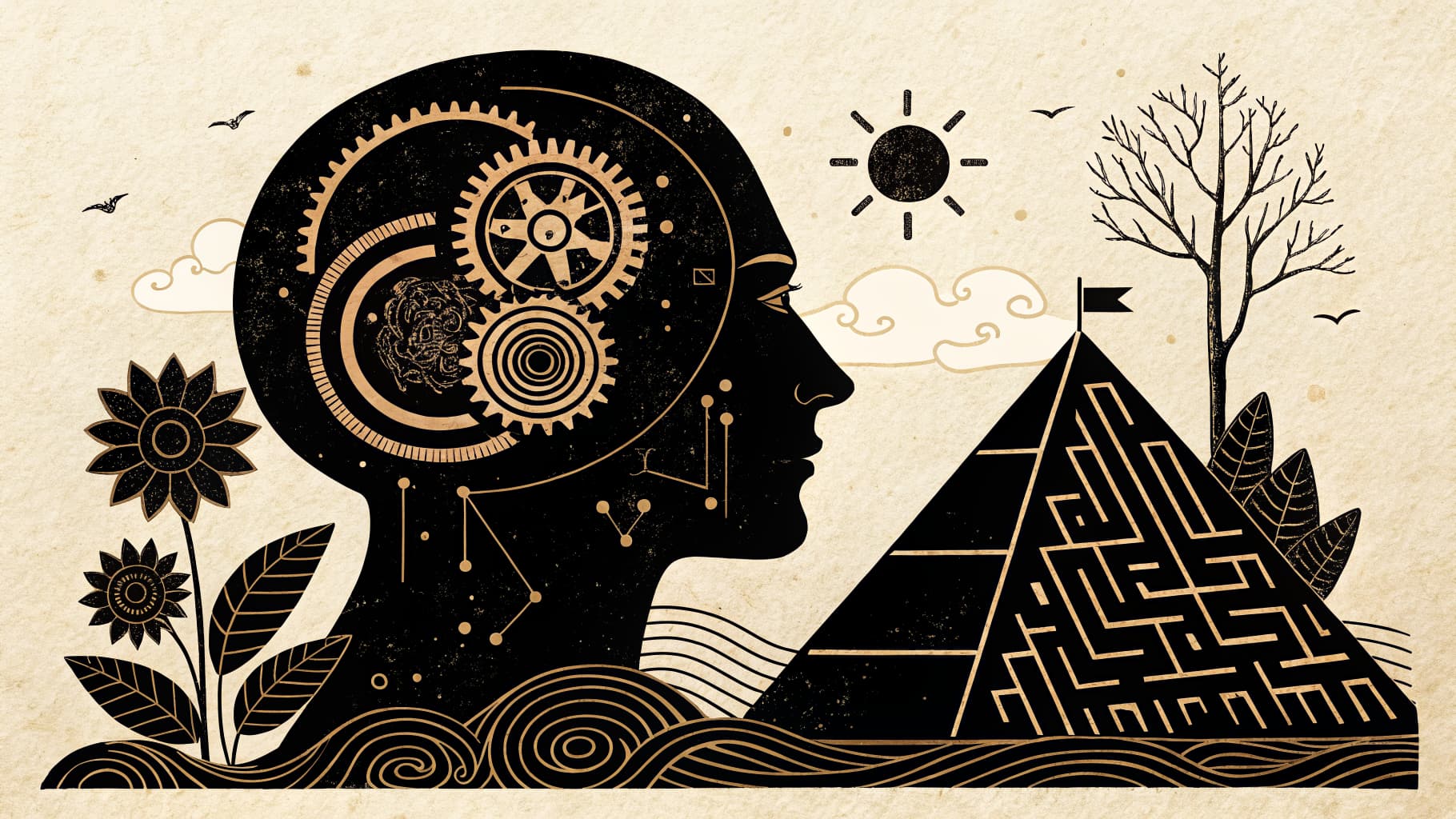
The Building Blocks of Thought
Discover the fundamental elements of thinking, including how we form mental images and organise information into concepts.
TL;DR:Let's investigate the invisible architecture of our minds. This topic explores the fundamental building blocks, mental images and concepts, that we use to construct our entire world of thought.
About This Topic
This topic, 'The Building Blocks of Thought', is a cornerstone of cognitive psychology and aligns with the NCERT Class 11 curriculum, specifically within the chapter on 'Thinking'. It moves beyond simply defining thought to deconstruct its fundamental components: mental images and concepts. For Indian students, this is a crucial step in understanding how we process the incredibly diverse sensory information in our environment. The overview should stress that these are not just abstract theories but the very mechanisms that enable higher-order processes like problem-solving, reasoning, and creativity, which are explored in subsequent topics. Contextualise this by explaining how our minds create mental 'shortcuts' (concepts) to navigate a complex world, from identifying a 'rickshaw' in traffic to understanding abstract ideas like 'dharma'. Emphasise that this topic lays the groundwork for appreciating both the efficiency and the potential biases of human cognition, a theme that recurs throughout psychology.
Key Questions
- Explain how mental images and concepts function as the basic elements of thought.
- Compare the process of forming natural concepts with artificial concepts.
- Identify the role of prototypes in concept formation.
Learning Objectives
- Define mental images and concepts as the fundamental elements of thought.
- Differentiate between natural concepts formed through experience and artificial concepts defined by rules.
- Explain the role of prototypes in concept formation and categorisation.
- Analyse how concepts help in organising knowledge and making thinking more efficient.
- Provide examples of how mental imagery is used in thinking and problem-solving.
Key Vocabulary
| Mental Image | A mental representation of a previously perceived sensory experience, which can be visual, auditory, tactile, etc. |
| Concept | A mental grouping of similar objects, events, ideas, or people that share common properties. |
| Prototype | The most typical and representative example of a particular concept. For example, a 'mango' is a good prototype for the concept 'fruit' in India. |
| Artificial Concept | A concept that is defined by a specific set of logical rules or features, such as a 'square' or the definition of a chemical element. |
| Natural Concept | A concept formed through everyday experiences, which often has fuzzy or ill-defined boundaries, like 'justice' or 'game'. |
Watch Out for These Misconceptions
Common MisconceptionMental images are like perfect photographs or videos stored in our brain.
What to Teach Instead
Mental images are actually reconstructions, not perfect recordings. They are often simplified, can be manipulated by our imagination, and are influenced by our existing knowledge and biases.
Common MisconceptionAll concepts have clear, fixed definitions, just like in a dictionary.
What to Teach Instead
While some 'artificial' concepts like 'triangle' have strict rules, most of our everyday 'natural' concepts like 'chair' or 'game' have fuzzy boundaries. We often define them based on a typical example or prototype rather than a rigid set of rules.
Common MisconceptionThinking is only done using words and internal speech.
What to Teach Instead
Thinking is multi-modal. We use non-verbal mental images to think about spatial layouts, solve puzzles, and recall sensory experiences. Both verbal (propositional) and non-verbal (imaginal) thoughts are essential.
Active Learning Ideas
See all activities→Concept Mapping
The Prototype Challenge
Present students with a series of images for a category like 'fruit' (e.g., apple, mango, watermelon, olive, tomato). Ask them to rate each image on a scale of 1-5 on how 'fruity' it is, leading to a discussion on what makes a 'good' example of a concept.
Concept Mapping
Concept Hierarchy Map
Give students a broad concept like 'Food' or 'Transport'. In pairs, they must create a mind map that breaks it down into subordinate and superordinate categories, showing the hierarchical nature of our conceptual knowledge.
Concept Mapping
Describe Your Mental Image
Ask students to close their eyes and form a detailed mental image of their school's main gate. They then describe this image to a partner, who has to listen for sensory details (colours, sounds, textures).
Real-World Connections
- In advertising, companies use vivid mental imagery to make their products seem more appealing and memorable.
- Architects and interior designers use mental imagery to visualise spaces and layouts before creating any plans.
- Doctors often use a prototypical set of symptoms to form an initial diagnosis for common illnesses like malaria or typhoid.
- In our legal system, abstract concepts like 'justice', 'negligence', and 'consent' must be debated and applied to specific cases.
- When we learn to cook, we develop a concept of 'spicy' or 'sweet' that allows us to adjust recipes without needing exact measurements.
Assessment Ideas
Exit Slip: Ask students to write down one example of a natural concept they used today and one example of an artificial concept they learned in another subject like Maths or Chemistry.
In a unit test, ask students to analyse a short case study and identify how the person in the study used mental images, prototypes, and concepts to solve a simple problem.
Provide a simple quiz on a platform like Google Forms where students can check their understanding of key vocabulary and receive immediate feedback.
Frequently Asked Questions
What is the difference between an 'image' and a 'mental image'?
Is a prototype the same as a stereotype?
Why do we need concepts? Why not just remember every single thing we see?
More in Thinking
Problem Solving Strategies and Hurdles
Learn about the systematic stages of problem-solving and identify common mental obstacles, like mental set and functional fixedness, that can hinder solutions.
8 methodologies
Reasoning and Decision-Making
Explore the different types of reasoning, such as deductive and inductive, and understand the cognitive processes that guide our judgments and decisions.
8 methodologies
The Nature of Creative Thinking
Delve into the concept of creativity, distinguishing it from general intelligence and examining the stages involved in the creative process.
8 methodologies
Language and Thought
Investigate the profound and debated relationship between language and thought, exploring whether language shapes our perception of reality.
8 methodologies