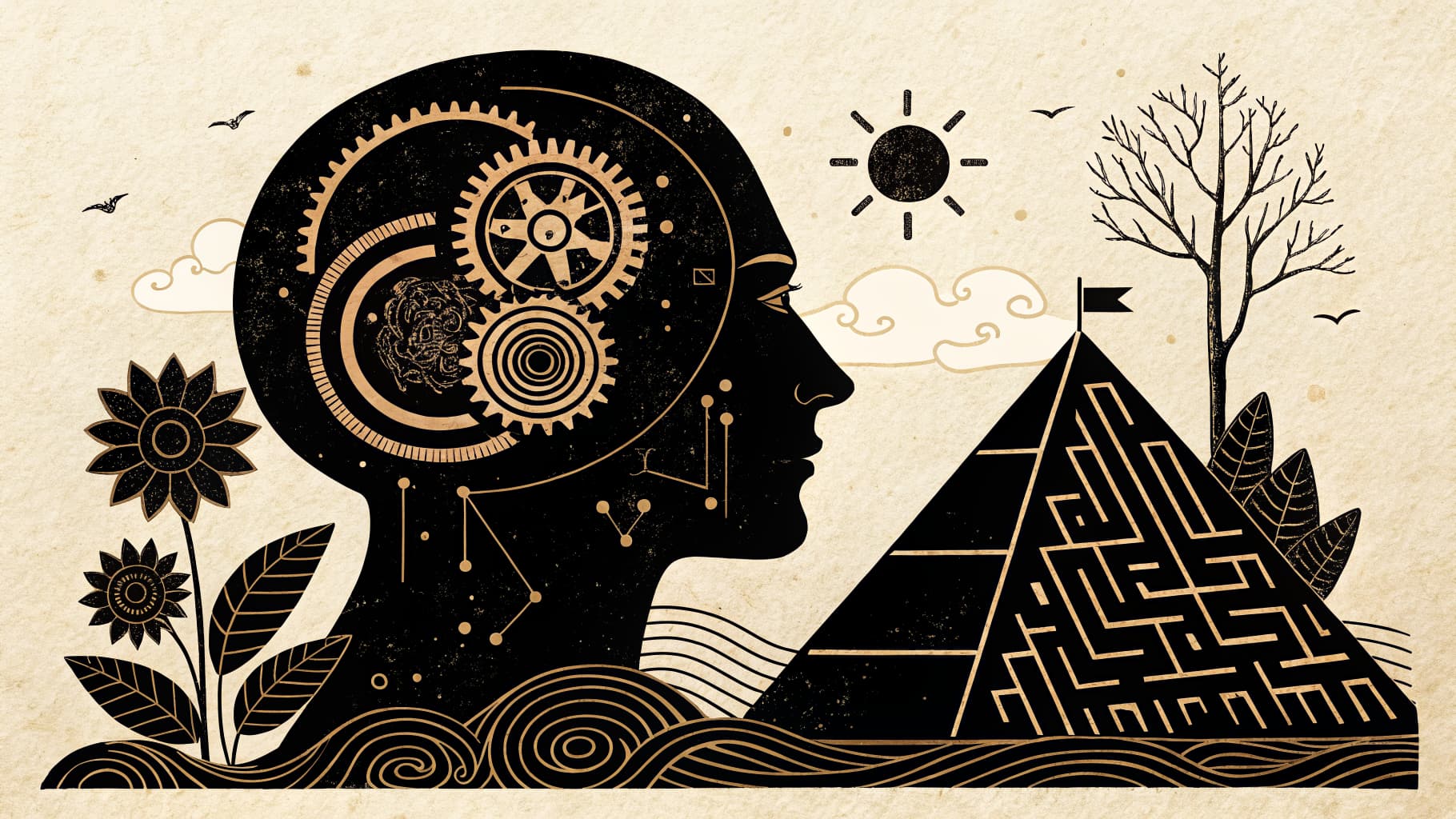
Reasoning and Decision-Making
Explore the different types of reasoning, such as deductive and inductive, and understand the cognitive processes that guide our judgments and decisions.
TL;DR:Ever wondered why we make the choices we do, from picking a snack to planning a career? This topic unpacks the mental machinery behind our everyday reasoning and decisions.
About This Topic
This topic, 'Reasoning and Decision-Making', is a cornerstone of the 'Thinking' unit in the Class 11 Psychology curriculum, as outlined by CBSE and other Indian educational boards. It moves beyond the basic mechanics of thought to explore the structured processes that underpin our conclusions and choices. The content directly aligns with the National Education Policy (NEP) 2020's emphasis on fostering critical thinking and analytical skills. For Indian students, understanding these concepts is crucial as they navigate an increasingly complex world of information overload and are on the cusp of making significant life decisions regarding their careers and higher education.
The first part of the topic introduces the two primary forms of reasoning: deductive and inductive. It's important to contextualise these not as abstract philosophical ideas, but as mental tools we use daily, from solving a math problem (deductive) to predicting a friend's behaviour based on past actions (inductive). The second part delves into judgment and decision-making, highlighting the reality that human rationality is limited. By introducing concepts like heuristics (mental shortcuts) and cognitive biases (systematic errors in thinking), students can develop metacognitive awareness. This helps them understand why they, and others, might make seemingly illogical choices, a valuable skill for improving interpersonal understanding and self-reflection.
Key Questions
- Compare and contrast deductive and inductive reasoning with relevant examples.
- Analyse the cognitive biases that can influence our decision-making process.
- Explain the relationship between judgment and decision-making.
Learning Objectives
- Differentiate between deductive and inductive reasoning using everyday examples.
- Identify at least three common cognitive biases (e.g., confirmation bias, availability heuristic) in given scenarios.
- Explain the relationship between judgment as an evaluation and decision-making as a choice.
- Analyse a simple decision-making process by breaking it down into its constituent steps.
- Evaluate how heuristics can be both helpful and harmful in making judgments.
Key Vocabulary
| Reasoning | The cognitive process of using logic and information to draw conclusions, make inferences, or form judgments. |
| Deductive Reasoning | A logical process that moves from a general principle or premise to a specific, guaranteed conclusion. Also known as 'top-down' logic. |
| Inductive Reasoning | A logical process that moves from specific observations to broader generalisations or theories. The conclusion is probable, not certain. |
| Cognitive Bias | A systematic error in thinking that affects the decisions and judgments that people make. |
| Heuristic | A mental shortcut or rule of thumb that allows people to solve problems and make judgments quickly and efficiently. |
| Judgment | The process of forming an opinion or making an evaluation after careful thought or consideration of information. |
Watch Out for These Misconceptions
Common MisconceptionMaking a good decision guarantees a good outcome.
What to Teach Instead
A good decision is based on a sound reasoning process, not its outcome. A well-thought-out choice can still lead to a negative result due to chance or unforeseen factors, just as a poor decision can sometimes luckily result in a good outcome.
Common MisconceptionLogical people don't have cognitive biases.
What to Teach Instead
Cognitive biases are a natural part of human cognition and affect everyone, regardless of their intelligence. They are mental shortcuts our brains use to be more efficient, but they can often lead to errors. Awareness is the key to mitigating them, not immunity.
Common MisconceptionDeductive reasoning is superior to inductive reasoning because it's certain.
What to Teach Instead
Both types of reasoning have different, equally important purposes. Deductive reasoning is great for applying established rules, but it doesn't generate new knowledge. Inductive reasoning is how we form new hypotheses and learn from experience, which is the foundation of scientific discovery, even though its conclusions are probabilistic, not certain.
Active Learning Ideas
See all activities→Decision Matrix
Cognitive Bias Detective
Present students with short scenarios or news headlines that are classic examples of cognitive biases like confirmation bias, anchoring, or the availability heuristic. In small groups, students must identify the bias at play and explain how it might lead to a flawed decision.
Decision Matrix
The Sherlock Holmes Challenge
Provide a mini-mystery with a set of clues. One set of clues leads to a guaranteed conclusion (deductive), while another set suggests a probable conclusion (inductive). Students must solve the mystery and correctly label which reasoning path they used for which part.
Decision Matrix
Decision-Making Dilemma
Give groups a real-world problem, such as 'Plan a budget-friendly, eco-conscious class trip'. They must brainstorm options, evaluate them based on set criteria (judgment), and make a final choice (decision), documenting their reasoning process and potential pitfalls.
Real-World Connections
- A doctor diagnosing a patient's illness by gathering symptoms (inductive) and then ruling out diseases based on tests (deductive).
- A voter evaluating a political candidate by being aware of confirmation bias, which is the tendency to favour information that confirms one's existing beliefs.
- Making a major purchase like a laptop by researching features and reviews, rather than relying on the 'availability heuristic' of buying the brand you see advertised most often.
- A manager hiring a new employee must be wary of the 'halo effect', where a good impression in one area (like being well-spoken) influences their judgment of the candidate's other abilities.
- Understanding legal proceedings, where a jury must use logical reasoning to reach a verdict based on the evidence presented, not on personal biases.
Assessment Ideas
Use an exit ticket where students have to write down one example of deductive reasoning and one example of inductive reasoning they have used or observed during their day.
Provide a case study of a complex decision (e.g., a historical event, a business failure). Students must write a short analysis identifying the reasoning used, the judgments made, and the cognitive biases that may have influenced the final outcome.
Ask students to keep a 'decision journal' for a week. They record one significant decision each day and reflect on their thought process, trying to identify any heuristics or biases that might have been at play.
Frequently Asked Questions
What is the main difference between a heuristic and a bias?
How is judgment different from decision-making?
Can we get rid of our cognitive biases completely?
More in Thinking
The Building Blocks of Thought
Discover the fundamental elements of thinking, including how we form mental images and organise information into concepts.
8 methodologies
Problem Solving Strategies and Hurdles
Learn about the systematic stages of problem-solving and identify common mental obstacles, like mental set and functional fixedness, that can hinder solutions.
8 methodologies
The Nature of Creative Thinking
Delve into the concept of creativity, distinguishing it from general intelligence and examining the stages involved in the creative process.
8 methodologies
Language and Thought
Investigate the profound and debated relationship between language and thought, exploring whether language shapes our perception of reality.
8 methodologies