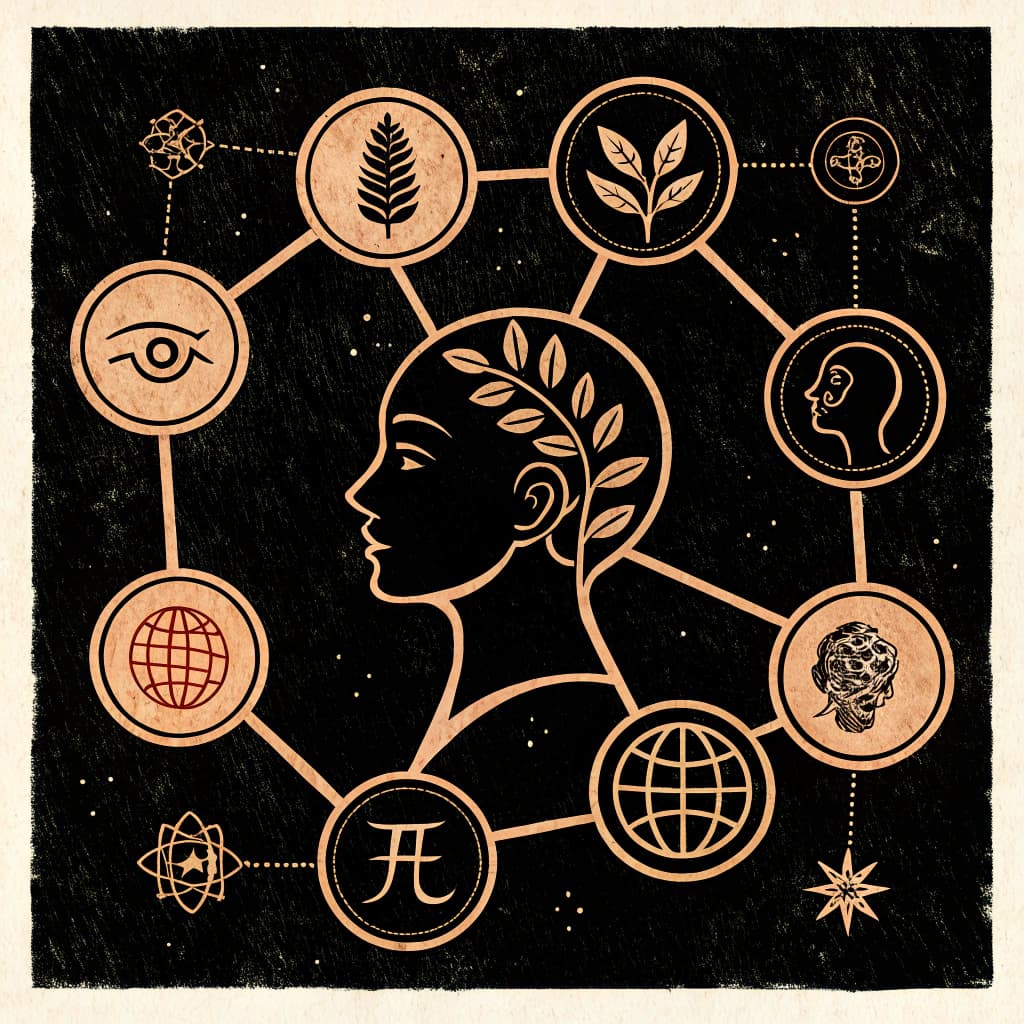
Students organise key concepts from the lesson into a visual map, drawing labelled arrows to show how ideas connect, building the relational understanding that board examination analysis questions demand.
Concept Mapping
Concept mapping asks students to arrange the key terms from a topic into a hierarchy and draw labelled links between them, writing a precise phrase on each arrow to describe the relationship. Aligned with NEP 2020 competency goals, it builds the higher-order thinking skills that CBSE, ICSE, and state board syllabi increasingly assess. Particularly effective for Class 6 to Class 12 students preparing for chapters where understanding how ideas interact matters as much as knowing definitions.
What Is Concept Mapping? Definition, Origins, and Why It Works
Concept mapping arrived in Indian classrooms at a particularly significant moment: the National Education Policy 2020 explicitly calls for a shift from rote memorisation and information recall toward competency-based education, higher-order thinking, and the ability to apply knowledge across contexts. For decades, the architecture of Indian school education , competitive board examinations, textbooks organised as dense information repositories, 30 to 50 students per class, and mark-sheet culture that rewards accurate reproduction over genuine understanding , had made meaningful learning difficult to operationalise at scale. Concept mapping is one of the most practical tools available to Indian teachers who want to implement NEP 2020's vision without abandoning the curriculum they are accountable for.
Joseph Novak developed the concept map at Cornell University in the early 1970s, drawing on David Ausubel's theory of meaningful learning. Ausubel argued that learning is meaningful when new knowledge is assimilated into existing cognitive structures rather than stored as isolated facts , and that the primary aim of instruction should be to activate and extend those structures. The concept map was built to make those structures visible. For Indian teachers working with NCERT textbooks, this is directly applicable: NCERT content is itself hierarchically organised, moving from broad concepts to specific examples and applications. A concept map of a Class 9 Science chapter on matter, or a Class 10 History chapter on nationalism, mirrors and reinforces exactly the organisational logic that NCERT intends students to internalise.
In practice, the concept map makes three cognitive operations explicit that board-exam preparation tends to obscure. The first is differentiation: students must decide which concepts are central and which are peripheral, resisting the pull of treating every line of the textbook as equally important. The second is hierarchical organisation: concepts must be arranged from most general to most specific, which requires understanding the logical structure of the topic rather than its chronological or page-order presentation. The third, and most demanding, is cross-linking: identifying relationships between concepts that belong to different parts of the map. A student who links 'photosynthesis' to 'food chain' and labels that link 'provides the base for' has understood something about ecology that the chapter may never have stated directly. Cross-links are the cognitive signature of systems thinking, and they are precisely what board examinations , particularly multiple-choice and short-answer formats , do not reward or even assess.
In CBSE and ICSE classrooms, concept mapping works most powerfully as a unit-opening and unit-closing exercise. Deployed at the start of a chapter, it reveals what students already know and believe about the topic , including misconceptions that, if unaddressed, will cause confusion later. The same map, revisited at the end of the chapter, becomes a record of conceptual growth: the links added, the labels refined, the cross-links discovered. This before-and-after comparison is one of the most efficient formative assessment tools available in a 45-minute period. In state board classrooms, where language of instruction varies and many students are learning content in their second or third language, the visual and relational structure of a concept map reduces linguistic load without reducing intellectual demand.
For teachers navigating the tension between NEP 2020's competency goals and the ongoing reality of board exam preparation, concept mapping offers a productive bridge. The act of constructing a map requires students to understand relationships deeply enough to describe them in their own words , which is precisely the kind of understanding that transfers to application and analysis questions in CBSE Class 10 and Class 12 board papers, and to ICSE structured-response questions that require reasoned explanation rather than rote recall. Research consistently shows that students who have mapped a topic retain it longer and transfer it more readily than students who have only read or copied notes. In the context of Indian secondary education, this is not merely a pedagogical preference: it is a structural advantage in preparation for examinations that increasingly reward explained answers over reproduced ones.
How to Facilitate Concept Mapping: Step-by-Step Implementation Guide
Define the Focus Question
5 min
Identify a specific problem or area of knowledge you want the students to map, such as 'How does the water cycle affect local weather?'
Generate a Parking Lot
5 min
Provide or have students brainstorm a list of 10 to 20 key concepts and terms related to the focus question.
Establish Hierarchy
5 min
Instruct students to place the most general and inclusive concepts at the top of the map and the most specific ones at the bottom.
Connect Concepts with Linking Phrases
5 min
Draw lines between concepts and require students to write a verb or short phrase (e.g., 'leads to', 'consists of', 'requires') on the line to create a proposition.
Identify Cross-Links
5 min
Challenge students to find and label connections between concepts in different segments or domains of the map to show complex interrelationships.
Review and Refine
5 min
Have students present their maps to peers for feedback, checking for logical flow and correcting any inaccurate propositions.
BEFORE YOU TEACH THIS
Read the Teacher's Guide first.
Flip Education's Teacher's Guide walks you through how to facilitate any active learning lesson: mindset, pre-class checklist, phase-by-phase facilitation, and a Quick Reference Card you can print and bring to class.
Read the Teacher's Guide →When to Use Concept Mapping: Best Classes, Subjects, and Group Sizes
- NCERT Science and Social Science chapters with interconnected concepts
- Class 9 to Class 12 board revision sessions where relational understanding is tested
- NEP 2020 competency-based assessment tasks requiring students to demonstrate synthesis
- Mixed-ability classrooms where visual scaffolding reduces linguistic load without reducing rigour
Common variants
Teacher-seeded concept map
Teacher provides 6 to 10 key concepts; students connect and label the relationships. Scaffolded entry point when the vocabulary is new.
Student-generated concept map
Students brainstorm the concepts themselves from a topic or reading, then map them. Higher cognitive load, more authentic to their understanding.
Comparative concept map
Two groups map the same topic independently, then compare. The differences reveal where their mental models diverge and where the class has shared ground.
Why Concept Mapping Works: Research and Impact on Student Learning
Novak, J. D., Cañas, A. J. (2010, IHMC Technical Report IHMC CmapTools 2006-01 Rev 01-2008)
Concept maps facilitate meaningful learning by integrating new concepts into existing cognitive frameworks through hierarchical organization and cross-links.
Nesbit, J. C., Adesope, O. O. (2006, Review of Educational Research, 76(3), 413–448)
A meta-analysis of 55 studies found that concept mapping is more effective than reading text, attending lectures, or participating in class discussions for knowledge retention.
Schroeder, N. L., Nesbit, J. C., Anguiano, C. J., Adesope, O. O. (2018, Educational Psychology Review, 30(2), 431–455)
The study confirmed that both studying expert-provided maps and constructing original maps significantly enhance student learning outcomes across various educational levels.
Common Mistakes Teachers Make with Concept Mapping (and How to Avoid Them)
Board exam culture pulling students back to rote copying
Indian students are conditioned from early schooling that 'real studying' means copying definitions and diagrams from the textbook. When asked to create a concept map, many will transcribe NCERT text onto nodes rather than synthesise ideas. Explicitly frame the activity as board exam preparation: 'The analysis and application questions in your Class 10 and Class 12 papers ask you to explain relationships. This is exactly the skill we are building.' Make the connection to marks visible.
Superficial maps due to class size making individual feedback impossible
With 40-plus students, a teacher cannot review every map in a 45-minute period. Build peer review into the structure: assign pairs to exchange maps and check that every link has a specific relational phrase , not 'is related to' but 'causes,' 'consists of,' 'is necessary for.' Peers often catch vague links more readily than the student who drew them. This also scales the feedback process without additional teacher time.
Language barriers leading to imprecise link labels
In classrooms where English is the medium of instruction but not the home language, students often struggle to articulate link relationships in precise English. Provide a printed 'link phrase bank' with 15 to 20 approved relational phrases in English alongside their vernacular equivalents. This is not a shortcut , it is a scaffold that keeps the cognitive focus on the relationship itself rather than on vocabulary retrieval.
Treating concept mapping as a one-time Chapter 1 activity
Many Indian teachers use concept mapping as an introductory exercise at the start of a unit, then return to conventional note-taking for the rest. The method's value compounds when the same map is revisited mid-chapter and again at revision time. A Class 8 student who updates their photosynthesis map three times across a unit builds a denser, more cross-linked understanding than a student who drew it once and filed it away. Schedule returns to the map explicitly in your lesson plan.
Resistance from parents and students who see it as 'not studying'
In many Indian households, studying means a child sitting with a textbook and writing. A student drawing a diagram with arrows may be told by parents to stop wasting time. Pre-empt this by sending home a brief note explaining that concept mapping is a research-backed revision strategy aligned with NEP 2020's competency goals. Include the phrase 'builds the skills tested in board examination analysis questions.' Parental buy-in significantly affects how seriously students engage.
How Flip Education Helps
NCERT and board-aligned concept card sets for large classes
Flip generates printable concept card sets and link phrase menus mapped directly to the topics and key terms in NCERT textbooks and aligned with CBSE, ICSE, and state board syllabi. Cards are formatted for easy cutting and classroom use with 30 to 50 students, with enough sets generated so every pair can work independently. No preparation time is spent deciding which terms matter , the AI selects concepts central to your syllabus learning objectives.
NEP 2020 competency framing for each mapping activity
Each Flip-generated concept mapping activity includes a competency statement linking the task to NEP 2020 learning outcomes and, where applicable, to NCERT chapter learning objectives. This framing helps Indian teachers justify the activity to department heads and parents by anchoring it in official curriculum policy, not just international research. The session plan also notes which board examination question types the activity directly prepares students for.
Facilitation guide scaled for 45-minute periods and large classes
The generated facilitation script is structured around the 45-minute period standard in Indian schools, with explicit time-checks at each stage: concept card distribution and sorting (10 minutes), initial linking (15 minutes), peer review and cross-link identification (12 minutes), and class debrief (8 minutes). Teacher prompts include suggested interventions for the most common difficulties in Indian classrooms, including students who are writing full sentences in nodes instead of single concepts, and groups that have produced a hierarchy without any cross-links.
Bilingual exit tickets and formative assessment tools
Flip's exit tickets for concept mapping ask students to identify their most important cross-link and explain it in writing , directly practising the explanatory reasoning that CBSE and ICSE board papers reward. Where Flip generates content for vernacular medium or regional board classrooms, exit ticket prompts are available in Indian English alongside space for students to annotate in their own language. Results give teachers immediate insight into which relationships the class has grasped and which require direct instruction in the next period.
Tools and Materials Checklist for Concept Mapping
- Blank A3 or large paper
- Markers or coloured pens
- List of key concepts to include (teacher-provided scaffold) (optional)
Concept Mapping FAQs: Questions Teachers Actually Ask
What is the difference between a mind map and a concept map?
Concept maps focus on the relationships between multiple concepts using labeled linking lines, whereas mind maps typically radiate from a single central idea. While mind maps are better for brainstorming, concept maps are superior for illustrating complex systems and hierarchical knowledge.
How do I use Concept Mapping in my classroom?
Start by providing a focus question and a list of 10-15 key terms for students to organize. Have students work in pairs to draw connections and, most importantly, write 'linking phrases' on the lines to explain the relationship between terms.
What are the benefits of Concept Mapping for students?
Concept mapping improves critical thinking by forcing students to synthesize information rather than just memorize facts. It also serves as a metacognitive tool that helps students identify what they do and do not understand about a topic.
Can Concept Mapping be used as a formal assessment?
Yes, concept maps can be graded using rubrics that evaluate the accuracy of propositions, the depth of the hierarchy, and the presence of valid cross-links. They provide a more nuanced view of student understanding than multiple-choice tests.
How does Concept Mapping support diverse learners?
It provides a visual scaffolding that reduces the linguistic load for English Language Learners and students with certain learning disabilities. By focusing on spatial relationships and keywords, it allows students to demonstrate complex understanding without relying solely on dense paragraph construction.
Classroom Resources for Concept Mapping
Free printable resources designed for Concept Mapping. Download, print, and use in your classroom.
Concept Map Building Sheet
Students identify key concepts, define relationships between them, and plan the structure of their concept map before building it.
Download PDFConcept Mapping Reflection
Students evaluate how creating a visual map of relationships between ideas deepened their understanding of the topic.
Download PDFCollaborative Concept Mapping Roles
Assign roles for group concept mapping so that identifying concepts, defining relationships, and checking accuracy are shared tasks.
Download PDFConcept Mapping Prompts
Prompts that guide students through building, analyzing, and refining concept maps.
Download PDFSEL Focus: Self-Awareness
A card focused on recognizing what you understand, what you do not, and where your thinking needs revision during concept mapping.
Download PDFRelated
Methodologies Similar to Concept Mapping
Hexagonal Thinking
A visual connection strategy where students arrange concept hexagons to map relationships, ideal for NCERT chapters, NEP 2020 competency goals, and CBQ preparation across CBSE, ICSE, and state boards.
Placemat Activity
A structured cooperative activity where students in each group write individually in assigned sections before reaching a shared synthesis in the centre, ensuring every voice is captured before group discussion begins.
Decision Matrix
A structured framework for evaluating multiple options against weighted criteria, directly building the evaluative reasoning and evidence-based justification skills assessed in CBSE HOTs questions, ICSE analytical papers, and NEP 2020 competency frameworks.
Ready to try this?
- Read the Teacher's Guide →
- Generate a mission with Concept Mapping →
- Print the toolkit after generating
Generate a Mission with Concept Mapping
A complete lesson plan, aligned to your curriculum.