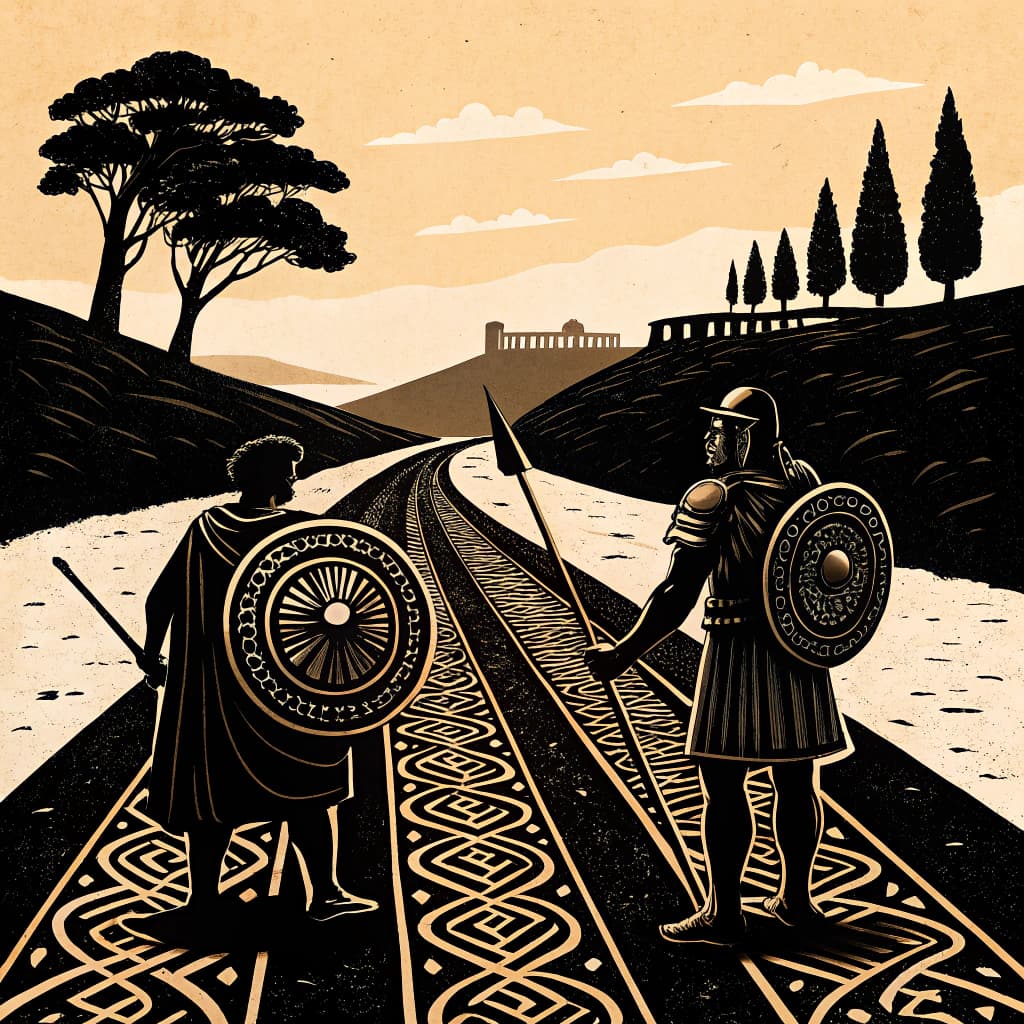
The Might of the Roman Army
Examining the equipment, training, and tactics of the Roman Legionaries.
TL;DR:Active learning helps Year 4 students grasp complex historical concepts by making them tangible and personal. Through role-play, discussion, and investigation, students connect governance and power to real human experiences, which builds deeper understanding than passive reading alone.
About This Topic
The transition from the Roman Republic to the Empire is a pivotal moment in world history. This topic introduces Year 4 students to the concepts of governance, power, and the role of the individual in society. By comparing the rule of the Senate with the absolute power of Emperors like Augustus, students begin to understand how political systems change and the impact this has on the lives of ordinary people.
Central to this study is the figure of Julius Caesar and his role in the Republic's downfall. Students will explore whether his actions were necessary for stability or a betrayal of Roman freedom. This topic aligns with the National Curriculum's focus on the expansion of the empire and the nature of ancient authority. Students grasp these complex political concepts faster through structured discussion and role plays that simulate the tension between different groups in Roman society.
Key Questions
- Analyze what made the Roman army more organised and effective than its enemies.
- Explain how technology like the testudo formation helped in battle.
- Justify why discipline was so important to a Roman soldier's success.
Learning Objectives
- Classify Roman military equipment based on its function in battle.
- Explain the training methods used to develop Roman legionary discipline and effectiveness.
- Compare the tactical formations of the Roman army with those of their likely opponents.
- Analyze the advantages of Roman military organization and technology over contemporary armies.
Before You Start
Why: Students need a basic understanding of what ancient civilizations are and their general time periods to contextualize the Roman Empire.
Why: Familiarity with Roman society helps students understand the context in which the army operated and the lives of the soldiers.
Key Vocabulary
| Legionary | A professional soldier in the Roman army, part of a large, highly organised military unit called a legion. |
| Pilum | A heavy javelin thrown by Roman legionaries before engaging the enemy, designed to bend or break on impact to disable enemy shields. |
| Gladius | A short, double-edged Roman sword used for stabbing and cutting in close combat. |
| Testudo | A defensive formation where soldiers held their shields over their heads and interlocked them in front, resembling a tortoise's shell. |
| Centurion | An officer who commanded a century, a unit of about 80 men, responsible for training and discipline. |
Watch Out for These Misconceptions
Common MisconceptionThe Roman Empire was always ruled by one person.
What to Teach Instead
Rome was a Republic for nearly 500 years before it had emperors. Using a timeline activity helps students see the long duration of the Republic compared to the later Empire.
Common MisconceptionAll Romans hated the Emperors.
What to Teach Instead
Many ordinary people preferred the stability of an Emperor to the civil wars of the late Republic. Role-playing different social classes helps students understand why a poor citizen might support a strong leader.
Active Learning Ideas
See all activities→Mock Trial
Julius Caesar
Students take on roles as senators, soldiers, and citizens to put Julius Caesar on trial. They must argue whether he was a hero who helped Rome or a tyrant who destroyed the Republic.
Think-Pair-Share
Republic vs. Empire
Provide students with two scenarios: one where many people vote on a law, and one where one person decides everything. Students discuss the pros and cons of each before applying these to Rome's history.
Inquiry Circle
The Emperor's Image
In small groups, students examine photos of Roman coins and statues. They must identify how emperors used these items as 'propaganda' to make themselves look powerful and kind to their subjects.
Real-World Connections
- Modern military training programs, such as those for the British Army, still emphasize rigorous physical conditioning and disciplined drill, echoing Roman methods to ensure unit cohesion and effectiveness in challenging environments.
- The design of protective gear, from riot shields used by police forces to the armoured vests worn by soldiers, shows a continuous evolution of the principles behind Roman armour and shield design, focusing on protection and mobility.
- Historical reenactment groups, like the Roman Army Museum's own living history displays, meticulously recreate Roman military equipment and tactics, allowing the public to witness firsthand the practical application of these ancient strategies.
Assessment Ideas
Provide students with images of different Roman military equipment (e.g., pilum, gladius, scutum, lorica segmentata). Ask them to label each item and write one sentence describing its purpose in battle.
Pose the question: 'Imagine you are a Roman soldier. What three aspects of your training or equipment do you think would be most important for surviving a battle, and why?' Facilitate a class discussion where students share and justify their choices.
On a small card, ask students to draw a simple diagram of the testudo formation and explain in one sentence why this formation was useful for Roman soldiers.
Frequently Asked Questions
What was the Roman Senate?
Why did the Romans kill Julius Caesar?
How does active learning help teach Roman government?
Who was the first Roman Emperor?
Planning templates for History
5E Model
The 5E Model structures lessons through five phases (Engage, Explore, Explain, Elaborate, and Evaluate), guiding students from curiosity to deep understanding through inquiry-based learning.
Unit PlannerThematic Unit
Organize a multi-week unit around a central theme or essential question that cuts across topics, texts, and disciplines, helping students see connections and build deeper understanding.
RubricSingle-Point Rubric
Build a single-point rubric that defines only the "meets standard" level, leaving space for teachers to document what exceeded and what fell short. Simple to create, easy for students to understand.
More in The Rise of the Roman Empire
The Legend of Romulus and Remus
Investigating the mythical origins of Rome and what the story tells us about Roman values.
8 methodologies
Early Roman Republic: Citizens and Government
Understanding the structure of the early Roman Republic, including the roles of citizens, consuls, and the Senate.
8 methodologies
Julius Caesar: General and Politician
Exploring the life and campaigns of Julius Caesar, focusing on his rise to power and impact on the Republic.
8 methodologies
From Republic to Empire: Augustus
Understanding the shift from Republic to Empire and how emperors like Augustus maintained control.
8 methodologies
Roman Engineering Marvels
Discovering how aqueducts, arches, and concrete allowed Rome to grow into a megacity.
8 methodologies
Social Classes: Patricians and Plebeians
Exploring the hierarchy of Roman society, including the roles of patricians, plebeians, and the enslaved.
8 methodologies