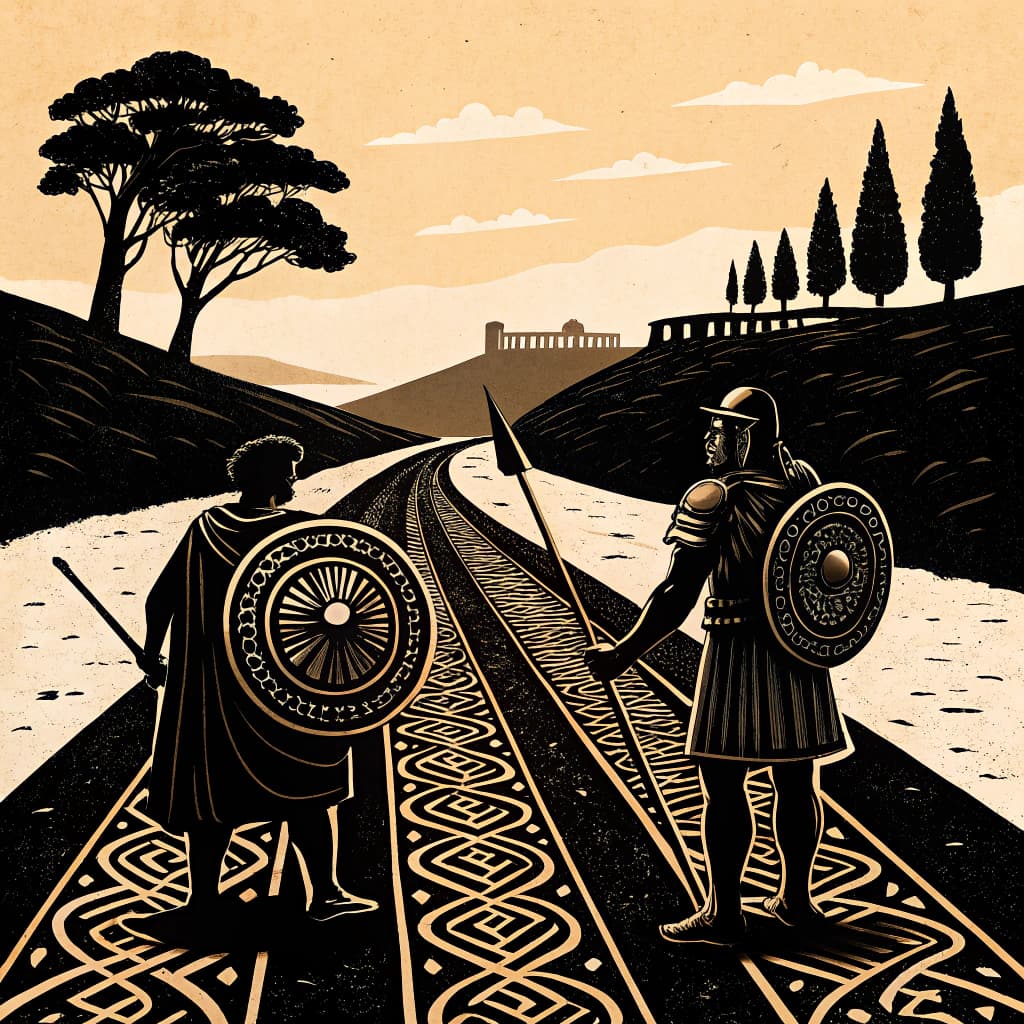
Social Classes: Patricians and Plebeians
Exploring the hierarchy of Roman society, including the roles of patricians, plebeians, and the enslaved.
About This Topic
Roman society rested on a strict hierarchy of social classes that determined rights, jobs, and influence. Patricians came from noble families, controlled the Senate, owned large farms worked by enslaved people, and passed power through birth. Plebeians formed the bulk of the population as farmers, shopkeepers, and laborers; they gained some rights through struggles like the creation of tribunes but still faced barriers to high office. Enslaved individuals, often war captives, had no freedoms and drove the economy through mining, farming, and household service. Women across classes managed homes and families, with rare public roles for elite patrician women.
This topic aligns with KS2 History standards on the Roman Empire's impact on Britain, where class systems shaped invaded communities. Students tackle key questions about how wealth and birth limited opportunities, women's household dominance contrasted with public exclusion, and slavery's essential economic role. These inquiries build skills in analyzing inequality and critiquing power dynamics, connecting ancient structures to modern ideas of fairness.
Active learning suits this topic perfectly. Role-plays of class interactions or sorting daily tasks by group make abstract hierarchies concrete. Students experience restrictions firsthand, sparking discussions that deepen empathy and retention.
Key Questions
- Analyze how wealth and birth determined rights and opportunities in Roman society.
- Explain the role of women in the Roman household and public life.
- Critique the Roman economy's dependence on enslaved people.
Learning Objectives
- Compare the rights and opportunities afforded to patricians versus plebeians in Roman society.
- Explain the economic and social functions of enslaved people within the Roman Empire.
- Analyze the constraints and responsibilities of women within Roman households and public life.
- Critique the influence of wealth and birth on social mobility in ancient Rome.
Before You Start
Why: Students need a basic understanding of what ancient civilizations are and their general characteristics before studying specific societies like Rome.
Why: Familiarity with terms like 'government', 'laws', and 'social groups' helps students grasp the structured nature of Roman society.
Key Vocabulary
| Patrician | A member of the wealthy, aristocratic families in ancient Rome who held most of the political power and social status. |
| Plebeian | A commoner in ancient Rome, belonging to the large group of ordinary citizens who were farmers, artisans, or merchants. |
| Enslaved Person | An individual who was owned by another person and had no legal rights or freedoms, performing labor essential to the Roman economy. |
| Tribune | An official elected by the plebeians to protect their rights and interests, holding the power to veto actions of magistrates. |
| Domus | The traditional Roman house, typically owned by wealthier citizens, managed by the domina (mistress of the house). |
Watch Out for These Misconceptions
Common MisconceptionPatricians and plebeians had equal opportunities.
What to Teach Instead
Birth locked patricians into elite roles while plebeians fought for basic representation. Role-play activities let students simulate barriers, like voting exclusions, helping them visualize and debate the real imbalances through peer negotiation.
Common MisconceptionEnslaved people were a small part of Roman life.
What to Teach Instead
Slavery powered the economy, with millions in forced labor. Hands-on timelines or economy models built in groups reveal this dependence, as students connect labor to empire growth and question its 'invisible' scale.
Common MisconceptionRoman women had no influence at all.
What to Teach Instead
Women ran households and advised husbands, though barred from politics. Household simulations in small groups highlight these powers, prompting discussions that correct oversimplifications with evidence from sources.
Active Learning Ideas
See all activities→Role Play
Role-Play: Roman Marketplace
Assign roles as patricians, plebeians, or enslaved workers. Groups set up a market stall: patricians buy goods, plebeians sell, enslaved carry loads. After 15 minutes, rotate roles and discuss how class affected actions and feelings.
Jigsaw
Class Profiles
Divide class into expert groups on patricians, plebeians, enslaved, or women. Each researches roles using sources, then mixes to teach others and complete a class comparison chart.
Role Play
Sorting Cards: Daily Duties
Provide cards with Roman jobs, rights, and homes. In pairs, students sort into class categories and justify choices, then share with class for feedback.
Real-World Connections
- Modern societies still grapple with social stratification, where factors like inherited wealth or family background can influence access to education and career paths, similar to how birth determined status in Rome.
- The concept of essential labor, where certain jobs are critical for a society's functioning but may be low paid or undervalued, echoes the reliance of the Roman economy on enslaved people for agriculture and construction.
- The historical role of women managing households and raising children, while often excluded from formal political power, is a pattern seen in many cultures and time periods, including parts of the modern world.
Assessment Ideas
Provide students with three scenarios: one describing a patrician's life, one a plebeian's, and one an enslaved person's. Ask them to write one sentence for each scenario explaining which social class it represents and why, based on the rights or limitations described.
Pose the question: 'If you were a Roman citizen in Year 4, would you rather be a patrician or a plebeian, and why?' Encourage students to justify their choice by referencing specific rights, opportunities, or challenges associated with each class.
Present students with a list of Roman occupations (e.g., senator, farmer, gladiator, household manager, shopkeeper). Ask them to sort these occupations into three categories: Patrician, Plebeian, or Enslaved Person, and briefly explain their reasoning for one choice.
Frequently Asked Questions
What were the main differences between patricians and plebeians?
How did slavery support the Roman economy?
What roles did women play in Roman society?
How can active learning help teach Roman social classes?
Planning templates for History
5E Model
The 5E Model structures lessons through five phases (Engage, Explore, Explain, Elaborate, and Evaluate), guiding students from curiosity to deep understanding through inquiry-based learning.
Unit PlannerThematic Unit
Organize a multi-week unit around a central theme or essential question that cuts across topics, texts, and disciplines, helping students see connections and build deeper understanding.
RubricSingle-Point Rubric
Build a single-point rubric that defines only the "meets standard" level, leaving space for teachers to document what exceeded and what fell short. Simple to create, easy for students to understand.
More in The Rise of the Roman Empire
The Legend of Romulus and Remus
Investigating the mythical origins of Rome and what the story tells us about Roman values.
3 methodologies
Early Roman Republic: Citizens and Government
Understanding the structure of the early Roman Republic, including the roles of citizens, consuls, and the Senate.
3 methodologies
The Might of the Roman Army
Examining the equipment, training, and tactics of the Roman Legionaries.
3 methodologies
Julius Caesar: General and Politician
Exploring the life and campaigns of Julius Caesar, focusing on his rise to power and impact on the Republic.
3 methodologies
From Republic to Empire: Augustus
Understanding the shift from Republic to Empire and how emperors like Augustus maintained control.
3 methodologies
Roman Engineering Marvels
Discovering how aqueducts, arches, and concrete allowed Rome to grow into a megacity.
3 methodologies