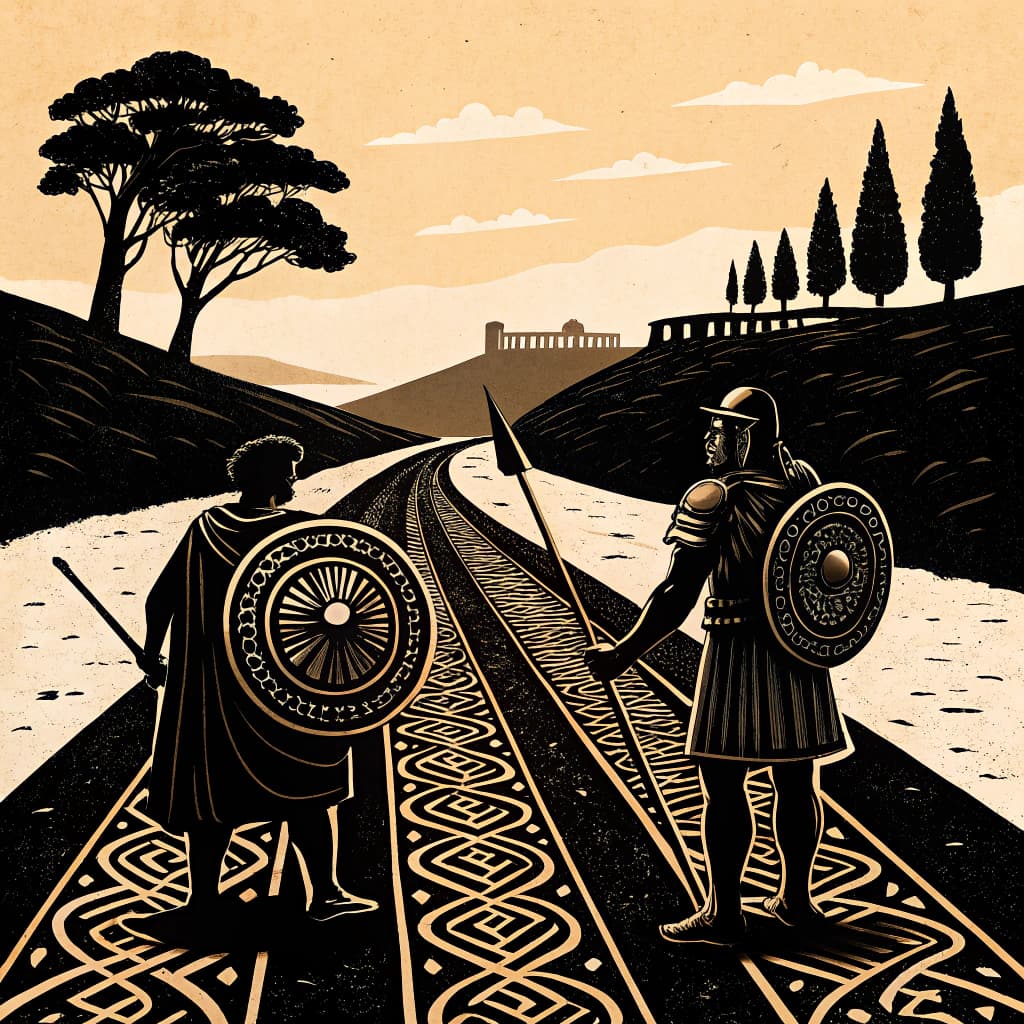
Julius Caesar: General and Politician
Exploring the life and campaigns of Julius Caesar, focusing on his rise to power and impact on the Republic.
TL;DR:Active learning helps students grasp Julius Caesar’s dual role as general and politician by letting them experience his campaigns and political struggles firsthand. Role-plays and debates make abstract historical events tangible, while mapping and timeline work build chronological reasoning skills critical for understanding cause and effect in history.
About This Topic
Julius Caesar's career as general and politician marks a turning point in Roman history, perfect for Year 4 students studying the Roman Empire's impact on Britain. They trace his Gallic Wars, which expanded Rome's territory and filled his coffers, and his dramatic crossing of the Rubicon in 49 BCE, sparking civil war against Pompey. These campaigns show how victories built his influence, leading to consulship, the First Triumvirate, and eventual dictatorship.
Students tackle key questions by weighing Caesar's achievements, like the Julian calendar and debt relief, against his power grabs, such as lifelong dictatorship. This sparks debates on hero versus tyrant and the risks of concentrated power in a republic. The topic builds skills in causation, source evaluation, and perspective-taking, linking to broader Roman changes that paved the way for empire and later invasions of Britain.
Active learning suits this topic well. Role-plays of Senate confrontations or group timeline builds make abstract power struggles concrete. Students internalize cause-and-effect through debates and mapping, while collaborative evidence sorting deepens understanding of historical complexity.
Key Questions
- Evaluate whether Julius Caesar was a hero or a tyrant for Rome.
- Explain how Caesar's military victories increased his political influence.
- Predict the consequences of one person gaining too much power in a Republic.
Learning Objectives
- Explain how Julius Caesar's military campaigns in Gaul contributed to his political power and popularity in Rome.
- Analyze primary source excerpts (e.g., Caesar's writings, senatorial records) to evaluate whether he acted as a hero or a tyrant.
- Compare and contrast the powers and responsibilities of a Roman Consul with those of a dictator.
- Synthesize information to construct an argument about the consequences of concentrated power in a republic, using Caesar's rise as an example.
Before You Start
Why: Students need a basic understanding of what ancient civilizations are and why we study them before focusing on a specific one like Rome.
Why: Understanding simple terms like 'leader' and 'rules' will help students grasp the concepts of Republic, Consul, and Dictator.
Key Vocabulary
| Republic | A form of government where power is held by the people and their elected representatives, rather than by a king or queen. Rome was a Republic before it became an Empire. |
| Consul | One of the two chief magistrates elected annually in the Roman Republic. They held executive power and commanded armies. |
| Dictator | In ancient Rome, a magistrate appointed during times of emergency with absolute power for a limited period, usually six months. Caesar was appointed dictator for life. |
| Gallic Wars | A series of military campaigns led by Julius Caesar between 58 and 50 BCE, resulting in the conquest of Gaul (modern-day France) by the Roman Republic. |
| Rubicon | A small river in northern Italy. Crossing it with an army was forbidden by Roman law, and Caesar's decision to cross it in 49 BCE marked the start of a civil war. |
Watch Out for These Misconceptions
Common MisconceptionJulius Caesar was the first Roman emperor.
What to Teach Instead
Caesar held the title of dictator for life but the empire began under his heir Augustus. Timeline activities help students sequence events accurately, while role-plays reveal Republic senators' opposition to monarchy, clarifying titles and transitions.
Common MisconceptionCaesar fully conquered Britain.
What to Teach Instead
Caesar's expeditions in 55-54 BCE were raids, not conquests; Claudius achieved that in 43 CE. Mapping campaigns distinguishes his actions from later invasions, and group discussions connect them to Rome's impact on Britain.
Common MisconceptionAll Romans admired Caesar equally.
What to Teach Instead
Opinions split between supporters of his reforms and republicans fearing tyranny. Evidence-sorting tasks in small groups expose divided sources, fostering nuanced views through peer debate.
Active Learning Ideas
See all activities→Formal Debate
Debate Pairs: Hero or Tyrant?
Provide evidence cards on Caesar's reforms and power grabs. Pairs prepare three arguments for one side, then switch partners to rebut. Conclude with whole-class vote and reflection on evidence strength.
Formal Debate
Campaign Mapping: Gaul and Beyond
Small groups receive outline maps of Europe. They plot Caesar's routes in Gaul, the Rubicon crossing, and Pharsalus battle, adding notes on political gains. Share maps in a gallery walk.
Formal Debate
Timeline Relay: Rise to Power
Pairs start personal timelines with five key events from Caesar's life. Relay strips to next pair to add details and links to influence. Assemble into class frieze for discussion.
Real-World Connections
- Historians and archaeologists, like those at the British Museum, study ancient texts and artifacts to understand figures like Caesar and the political systems they operated within. This helps us interpret historical events and their lasting impact.
- Modern political scientists analyze the balance of power in democracies, drawing parallels to historical situations like Caesar's rise to understand the potential dangers of unchecked executive authority and the importance of checks and balances.
- Military strategists still study Roman campaigns, including those of Caesar, to learn about tactics, logistics, and the relationship between military success and political influence.
Assessment Ideas
Pose the question: 'Was Julius Caesar a hero or a tyrant for Rome?' Ask students to share one piece of evidence from his campaigns or political actions that supports their view. Encourage them to listen to classmates with differing opinions and explain why they agree or disagree.
Students write two sentences on a slip of paper. The first sentence should explain one way Caesar's military victories helped him gain political power. The second sentence should describe one potential problem if a single person gained too much power in a country today.
Show students a short, simplified timeline of key events in Caesar's career (e.g., Consulship, Gallic Wars, crossing the Rubicon, Dictatorship). Ask them to point to two events and explain the cause-and-effect relationship between them using sentence starters like 'Because Caesar did ______, it led to ______.'
Frequently Asked Questions
How to teach Year 4 students if Julius Caesar was a hero or tyrant?
What activities show how Caesar's victories boosted his politics?
How does active learning help teach Julius Caesar?
Common misconceptions about Julius Caesar in KS2 history?
Planning templates for History
5E Model
The 5E Model structures lessons through five phases (Engage, Explore, Explain, Elaborate, and Evaluate), guiding students from curiosity to deep understanding through inquiry-based learning.
Unit PlannerThematic Unit
Organize a multi-week unit around a central theme or essential question that cuts across topics, texts, and disciplines, helping students see connections and build deeper understanding.
RubricSingle-Point Rubric
Build a single-point rubric that defines only the "meets standard" level, leaving space for teachers to document what exceeded and what fell short. Simple to create, easy for students to understand.
More in The Rise of the Roman Empire
The Legend of Romulus and Remus
Investigating the mythical origins of Rome and what the story tells us about Roman values.
8 methodologies
Early Roman Republic: Citizens and Government
Understanding the structure of the early Roman Republic, including the roles of citizens, consuls, and the Senate.
8 methodologies
The Might of the Roman Army
Examining the equipment, training, and tactics of the Roman Legionaries.
8 methodologies
From Republic to Empire: Augustus
Understanding the shift from Republic to Empire and how emperors like Augustus maintained control.
8 methodologies
Roman Engineering Marvels
Discovering how aqueducts, arches, and concrete allowed Rome to grow into a megacity.
8 methodologies
Social Classes: Patricians and Plebeians
Exploring the hierarchy of Roman society, including the roles of patricians, plebeians, and the enslaved.
8 methodologies