The Gulf War (1990-91) & British Involvement
Students will examine the Supreme Court's Milliken v. Bradley decision, analyzing how it limited the scope of desegregation efforts to individual school districts.
TL;DR:This topic involves complex legal and ethical arguments that benefit from active debate and structured analysis. Students engage with primary sources and role-playing to see how historical decisions were shaped by competing priorities, making abstract concepts tangible and memorable.
About This Topic
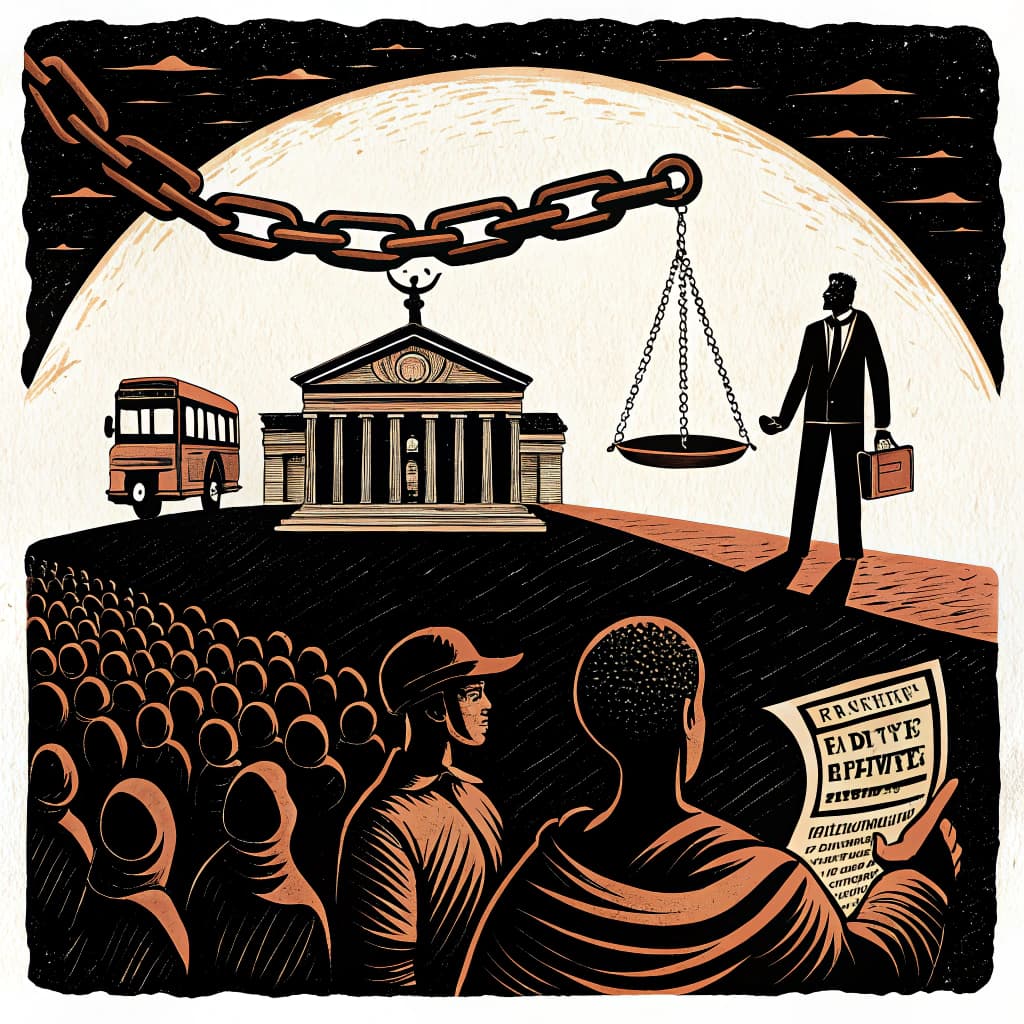
This topic evaluates the legal and social debates surrounding affirmative action, focusing on the landmark Regents of the University of California v. Bakke (1978) case. Students examine how the concept of 'reverse discrimination' emerged as a powerful political force and how the Supreme Court attempted to balance the goal of diversity with the rights of the individual. The study also covers the expansion of affirmative action in the 1970s and the growing conservative backlash against 'quotas'.
At Year 13, students analyse the impact of affirmative action on the growth of the Black middle class and the internal debates within the African American community about its effectiveness. They consider how the debate intensified during the Reagan era and the shift toward 'colourblind' policies. This topic is best taught through mock trials of the Bakke case and by debating the merits of 'equity' vs. 'equality' in a historically unequal society.
Key Questions
- Analyze the strategic, diplomatic, and moral factors that led Britain to join the US-led coalition in the Gulf War of 1990–91.
- Explain how British involvement in the Gulf War reinforced and redefined the 'special relationship' with the United States.
- Evaluate the long-term consequences of the Gulf War for British foreign policy and its willingness to engage in future military interventions.
Learning Objectives
- Analyze the strategic, diplomatic, and moral justifications presented by the British government for its participation in the 1990-91 Gulf War.
- Explain how the Gulf War influenced the nature and perception of the 'special relationship' between the United Kingdom and the United States.
- Evaluate the lasting impact of the Gulf War on British defense policy and its approach to international military alliances.
- Compare the stated objectives of the coalition in the Gulf War with the actual outcomes for regional stability.
- Critique the ethical considerations surrounding the decision to intervene militarily in the Persian Gulf region.
Before You Start
Why: Understanding the post-Cold War geopolitical landscape is essential for grasping the context of the Gulf War and shifts in international relations.
Why: Knowledge of Britain's evolving role in international affairs and its relationship with the US provides a foundation for analyzing the 'special relationship' during the Gulf War.
Key Vocabulary
| Coalition | An alliance of countries formed for a specific purpose, in this case, to counter Iraq's invasion of Kuwait. |
| Sovereignty | The supreme authority of a state within its own territory, which was a key issue in Iraq's invasion of Kuwait. |
| Realpolitik | A foreign policy based on practical considerations of national interest rather than ideological concerns, often influencing decisions about military intervention. |
| UN Security Council Resolutions | Formal decisions passed by the United Nations Security Council, which provided the legal framework for international action against Iraq. |
| Special Relationship | The historically close political, cultural, and diplomatic ties between the United Kingdom and the United States. |
Watch Out for These Misconceptions
Common MisconceptionAffirmative action means that unqualified people are given jobs or university places.
What to Teach Instead
In most cases, it involves choosing between qualified candidates while considering race as one of many factors to promote diversity. Peer discussion of the 'plus factor' approach helps students understand the nuance of the policy.
Common MisconceptionThe Bakke case ended affirmative action.
What to Teach Instead
The Court actually upheld the use of race as a factor in admissions, while banning the use of rigid racial quotas. Using a station rotation to look at subsequent cases like Grutter v. Bollinger helps students see the ongoing legal evolution of the policy.
Active Learning Ideas
See all activities→Mock Trial
Bakke v. University of California
Students act as lawyers for Allan Bakke and the University. They must argue whether the use of a specific racial quota for medical school admissions violated the 14th Amendment's equal protection clause, focusing on the distinction between 'quotas' and 'goals'.
Think-Pair-Share
Equity vs. Equality
Students look at the famous illustration of people of different heights trying to see over a fence. They discuss in pairs how this visual represents the difference between 'equality' (giving everyone the same) and 'equity' (giving everyone what they need to succeed) in the context of affirmative action.
Inquiry Circle
The Impact on the Black Middle Class
Groups research data on Black college enrollment and professional employment from 1960 to 1990. They present on the extent to which affirmative action contributed to the significant growth of the Black middle class during this period.
Real-World Connections
- The decision-making process mirrors that of contemporary international crises, such as the debates surrounding intervention in Syria or the response to Russian actions in Ukraine, requiring analysis of geopolitical alliances and national interests.
- The role of international law and organizations like the UN Security Council in authorizing military action remains a critical aspect of modern diplomacy, influencing how nations respond to aggression and territorial disputes.
- The concept of the 'special relationship' continues to shape foreign policy discussions, impacting trade agreements, intelligence sharing, and joint military operations between the UK and the US.
Assessment Ideas
Facilitate a class debate using the prompt: 'Was British involvement in the Gulf War primarily driven by strategic necessity, diplomatic obligation, or moral imperative?'. Ask students to cite specific historical evidence to support their arguments, referencing key speeches or policy documents from the period.
Provide students with a short primary source document, such as a parliamentary speech or a newspaper editorial from 1990-91, related to the Gulf War. Ask them to identify the author's main argument and list two pieces of evidence they use to support it.
Students write a brief paragraph evaluating the impact of the Gulf War on the UK-US 'special relationship'. They then exchange paragraphs with a partner and assess: Does the paragraph clearly state an evaluation? Are specific examples provided to support the claim? Partners provide one sentence of constructive feedback.
Frequently Asked Questions
What was the Bakke case about?
What did the Supreme Court decide in Bakke?
Why did affirmative action become so controversial in the 1980s?
How can active learning help students understand affirmative action?
Planning templates for History
5E Model
The 5E Model structures lessons through five phases (Engage, Explore, Explain, Elaborate, and Evaluate), guiding students from curiosity to deep understanding through inquiry-based learning.
Unit PlannerThematic Unit
Organize a multi-week unit around a central theme or essential question that cuts across topics, texts, and disciplines, helping students see connections and build deeper understanding.
RubricSingle-Point Rubric
Build a single-point rubric that defines only the "meets standard" level, leaving space for teachers to document what exceeded and what fell short. Simple to create, easy for students to understand.
More in New Labour and Constitutional Change 1990–2000
End of the Cold War & Britain's Role
Students will analyze the attempt to desegregate schools through court-ordered busing and the fierce white resistance it provoked, particularly in Boston.
8 methodologies
Maastricht Treaty & European Integration
Students will evaluate the legal and social debates surrounding 'reverse discrimination' and racial quotas, focusing on the landmark Bakke Supreme Court case.
8 methodologies
Rise of New Labour and Tony Blair
Students will examine how the debate over affirmative action intensified during the Reagan era, reflecting a broader conservative shift in American politics.
8 methodologies
Good Friday Agreement (1998)
Students will assess the impact of the 1980s conservative shift on civil rights enforcement, social programs, and the concept of 'colourblindness' in policy.
8 methodologies
Devolution in the UK: Scotland & Wales
Students will investigate the significance of the 1982 extension of the Voting Rights Act, analyzing the political struggle to preserve this landmark legislation.
8 methodologies
Devolution in Northern Ireland
Students will examine the specific challenges and processes of devolution in Northern Ireland, focusing on power-sharing arrangements and the legacy of the Troubles.
8 methodologies