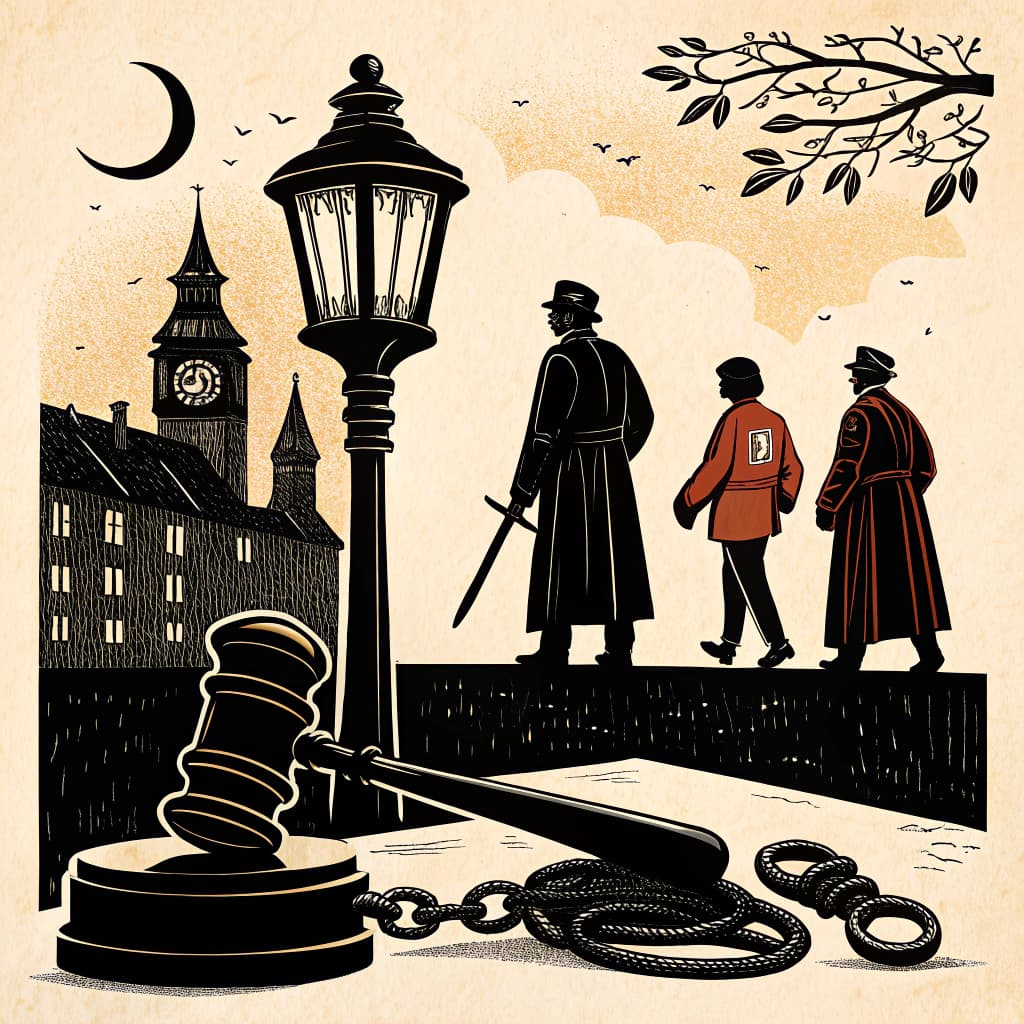
Robert Peel & 1829 Metropolitan Police Act
The establishment of the Metropolitan Police and the 'Peelian Principles'.
TL;DR:Active learning builds empathy and critical thinking for this topic by letting students experience the tensions of 1829 London. When students analyze Peel’s principles through role-play or station work, they connect abstract ideas to human choices, making the shift from watchmen to Bobbies real and memorable.
About This Topic
Robert Peel, as Home Secretary, introduced the 1829 Metropolitan Police Act, creating a professional police force for London. This replaced inefficient watchmen and parish constables with 3,200 'Bobbies,' uniformed officers focused on prevention rather than detection. The nine Peelian Principles emphasised policing by consent, public approval as the sole authority, and minimum force, marking a shift from militaristic models.
This topic fits GCSE History units on Crime and Punishment through Time and Industrial Britain, as 1829 stands as a turning point. It addressed rising urban crime amid industrialisation, fostering public trust through visible patrols and impartiality. Students analyse how these principles influenced modern UK policing, evaluating successes like crime reduction against initial resistance, including nicknames like 'Blue Devils.'
Active learning suits this topic well. Students engage deeply through role-plays of public-police interactions or debates on principle effectiveness, making abstract ideas concrete. Collaborative source evaluations reveal nuances in historical attitudes, building skills in analysis and empathy essential for GCSE assessments.
Key Questions
- Explain why 1829 was a turning point in British history.
- Analyze the Peelian Principles of policing by consent.
- Evaluate how the 'Bobbies' gained the trust of the public.
Learning Objectives
- Analyze the social and economic conditions in early 19th-century London that necessitated the creation of the Metropolitan Police.
- Evaluate the effectiveness of the Peelian Principles in establishing public trust and legitimacy for a new police force.
- Compare the methods of law enforcement before and after the 1829 Metropolitan Police Act, identifying key differences in approach and personnel.
- Explain the long-term impact of the Peelian Principles on the development of modern policing in the United Kingdom.
Before You Start
Why: Understanding the existing fragmented and often ineffective methods of law enforcement before 1829 is crucial for appreciating the significance of the Metropolitan Police Act.
Why: Students need to grasp the social changes and increased crime associated with industrial growth to understand the context and need for a new police force.
Key Vocabulary
| Metropolitan Police Act 1829 | The legislation that established a unified, professional police force for London, replacing older, fragmented systems of watchmen and constables. |
| Peelian Principles | A set of nine principles drafted by Robert Peel, emphasizing policing by consent, public cooperation, and the use of minimum force. |
| Policing by Consent | The idea that police legitimacy and effectiveness depend on the approval and cooperation of the public they serve. |
| Parish Constable | An unpaid local official, often elected or appointed, responsible for law enforcement within a specific parish before the advent of professional police forces. |
Watch Out for These Misconceptions
Common MisconceptionThe Metropolitan Police were immediately popular and trusted.
What to Teach Instead
Initial public suspicion led to mockery as 'Raw Lobsters.' Active role-plays help students experience resistance, comparing sources to see gradual trust via consistent patrols. Discussions reveal how principles addressed fears over time.
Common MisconceptionPeelian Principles focused mainly on catching criminals.
What to Teach Instead
They prioritised prevention and consent, not detection. Source analysis stations let students contrast principles with old systems, clarifying shifts. Peer teaching reinforces prevention's role in crime drops.
Common MisconceptionBobbies were armed like soldiers.
What to Teach Instead
They carried only truncheons, stressing minimum force. Debates on principle application show civilian nature; students evaluate via mock patrols, building understanding of consent-based authority.
Active Learning Ideas
See all activities→Stations Rotation
Peelian Principles Analysis
Set up stations with sources: Principle 1 (public approval), patrols, uniforms, and public reactions. Groups spend 8 minutes per station, extracting evidence and noting challenges. Conclude with whole-class share-out to identify patterns.
Socratic Seminar
Role-Play: Bobby vs Public Debate
Assign roles as 1829 Londoners (shopkeepers, workers) and Bobbies. Groups prepare arguments for/against the new force using principles. Perform short debates, then vote on trust-building effectiveness with peer feedback.
Socratic Seminar
Timeline Build: Turning Point Evidence
Provide cards with pre-1829 policing events, Act details, and post-1829 outcomes. Pairs sequence them on a class timeline, annotating why 1829 marks change. Discuss as whole class.
Real-World Connections
- Modern police forces across the UK, such as the Metropolitan Police Service or Police Scotland, still operate under principles derived from Peel's original ideas, focusing on community engagement and accountability.
- The concept of 'community policing' practiced today, where officers build relationships with residents in specific neighborhoods, directly reflects the Peelian emphasis on public approval and cooperation.
- The uniform and visible presence of police officers on patrol in towns and cities is a direct legacy of the 'Bobbies' and their role in deterring crime and reassuring the public.
Assessment Ideas
Pose the question: 'Imagine you are a London resident in 1830. Would you trust the new 'Bobbies' or prefer the old system? Why?' Encourage students to reference specific Peelian Principles or historical accounts of public reaction in their responses.
Provide students with a list of historical policing methods and modern policing practices. Ask them to sort these into two columns: 'Pre-1829' and 'Post-1829/Peelian Influence.' Discuss any items that are difficult to categorize and why.
Ask students to write down one Peelian Principle and explain in their own words why it was considered revolutionary for its time. Then, have them identify one modern policing challenge that relates to this principle.
Frequently Asked Questions
What were the key Peelian Principles of 1829?
Why was 1829 a turning point in British policing history?
How did the Bobbies gain public trust after 1829?
How can active learning teach the 1829 Metropolitan Police Act?
Planning templates for History
5E Model
The 5E Model structures lessons through five phases (Engage, Explore, Explain, Elaborate, and Evaluate), guiding students from curiosity to deep understanding through inquiry-based learning.
Unit PlannerThematic Unit
Organize a multi-week unit around a central theme or essential question that cuts across topics, texts, and disciplines, helping students see connections and build deeper understanding.
RubricSingle-Point Rubric
Build a single-point rubric that defines only the "meets standard" level, leaving space for teachers to document what exceeded and what fell short. Simple to create, easy for students to understand.
More in Early Modern Challenges: 1500–1700
Heresy and Treason: Tudor Religious Changes
How religious changes under the Tudors made belief a criminal offence.
8 methodologies
The Vagrancy Crisis: Criminalising the Poor
The criminalisation of the 'unworthy poor' and the 1547 Vagrancy Act.
8 methodologies
Smuggling: A Social Crime
Why crimes like smuggling were supported by local communities despite being illegal.
8 methodologies
The Witchcraft Craze: Matthew Hopkins
Investigating the peak of witch trials and the role of Matthew Hopkins.
8 methodologies
The Bloody Code: Expansion of Capital Crimes
The expansion of the death penalty to over 200 offences.
8 methodologies
Gunpowder Plot: Political Crime & Response
A case study of the 1605 plot and the harsh response to Catholic dissent.
8 methodologies