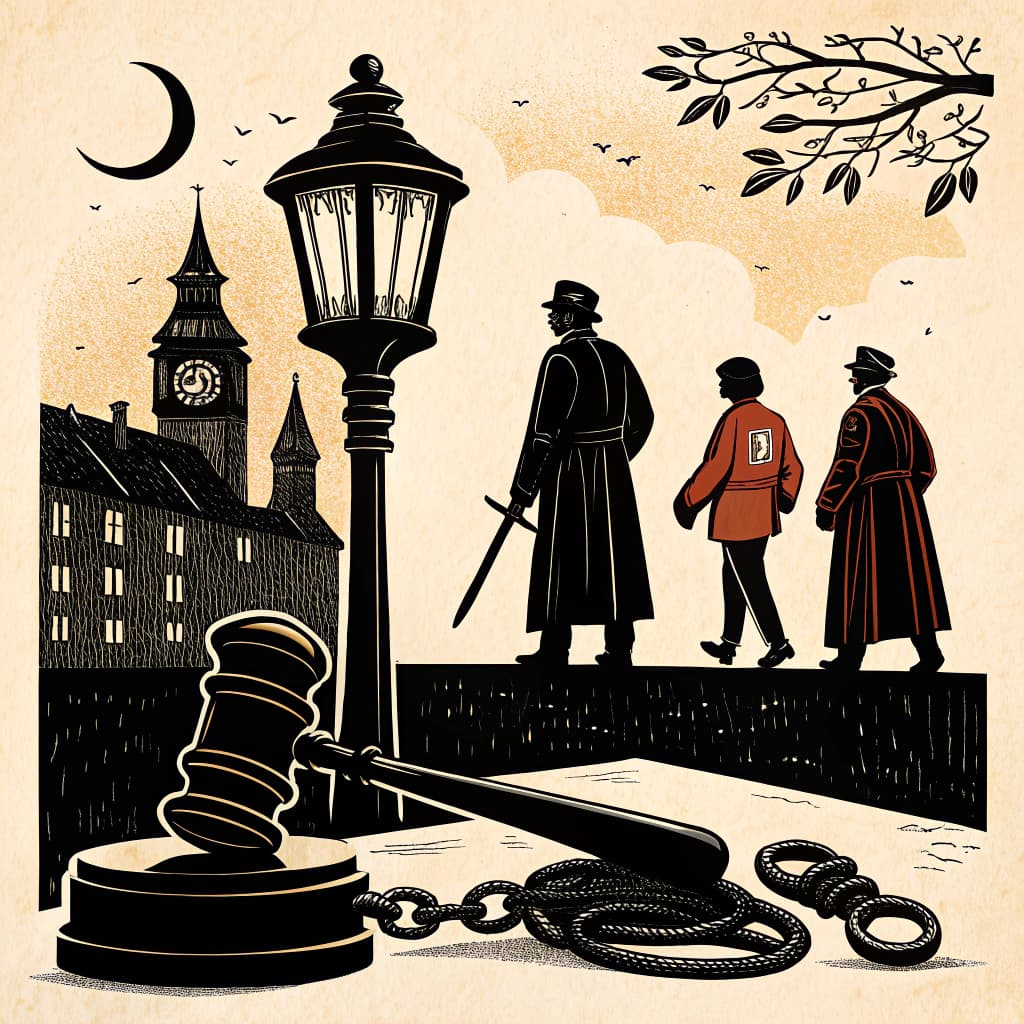
The Bloody Code: Expansion of Capital Crimes
The expansion of the death penalty to over 200 offences.
TL;DR:Active learning helps students grasp the human impact behind the Bloody Code’s dry statistics. When students simulate jury decisions or debate pardons, they confront the contradictions in the system's severity versus its actual application. This makes the topic’s complexities memorable and relevant.
About This Topic
The 'Bloody Code' refers to the period between the late 17th and early 19th centuries when the number of crimes carrying the death penalty rose to over 200. Surprisingly, this included minor offences like 'stealing a rabbit' or 'being in the company of gypsies'. This topic explores why the government turned to such extreme deterrence and how the system of 'royal pardons' actually meant that many people escaped the gallows.
Students will investigate the paradox of the Bloody Code: as the laws became harsher, juries became more reluctant to convict. This is a vital lesson in the effectiveness of punishment versus the reality of enforcement. Active learning through a 'Pardon Simulation' helps students understand the complex negotiations that took place behind the scenes of the 'theatre of the law'.
Key Questions
- Explain why the number of capital crimes increased as the 18th century approached.
- Evaluate if the Bloody Code was an effective deterrent.
- Analyze how the 'Pardon' system mitigated the severity of the law.
Learning Objectives
- Analyze the social and economic factors that led to the expansion of capital crimes in England between 1500 and 1700.
- Evaluate the effectiveness of the Bloody Code as a deterrent against crime, using historical evidence.
- Explain the function and impact of the royal pardon system in mitigating the harshness of capital punishment.
- Compare the stated aims of the Bloody Code with its practical application and outcomes.
Before You Start
Why: Students need a foundational understanding of earlier legal systems and punishments to analyze the changes and continuities leading to the Bloody Code.
Why: Understanding the social structures and attitudes of the period helps explain the motivations behind harsher laws and their selective application.
Key Vocabulary
| Bloody Code | A period in English legal history when the number of crimes punishable by death increased significantly, reaching over 200 by the late 18th century. |
| Capital crime | A crime that is punishable by death. |
| Transportation | A form of punishment where convicted criminals were sent to penal colonies, often in North America or Australia, as an alternative to execution. |
| Royal Pardon | An official act of forgiveness by the monarch, which could commute a death sentence to another punishment, such as transportation or imprisonment. |
| Felony | A serious crime, typically one involving violence, for which the offender can be punished by imprisonment for more than one year or by death. |
Watch Out for These Misconceptions
Common MisconceptionEveryone who committed a capital crime was hanged.
What to Teach Instead
In reality, execution rates actually dropped as the number of capital crimes rose. Juries often 'undervalued' stolen goods to save the accused. A simulation of jury deliberations helps students see this 'pious perjury' in action.
Common MisconceptionThe Bloody Code was effective at stopping crime.
What to Teach Instead
Crime continued to rise because people didn't believe they would actually be caught or executed. Peer discussion helps students understand the difference between 'harshness' and 'certainty' of punishment.
Active Learning Ideas
See all activities→Simulation Game
The Pardon Game
Students are given 10 'convicts' on death row for minor crimes. They have only 3 'pardons' to give out. They must debate which criminals deserve to live based on character references and the nature of the crime.
Inquiry Circle
The List of 200
Provide a list of capital offences. Students must categorise them (e.g., property, person, state) and identify the 'most ridiculous' one, discussing why property was valued so highly.
Think-Pair-Share
Does it Deter?
Students discuss whether they would be more or less likely to steal if the punishment was death. They then consider why crime rates actually went up during this period.
Real-World Connections
- Historians specializing in legal history, such as those at the National Archives, analyze surviving court records and legislation to understand the evolution of criminal law and its societal impact.
- Legal scholars and criminologists today study historical patterns of punishment, like the Bloody Code, to inform contemporary debates on sentencing, deterrence, and the justice system's fairness.
Assessment Ideas
Pose the question: 'Was the Bloody Code a success or failure in its aims?' Ask students to take a stance and support it with at least two specific examples of crimes, punishments, or pardon outcomes discussed in class. Encourage them to consider different perspectives, such as those of the accused, the judges, and the general public.
Provide students with a short case study of a person convicted under the Bloody Code, detailing their crime and sentence. Ask them to write a paragraph explaining whether they think this individual would have been executed, transported, or pardoned, and why. This checks their understanding of the pardon system's variability.
On an index card, have students write one reason why the number of capital crimes increased and one way the pardon system acted as a 'safety valve' for the legal system.
Frequently Asked Questions
Why did the number of capital crimes increase?
What was 'pious perjury'?
How did the pardon system work?
How can active learning help students understand the Bloody Code?
Planning templates for History
5E Model
The 5E Model structures lessons through five phases (Engage, Explore, Explain, Elaborate, and Evaluate), guiding students from curiosity to deep understanding through inquiry-based learning.
Unit PlannerThematic Unit
Organize a multi-week unit around a central theme or essential question that cuts across topics, texts, and disciplines, helping students see connections and build deeper understanding.
RubricSingle-Point Rubric
Build a single-point rubric that defines only the "meets standard" level, leaving space for teachers to document what exceeded and what fell short. Simple to create, easy for students to understand.
More in Early Modern Challenges: 1500–1700
Heresy and Treason: Tudor Religious Changes
How religious changes under the Tudors made belief a criminal offence.
8 methodologies
The Vagrancy Crisis: Criminalising the Poor
The criminalisation of the 'unworthy poor' and the 1547 Vagrancy Act.
8 methodologies
Smuggling: A Social Crime
Why crimes like smuggling were supported by local communities despite being illegal.
8 methodologies
The Witchcraft Craze: Matthew Hopkins
Investigating the peak of witch trials and the role of Matthew Hopkins.
8 methodologies
Gunpowder Plot: Political Crime & Response
A case study of the 1605 plot and the harsh response to Catholic dissent.
8 methodologies
Fielding Brothers & Bow Street Runners
The first attempts at a professional detective force in London.
8 methodologies