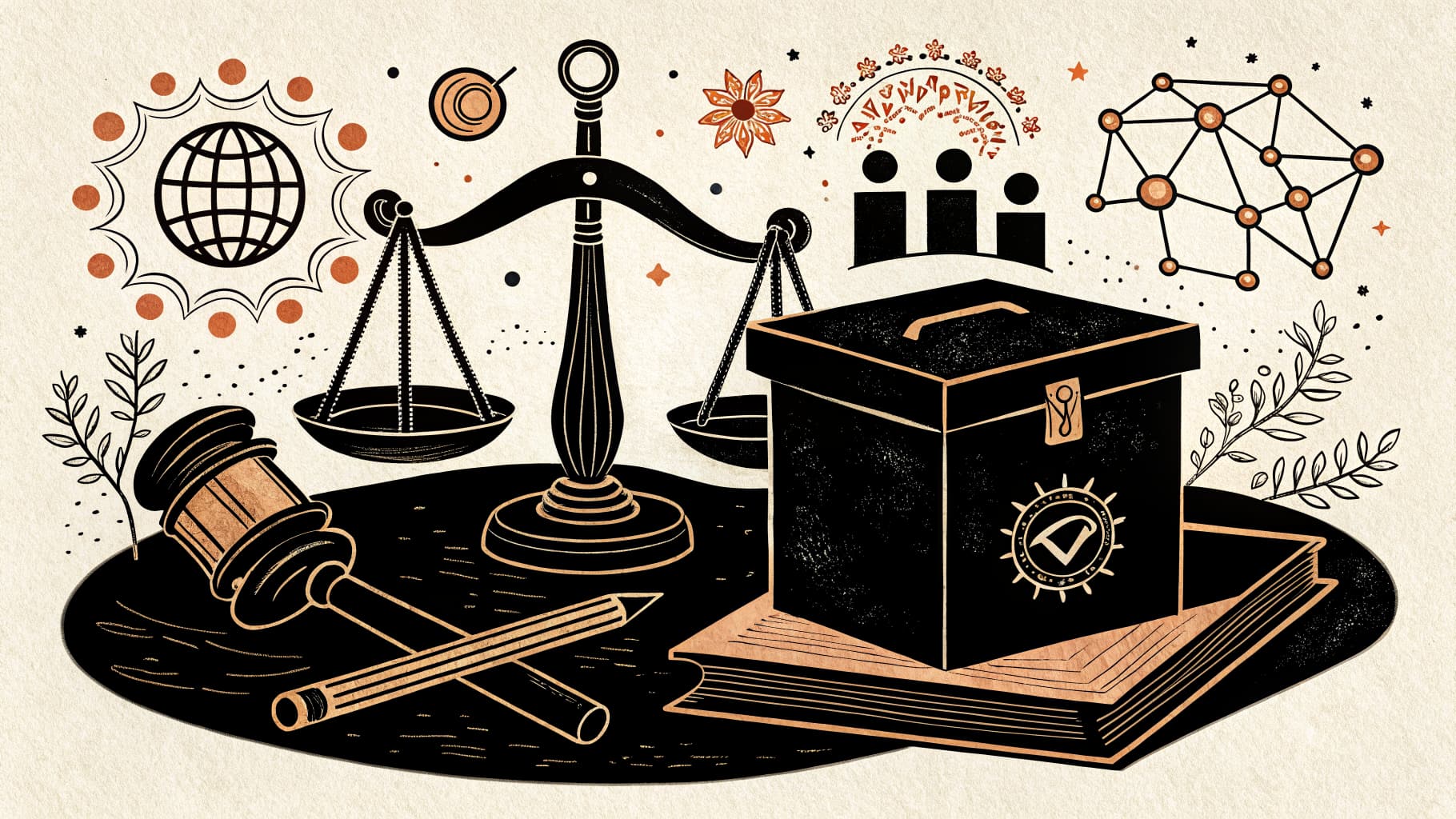
Different Jobs in Government
Identifying that different parts of government have different jobs, such as making laws, putting laws into action, and making sure laws are fair, without using the term 'separation of powers'.
TL;DR:Active learning works for this topic because government roles are abstract and interconnected. Hands-on simulations and sorting tasks make invisible processes visible, helping students grasp how each job contributes to stable governance rather than memorizing titles alone.
About This Topic
The topic Different Jobs in Government helps Year 5 students identify key roles in Australia's parliamentary system. They recognize that Parliament creates laws through debate and voting, the executive branch, led by the Prime Minister and public servants, puts those laws into practice, and courts check that laws are applied fairly. This aligns with AC9HASS5K01 and addresses key questions about differentiating roles, explaining the benefits of specialization, and assessing contributions to national stability.
Within the Civics and Citizenship strand of the Australian Curriculum, this content lays groundwork for understanding democratic processes. Students connect these jobs to everyday examples, such as road rules moving from parliamentary approval to police enforcement and court reviews. Specialization ensures efficiency, accountability, and fairness, skills that encourage informed citizenship.
Active learning benefits this topic through interactive simulations that make roles concrete. When students role-play as parliamentarians drafting a bill, executives implementing it, or judges evaluating it, they grasp interdependencies firsthand. Collaborative tasks build empathy for diverse perspectives and strengthen recall of how these jobs keep Australia running smoothly.
Key Questions
- Differentiate some different jobs that people in government do.
- Explain why it is a good idea for different people to have different jobs in government.
- Assess how these different jobs help our country run smoothly.
Learning Objectives
- Identify the primary functions of the legislative, executive, and judicial branches of the Australian government.
- Explain how the roles of parliamentarians, public servants, and judges differ in the law-making and application process.
- Compare the responsibilities of individuals involved in creating laws versus those who implement or review them.
- Analyze the importance of distinct governmental roles for the fair and efficient operation of Australia.
Before You Start
Why: Students need a basic understanding of what government is and its purpose in society before learning about its different functions.
Why: Familiarity with different roles and responsibilities within a community helps students understand specialized jobs within the larger government structure.
Key Vocabulary
| Parliament | The group of elected representatives who debate and make laws for Australia. This includes the House of Representatives and the Senate. |
| Executive | The part of government, led by the Prime Minister and Ministers, that puts laws made by Parliament into action. It includes government departments and public servants. |
| Courts | The places where judges make decisions about laws and settle disputes, ensuring laws are applied fairly. The High Court is the highest court in Australia. |
| Law-making | The process by which Parliament debates, amends, and votes on proposed laws, called bills, before they become official. |
| Implementing laws | The work done by the executive government and public servants to put laws into practice and manage government services. |
| Ensuring laws are fair | The role of the courts in interpreting laws and making sure they are applied correctly and justly to all people. |
Watch Out for These Misconceptions
Common MisconceptionThe Prime Minister makes and enforces all laws alone.
What to Teach Instead
The Prime Minister leads the executive to enact laws created by Parliament. Role-play simulations let students experience the distinct steps, clarifying limits through peer feedback and reflection.
Common MisconceptionCourts create new laws when problems arise.
What to Teach Instead
Courts interpret existing laws to ensure fair application. Card sorting activities help students categorize jobs accurately, with discussions revealing how interpretation differs from creation.
Common MisconceptionAll government workers do the same job.
What to Teach Instead
Roles divide tasks for efficiency. Flowchart building in pairs highlights connections and specializations, reducing oversimplification through visual mapping and group critique.
Active Learning Ideas
See all activities→Concept Mapping
Role-Play: Law Journey Simulation
Divide class into three groups: Parliament (debate and vote on a new school rule), Executive (plan how to enforce it), Judiciary (review for fairness). Groups present to whole class, then switch roles. End with reflection on why each job matters.
Concept Mapping
Card Sort: Job Matching
Prepare cards listing jobs like 'vote on bills' or 'interpret laws.' Students sort into Parliament, Executive, or Courts categories, then justify choices in pairs. Discuss as class and create a shared poster.
Concept Mapping
Flowchart Build: Government Process
Provide flowchart templates. In pairs, students sequence steps from law idea to enforcement, labeling roles. Share and compare flowcharts, noting checks between jobs.
Real-World Connections
- When a new road safety law is passed by the Australian Parliament, police officers (part of the executive) enforce it, and if there's a dispute, a magistrate in a local court (judicial) might hear the case.
- The Department of Health, a part of the executive government, uses laws made by Parliament to manage Medicare services and public health campaigns across the country.
- A judge in the Federal Court might review a decision made by a government agency to ensure it followed the correct procedures and applied the relevant laws fairly.
Assessment Ideas
Provide students with three scenarios: 1) A new law about recycling is proposed. 2) A council is building a new park. 3) Someone disagrees with a parking fine. Ask students to write which part of government (Parliament, Executive, or Courts) is most involved in each scenario and why.
Display images representing Parliament House, a government office building, and a courthouse. Ask students to label each image with the corresponding branch of government and briefly describe one job that happens there.
Pose the question: 'Imagine if only one group of people made all the laws, carried them out, and decided if they were fair. What problems might happen?' Guide students to discuss the benefits of having different roles.
Frequently Asked Questions
What are the main jobs of different parts of Australian government?
Why is it good for government to have different jobs?
How can active learning help students understand different jobs in government?
How to explain government roles to Year 5 without complex terms?
More in The Democratic Engine: How Australia Governs
Federal Government: Powers & Responsibilities
Distinguishing the specific responsibilities of the federal government to citizens, such as defence and national laws.
8 methodologies
State & Territory Governments: Local Impact
Investigating the roles of state and territory governments in areas like education, health, and transport.
8 methodologies
Local Councils: Community Governance
Examining the functions of local councils in managing community services, parks, and local infrastructure.
8 methodologies
The Australian Constitution: Structure & Purpose
Analyzing the Australian Constitution as the foundational document that governs the government, focusing on its key sections.
8 methodologies
Changing the Constitution: Referendums
Investigating the process of changing the Australian Constitution through a referendum and historical examples.
8 methodologies
The Governor-General's Role
Understanding the symbolic and constitutional role of the Governor-General in Australia's parliamentary system.
8 methodologies