How to Write a Lesson Plan: A 7-Step Guide for Teachers
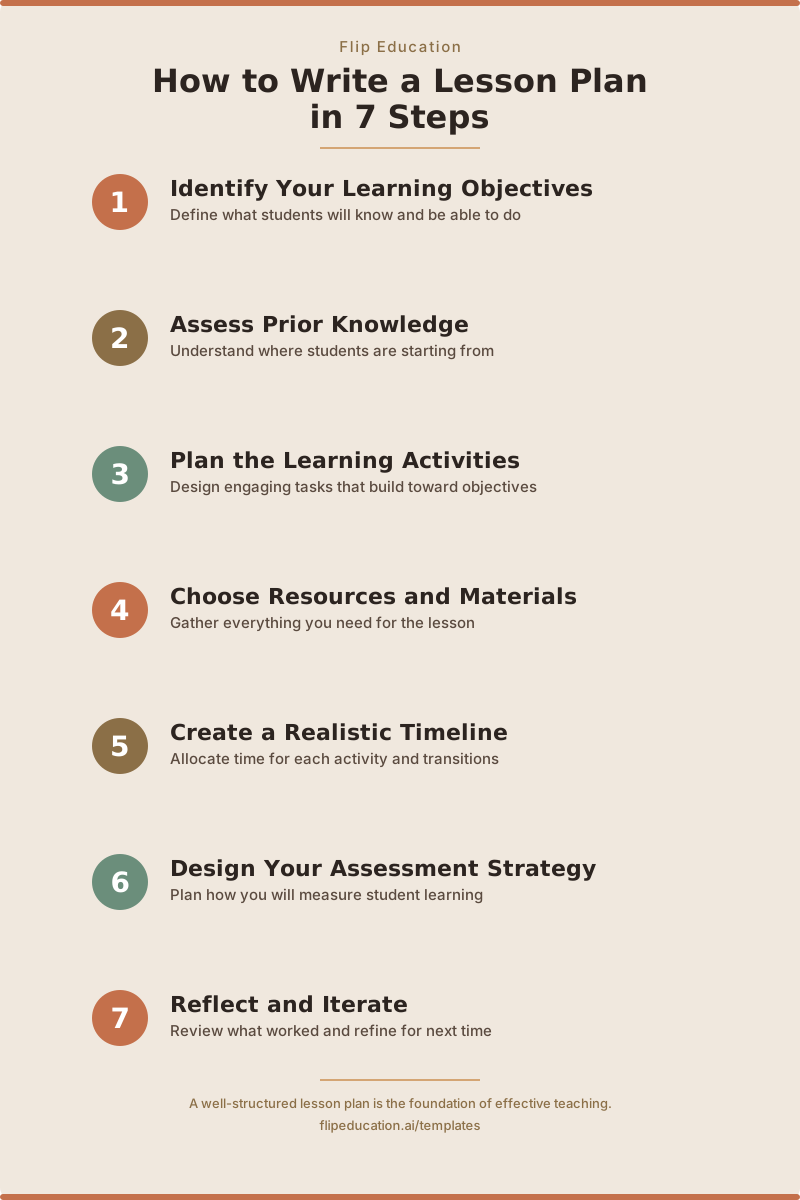
- Identify your learning objectives
- Assess your students' prior knowledge
- Plan the learning activities
- Choose your resources and materials
- Create a realistic timeline
- Design your assessment strategy
- Reflect and iterate after the lesson
Whether you're a first-year teacher or a veteran looking to sharpen your practice, knowing how to write a lesson plan is one of the most practical skills you can build. A strong plan doesn't just organize your class period; it connects every activity, question, and resource back to what students actually need to learn. This guide walks through each step with concrete examples you can apply tomorrow.
1. Identify your learning objectives
Learning objectives are the foundation of any effective lesson plan. They describe exactly what students should be able to do, know, or understand by the end of the period. Without them, activities become untethered from purpose and assessment becomes guesswork.
Effective objectives are SMART: specific, measurable, achievable, relevant, and time-bound. A vague goal like "students will understand fractions" gives you nothing to measure. A precise one like "students will convert three improper fractions to mixed numbers with 80% accuracy" tells you exactly what success looks like.
Practical Example: In a 5th-grade Social Studies unit on the American Revolution, an objective might be: "Students will be able to list three primary causes of the Boston Tea Party and explain their impact on colonial relations with Britain."
View our Grade 5 Social Studies curriculum guide for more objective examples across units.
2. Assess your students' prior knowledge
Understanding what your students already know prevents two common problems: boring the students who are ready to move on, and losing the students who lack prerequisite skills. A quick pre-assessment takes five minutes and saves you from discovering mid-lesson that half the class can't follow along.
This step also surfaces misconceptions. Students often arrive with confident but incorrect mental models, especially in science and math. Identifying these early lets you address them directly rather than layering new content on top of a shaky foundation.
Practical Example: Before starting a high school chemistry lesson on stoichiometry, use a five-question digital poll to check whether students remember how to balance chemical equations. If fewer than 70% get the basics right, spend the first ten minutes reviewing before moving forward.
Research on formative pre-assessment consistently shows significant gains when teachers adjust instruction based on what students already know.
3. Plan the learning activities
Active learning activities are the engine of your lesson. They're where students engage with the content rather than passively absorbing it. The key is selecting activities that directly serve your learning objectives while keeping students doing the thinking, not just listening.
Mix your methods. A lesson built entirely on lecture loses student attention after 10-15 minutes. Alternating between direct instruction, collaborative tasks, and individual practice keeps energy high and gives every type of learner a way into the material. Think-pair-share, jigsaw groups, hands-on experiments, case studies, and structured debates all have their place depending on the objective.
Practical Example: For a middle school English lesson on persuasive writing, have students participate in a "Four Corners" debate where they take physical stands on a topic (strongly agree, agree, disagree, strongly disagree) and defend their positions verbally before drafting their written arguments.
Explore our active learning strategies guide for more methods that fit different grade levels and subjects.
4. Choose your resources and materials
Selecting and preparing your tools in advance keeps the lesson flowing. Every pause to find a handout, troubleshoot a projector, or track down supplies erodes instructional time and student focus. List everything you need, from physical manipulatives and printed worksheets to digital links and login credentials, and have it staged before students arrive.
Think about accessibility, too. Do all students have the same access to technology? Are handouts readable for students with visual impairments? Will the video you selected work without Wi-Fi? Planning for these scenarios ahead of time prevents scrambling in the moment.
Practical Example: A geometry teacher preparing a lesson on calculating the volume of spheres might stage three resources: a set of physical manipulatives (foam spheres and rulers), a GeoGebra interactive link bookmarked on each tablet, and printed guided notes with worked examples and blank practice problems.
, Dr. Linda Darling-Hammond, Stanford UniversityThe quality of teaching is the most important school-related factor influencing student achievement.
5. Create a realistic timeline
A well-structured lesson plan format means nothing if you run out of time before the wrap-up. Timing is consistently one of the biggest challenges for teachers, and the only reliable fix is planning it explicitly. Break your class period into segments and assign each one a target duration.
A common structure looks like this: hook or bell-ringer (5-10 minutes), direct instruction or mini-lesson (10-15 minutes), guided practice or group work (15-20 minutes), independent practice (10 minutes), and closure or exit ticket (5 minutes). Always build in a two-minute buffer for transitions, because moving between activities never takes zero time.
Practical Example: In a 50-minute biology lab, allocate 10 minutes for safety instructions and procedure review, 30 minutes for hands-on data collection, and 10 minutes for cleanup and initial data analysis. If cleanup runs long, the data discussion can carry over to the next class rather than being skipped entirely.
Check out our Simple Lesson Plan Template for a pre-formatted timing grid you can adapt to any subject or period length.
6. Design your assessment strategy
Assessment tells you whether your objectives were actually met. Without it, you're guessing about student understanding, and guessing leads to pacing problems down the road. The good news: assessment doesn't have to mean a quiz or test. Formative assessments baked into the lesson give you real-time data while students are still in the room.
Exit tickets are the workhorse of formative assessment. A single well-crafted question at the end of class, such as "Explain one way the water cycle affects weather patterns in your own words," tells you immediately which students grasped the concept and which need support tomorrow. Other options include "fist-to-five" self-ratings, quick sketches, turn-and-teach partner checks, or one-sentence summaries.
Practical Example: At the end of a 4th-grade lesson on fractions, ask students to complete a "3-2-1" exit ticket: 3 things they learned, 2 things they found interesting, and 1 question they still have. Review the responses that evening to identify which concepts need reteaching.
7. Reflect and iterate after the lesson
The final step happens after students leave the room. Reflection closes the loop between planning and practice, turning every lesson into a data point for the next one. Spend two to three minutes jotting notes while the experience is fresh: What worked? What fell flat? Did students meet the objectives? Was the timing right?
This doesn't need to be formal. A sticky note on the lesson plan with "shorten intro, more time for group work" or "kids loved the debate format, use again for civil rights unit" is enough. Over time, these notes build into a personal playbook of what works with your specific students.
Practical Example: After a group project session that fell apart because the instructions were too complex, a teacher writes "break instructions into three checkpoints instead of one long handout" on the plan. Next time, she scaffolds the process and the groups run smoothly.
Try our Backward Design Template to align your daily reflections with long-term unit goals.
Frequently asked questions
Putting it all together
Learning how to make a lesson plan is really about building a repeatable process. Start with what you want students to learn (objectives), figure out where they're starting from (prior knowledge), design the path between those two points (activities, resources, timeline), check whether they got there (assessment), and then make it better next time (reflection).
The templates below give you a head start with pre-built structures you can fill in for any subject or grade:
- 5E Model Lesson Plan Template
- Backward Design Lesson Plan Template
- Simple Daily Lesson Plan Template
Generate a curriculum-aligned lesson plan in seconds with Flip Education