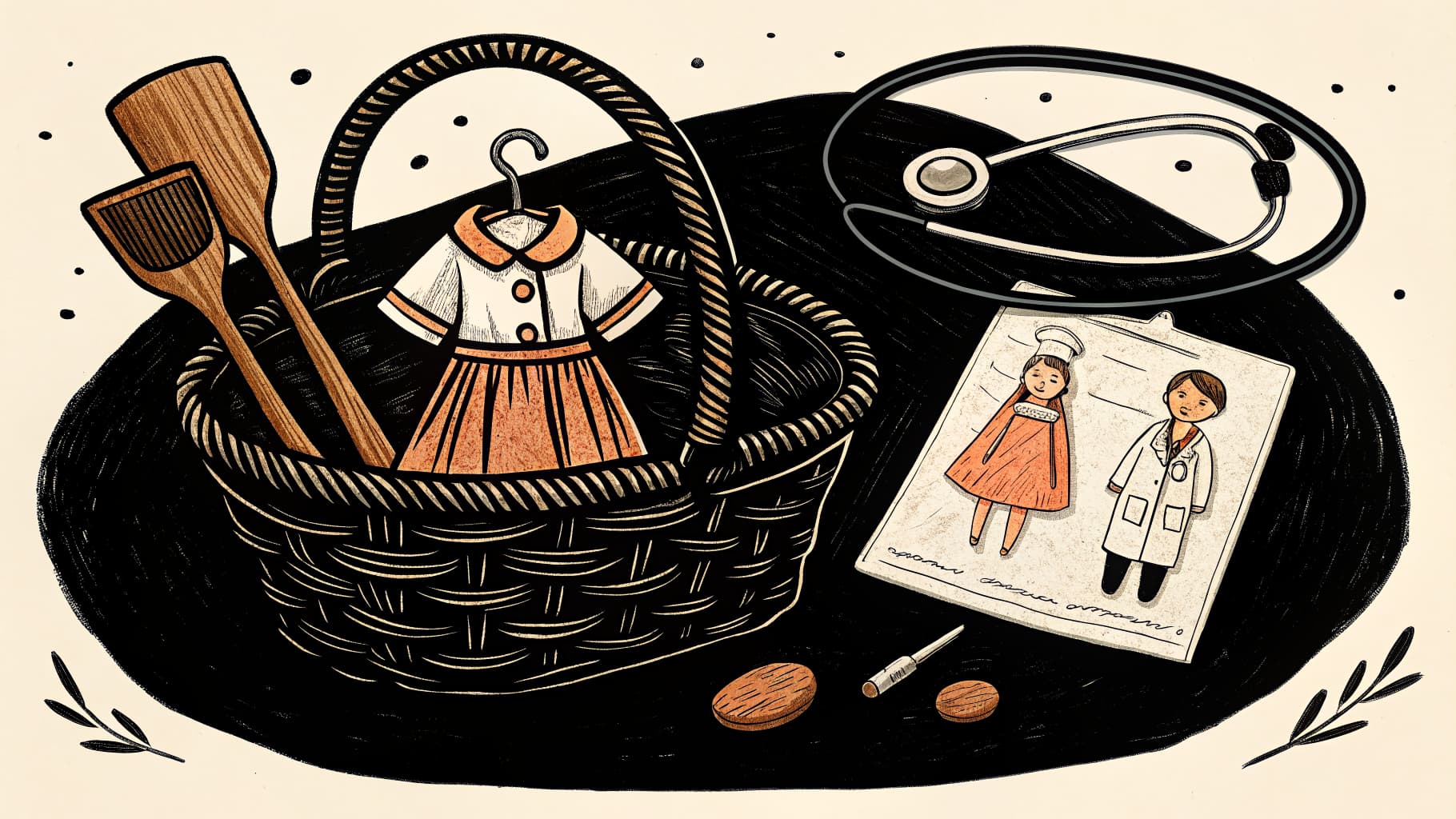
Child draws or dictates a play plan, then enacts it as dramatic play
Play Planning
Before dramatic play, the child draws or dictates a "play plan" naming the role she will take and the actions she will perform. Carries the plan into the play area and refers to it during play. Afterward, reviews what she did vs the plan with the didi. Turns dramatic play from unstructured fun into self-regulation training (mature dramatic play in Vygotskian terms). Strong RCT evidence for executive-function gains.
What Is Play Planning? Definition, Origins, and Why It Works
Play Planning is a cornerstone of the Tools of the Mind curriculum, a pedagogical approach deeply rooted in the theories of Lev Vygotsky. Developed by researchers Elena Bodrova and Deborah Leong, this method addresses a critical need in early childhood education: the development of self-regulation and executive function. In their seminal work, Bodrova and Leong (2007) describe play planning as a routine that anchors intentional, sustained play. For children between the ages of 4 and 7, the ability to plan is not just a school skill; it is a developmental milestone that allows them to move from being reactive to being proactive learners.
At its core, Play Planning requires a child to externalise their thoughts before they act. In a typical classroom, a child might run to the block area and start throwing pieces without a clear goal. With Play Planning, that same child must first sit down and decide, 'I am going to be a construction worker building a bridge.' By drawing this idea and having a teacher scribe the words, the child creates a mental map. This map serves as a 'tool of the mind' that the child can use to stay focused when distractions arise. As Diamond et al. (2007) noted in their study published in Science, this routine is a significant factor in why children in these programs show measurable gains in cognitive control compared to those in traditional literacy-heavy environments.
The process begins with a 10 to 15 minute planning session. Each child has a clipboard and a planning sheet. The teacher's role during this time is that of a facilitator and scribe. For a four-year-old, writing is often a series of scribbles or a single representative drawing. The teacher validates this by saying, 'I see you drew a big circle for the pizza. Let me write that down for you.' This interaction is a powerful literacy moment. The child sees that their ideas have permanent value and that writing is a tool for communication. It bridges the gap between the child's internal imagination and the external world.
Once the plans are complete, the children move into 30 to 50 minutes of play. This is not 'free play' in the sense of being aimless; it is 'mature play' (a term used by Bodrova and Leong, 2007, to describe complex, role-based dramatic play). Because the children have roles and plans, the play becomes more complex and social. If two children are both planning to be the 'mommy' in the house area, the planning phase allows them to negotiate those roles before the play even starts. During the play period, the teacher uses the plans as a scaffolding tool. If a child begins to wander or disrupt others, the teacher can gently ask, 'What was your plan today?' and look at the paper together. This helps the child self-correct and return to their intended activity without the teacher needing to use traditional disciplinary measures.
The final component is the review, lasting 5 to 10 minutes. This is a brief check-in where children look at their drawings and reflect on their actions. Did they build the bridge they planned? Did they stay in their role as the doctor? This reflection is crucial for developing metacognition, or thinking about one's own thinking. Over time, children who engage in Play Planning become more independent and better at managing their own behaviour and learning tasks. As Bodrova and Leong (2007) emphasise, the goal is to help children become masters of their own behaviour, providing them with the internal tools they need to succeed in more formal academic settings later on.
How to Facilitate Play Planning: Step-by-Step Implementation Guide
Provide a draw-first planning sheet
3 min
Give each child a clipboard holding an unlined sheet with a large blank box for drawing and a single ruled line at the bottom for teacher scribing.
Draw the play scenario
3 min
Ask the child to draw themselves in their chosen role, including the specific props they intend to use during the session.
Scribe the intentional message
3 min
Sit beside (not across from) the child so they can watch your pen move left to right as you write their exact words. Read the sentence back aloud while pointing to each word, such as 'I am going to be the doctor and fix the baby's leg.'
Transition to active play
4 min
Allow the child to take their plan to the play area for 30 to 50 minutes of sustained, role-based activity.
Support play using the plan
4 min
Circulate through the room and use the children's plans to help them solve problems or remember their roles when they get distracted.
Conduct the play review
3 min
Gather for 5 to 10 minutes at the end. Hold up your drawing and ask: 'Did you do what you drew? Thumbs up if yes, thumbs sideways if you changed your plan.' Then invite one or two children to share what surprised them.
BEFORE YOU TEACH THIS
Read the Teacher's Guide first.
Flip Education's Teacher's Guide walks you through how to facilitate any active learning lesson: mindset, pre-class checklist, phase-by-phase facilitation, and a Quick Reference Card you can print and bring to class.
Read the Teacher's Guide →When to Use Play Planning: Best Classes, Subjects, and Group Sizes
- Dramatic play that builds self-regulation
- Bridging language and behaviour at age 4 to 6
- Pre-literacy via dictated play plans
- Children who struggle with sustained play or transitions
Why Play Planning Works: Research and Impact on Student Learning
Diamond, A., Barnett, W. S., Thomas, J., Munro, S. (2007, Science, 318(5855), 1387-1388)
Reports that children in Tools-of-the-Mind classrooms showed measurable gains in executive-function tasks compared with a balanced-literacy control, attributed in part to the play-planning routine.
Barnett, W. S., Jung, K., Yarosz, D. J., Thomas, J., Hornbeck, A., Stechuk, R., Burns, S. (2008, Early Childhood Research Quarterly, 23(3), 299-313)
Randomized trial across 18 preschool classrooms. Tools of the Mind classrooms (where play planning is a daily routine) showed positive effects on social behaviour, language, and literacy compared with the district's standard balanced-literacy curriculum.
Diamond, A., Lee, C., Senften, P., Lam, A., Abbott, D. (2019, PLoS ONE, 14(9), e0222447)
Cluster RCT in 18 kindergarten classrooms. Tools of the Mind children outperformed controls on academic skills (reading, writing, math) and executive function. Teachers also reported reduced workload and improved classroom climate.
Principles and Practice of Play Planning
Bodrova, E., Leong, D. J. (2007, Pearson Merrill Prentice Hall, 2nd Edition)
Describes play planning as a routine in which the child draws or writes a plan for their dramatic-play scenario before play begins, anchoring intentional, sustained play that develops self-regulation.
Common Mistakes Teachers Make with Play Planning (and How to Avoid Them)
Treating the plan like a worksheet
If children feel they are doing 'work' rather than preparing for fun, they will lose interest. Keep the focus on the exciting play that is about to happen.
Scribing without the child watching
The magic of literacy happens when the child sees their spoken words turn into written symbols. Always scribe while the child is looking at the paper.
Allowing plans to be too vague
A plan that just says 'I will play' does not help a child stay in character. Encourage them to name a specific role like 'the baker' or 'the bus driver'.
Forgetting the review at the end
Without the review, children do not learn to evaluate their own progress. Use a quick show-and-tell circle: each child holds up their drawing and gives a thumbs-up or thumbs-down to signal whether they followed their plan, then one or two children share a sentence.
Intervening too much in the play
The teacher should use the plan to support the child's own ideas, not to take over the story. Use the plan as a gentle reminder, not a rigid rulebook.
How Flip Education Helps
Printable Picture Role Cards
Flip Education generates sets of visual cards representing different roles and props that children can use as references while drawing their plans.
Daily Planning Strip Templates
A three-panel horizontal strip showing Panel 1: a clock icon labelled Plan (10 min) with a drawing box; Panel 2: a play icon labelled Play (30-50 min) with a role-card slot; Panel 3: a speech-bubble icon labelled Review (5-10 min) with a reflection prompt.
Observation Grid for Executive Function
Teachers can print a simple grid to check off which children are successfully following their plans, helping track growth in self-regulation.
Picture-Based Reflection Prompts
Flip Education creates visual prompts for the review session, such as 'Did I use my prop?' or 'Did I stay in my role?', to guide the end-of-day discussion.
Tools and Materials Checklist for Play Planning
- Sturdy clipboards for every child
- Unlined paper or simple planning templates
- Washable markers or thick crayons
- A dedicated 'Planning Station' table
- Visual role cards with pictures of community helpers
- A timer to signal transitions between planning, play, and review
Play Planning FAQs: Questions Teachers Actually Ask
What if a child cannot write yet?
This is expected in the 4 to 7 age band. The child should draw their plan first, and then you can scribe their words exactly as they say them while they watch your pen move across the paper.
How long should the planning phase take?
Keep it brief to maintain energy. Aim for 10 to 15 minutes where children are focused on their individual clipboards or papers. If a child finishes quickly, prompt them to add one more prop to their drawing. If a child cannot start, offer the visual role cards to help them choose a character.
What do I do if a child changes their mind during play?
Gently refer back to their written plan to encourage persistence in their role. If they are truly finished with that scenario, they can return to the planning station to update their plan for a new role.
Does every child need a plan every day?
Yes, making the plan is the 'ticket' to enter the play centers. This consistency helps children build the habit of intentionality and mental preparation.
How does this help with behavior management?
Most classroom conflicts happen when children lack a clear role or purpose. The plan gives them a specific job to do, which naturally reduces aimless wandering and impulsive disagreements.
Classroom Resources for Play Planning
Free printable resources designed for Play Planning. Download, print, and use in your classroom.
My Play Plan Template
A simple visual sheet for children to draw their plan and for teachers to scribe the intentional message.
Download PDFCommunity Play Roles
Visual cards to help children choose a specific role during the planning phase.
Download PDFEnd of Play Check-In
A set of simple questions to guide the 5-minute review session at the end of play.
Download PDFSelf-Regulation Through Play
A guide for teachers to observe and support emotional growth during the play planning routine.
Download PDFRelated
Methodologies Similar to Play Planning
Hundred Languages
Re-represent one concept across 2 to 3 child-chosen "languages" (clay, paint, body, sound)
Morning Circle
Daily rhythmic gathering: greeting, song, calendar, weather, day-plan preview
Progettazione (Reggio Investigation)
Reggio emergent investigation: launch a question that drives multi-day investigation
Ready to try this?
- Read the Teacher's Guide →
- Generate a mission with Play Planning →
- Print the toolkit after generating
Generate a Mission with Play Planning
A complete lesson plan, aligned to your curriculum.