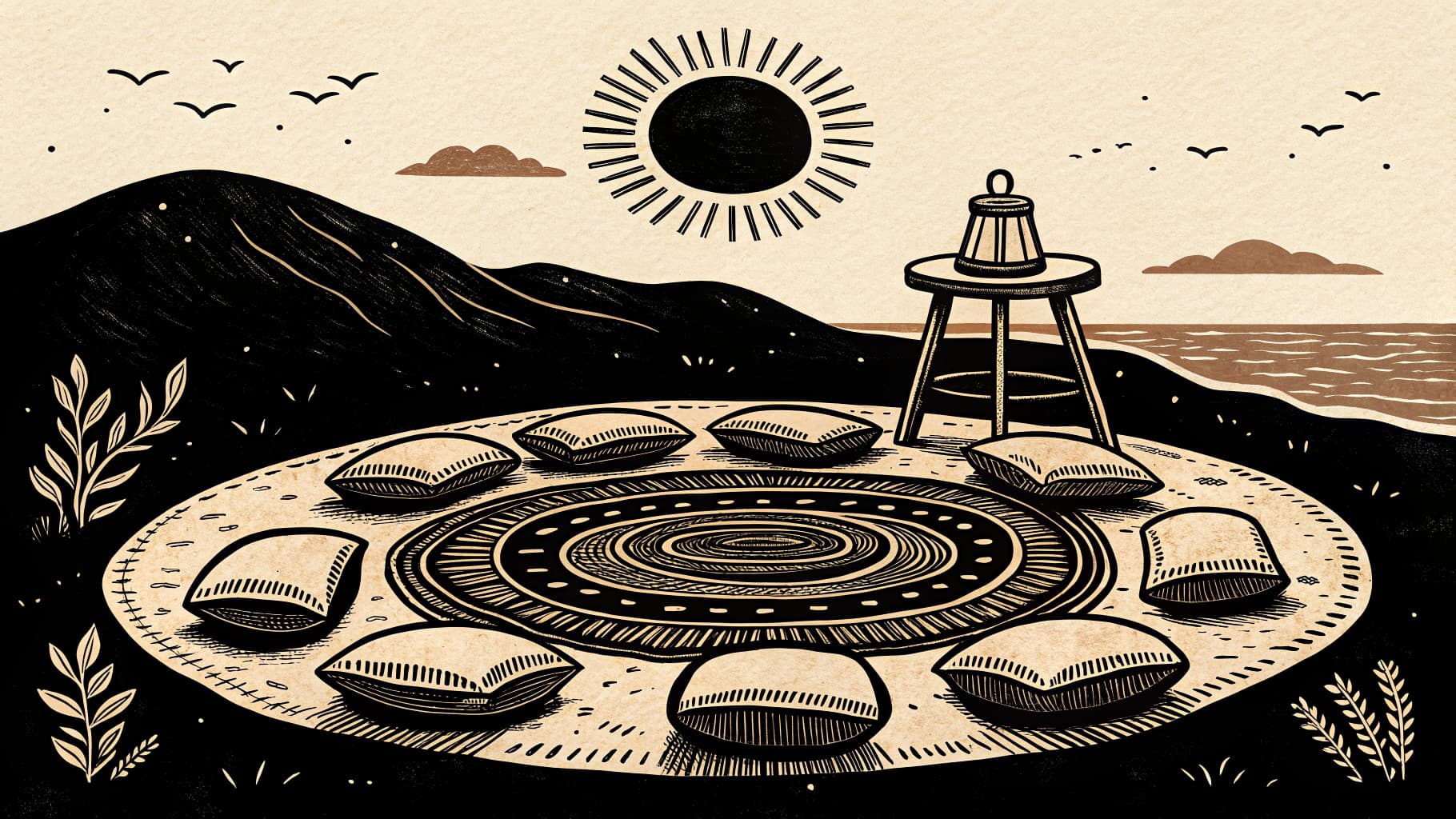
Daily rhythmic gathering: greeting, song, calendar, weather, day-plan preview
Morning Circle
A 10 to 15 minute daily gathering that opens the school day. Didi greets each child by name, leads a rhythmic song or fingerplay, walks through the calendar with picture cards (day, month, season), checks the weather with picture cards, and previews the day with picture cards of the planned activities. Provides predictable rhythm, builds community, and scaffolds language and pre-mathematical thinking. Universal across HighScope, Waldorf, Reggio, Montessori, and aligns with NCF-FS daily routine guidance.
What Is Morning Circle? Definition, Origins, and Why It Works
The Morning Circle is more than just a transition: it is the heartbeat of the preschool day. By blending the HighScope greeting circle with Reggio Emilia gathering rituals, teachers create a space where every child feels a sense of belonging and agency. This methodology is specifically designed for the 3 to 6 year old age band, recognising that young children need physical, visual, and social cues to transition from their home lives into the school environment. At this developmental stage, children are building their internal sense of time and community. The Morning Circle provides the scaffolding they need to understand their place within the group and the structure of their day.
According to Hohmann, Weikart, and Epstein (2008), the Greeting Circle is a vital component of an active-learning preschool day. It serves as the opening segment where the day plan is previewed, allowing children to anticipate what comes next. This predictability is crucial for reducing stress and helping children feel in control of their environment. When a teacher greets a child by name and makes eye contact, they are practising the HighScope principle of acknowledging the child as an individual learner. This simple act builds a foundation of trust that supports all subsequent learning activities throughout the day.
Complementing the HighScope approach are the gathering rituals of Reggio Emilia. Edwards, Gandini, and Forman (2011) describe the gathered group as the 'unit of listening and protagonism.' In this tradition, the morning gathering is not just a time for announcements, but a ritual that honours the children's voices and their roles as active members of a community. The HighScope calendar and weather steps give children concrete tools to understand time and environment. Separately, the Reggio Emilia tradition encourages children to express their observations through drawing, gesture, and oral storytelling, the hundred languages, rather than through calendar mechanics alone.
For children aged 3 to 6, abstract concepts like 'Tuesday' or 'partly cloudy' are best understood through concrete, visual representations. This is why the methodology insists on the use of picture cards rather than written words alone. Laminated icon cards placed in a velcro pocket chart give children a tactile, visual map of the day, making abstract time sequences concrete and manipulable. When a child moves a picture of a sun onto the weather board, they are engaging in a cognitive process that links their physical observation of the world to a symbolic representation. Similarly, the day-plan preview uses a picture strip to help children visualise the passage of time. This visual schedule acts as a map, giving children the security of knowing that snack time follows circle time, and outdoor play follows small groups.
Implementation of the Morning Circle requires the teacher to be a facilitator rather than a lecturer. The goal is to keep the energy focused and the pace moving. A typical session lasts between 10 and 15 minutes, which respects the natural attention spans of preschoolers. By starting with a personal greeting and moving into a unifying song, the teacher brings the group's focus together. The calendar and weather steps provide opportunities for individual children to take on small leadership roles, while the day-plan preview ensures everyone is aligned for the hours ahead. This structured yet warm approach ensures that the classroom begins each day as a cohesive, supportive community of learners.
How to Facilitate Morning Circle: Step-by-Step Implementation Guide
Greet every child individually
2 min
Sit at the children's level and make eye contact with each child, saying their name and a brief, warm acknowledgement as they join the circle.
Lead a rhythmic song or fingerplay
2 min
Use a short, familiar song with hand gestures to unify the group's energy. Try to adapt the lyrics slightly to match a current classroom interest or theme.
Update the picture calendar
3 min
Invite a child to place the correct picture card for the day, month, or season on the board to build a sense of time.
Perform a weather check
3 min
Look out the window together and have a child select the matching weather picture card (sun, clouds, rain) to display for the group.
Preview the day plan
3 min
Walk through a short vertical or horizontal picture strip that shows the sequence of the day, such as snack, outside time, and small groups.
BEFORE YOU TEACH THIS
Read the Teacher's Guide first.
Flip Education's Teacher's Guide walks you through how to facilitate any active learning lesson: mindset, pre-class checklist, phase-by-phase facilitation, and a Quick Reference Card you can print and bring to class.
Read the Teacher's Guide →When to Use Morning Circle: Best Classes, Subjects, and Group Sizes
- Opening every Foundational Stage day with a predictable ritual
- Building classroom community and individual recognition
- Pre-mathematical and pre-literacy through song and pattern
- Topic-tied songs that re-anchor a learning thread daily
Why Morning Circle Works: Research and Impact on Student Learning
Schweinhart, L. J., Montie, J., Xiang, Z., Barnett, W. S., Belfield, C. R., Nores, M. (2005, HighScope Press, Monographs of the HighScope Educational Research Foundation, 14)
Longitudinal RCT of 123 children followed to age 40. The HighScope group, whose daily routine opens with the greeting circle, showed higher graduation rates, higher earnings, and fewer arrests than controls. The greeting circle is one element of the daily active-learning routine being measured.
Schweinhart, L. J., Weikart, D. P. (1997, Early Childhood Research Quarterly, 12(2), 117-143)
Compared the HighScope curriculum (which uses the daily greeting circle) with Direct Instruction and traditional Nursery School models. Followed 68 children to age 23. The HighScope and Nursery groups had significantly fewer felony arrests than the Direct Instruction group.
Morning Circle as a discrete routine has no dedicated peer-reviewed RCTs. The evidence above measures HighScope at the program level, where the greeting circle is one element of a longer daily active-learning sequence.
Principles and Practice of Morning Circle
Hohmann, M., Weikart, D. P., Epstein, A. S. (2008, HighScope Press, 3rd Edition)
Documents the daily routine including the Greeting Circle as the opening segment of the active-learning preschool day, where each child is greeted by name and the day plan is previewed.
Edwards, C., Gandini, L., Forman, G. (Eds.) (2011, Praeger, 3rd Edition)
Describes the gathered group as the unit of listening and protagonism in Reggio Emilia practice, with morning gathering rituals serving as the daily rhythm of the classroom.
Common Mistakes Teachers Make with Morning Circle (and How to Avoid Them)
Making the circle session too long
Preschoolers often lose focus after 15 minutes, leading to disruptions. If you notice wiggling, quickly move to the day-plan preview and transition to the next activity immediately.
Using too much teacher talk
If the teacher speaks for the entire time, children become passive. Use picture cards and hand gestures to keep children involved and give them roles like 'weather reporter' to encourage active participation.
Lack of visual support materials
Relying only on spoken words is difficult for 3 to 6 year olds. Always use clear, simple picture cards for the calendar, weather, and schedule to help children visualise the concepts you are discussing.
Inconsistent routine or sequence
Changing the order of the circle every day can cause anxiety for children who rely on predictability. Stick to the same five steps so children know exactly what to expect when they sit down.
Ignoring individual emotional states
If a child is visibly upset, rushing through the greeting can make them feel ignored. Take five seconds to acknowledge their feeling quietly, which aligns with the HighScope principle of supportive adult-child interaction (Hohmann, Weikart, and Epstein, 2008) and the Reggio Emilia value of honouring each child's voice within the group.
How Flip Education Helps
Printable Picture Card Sets
Flip Education generates high-contrast, simple picture cards for weather, seasons, and months that are easy for small hands to hold and recognise.
Visual Day-Plan Strips
The system creates customisable icon-based schedule strips that teachers can print and display to show the sequence of daily classroom events.
Song and Fingerplay Library
Teachers can access a collection of short, rhythmic lyrics and gesture descriptions that are developmentally appropriate for the 3 to 6 year old age band.
Teacher Observation Grids
Flip Education provides simple grids for teachers to quickly note social interactions or moods during the greeting circle. Each grid row represents one child. Columns include: Child Name, Greeting Response (eye contact / verbal / none), Mood Indicator (calm / unsettled / distressed), and a free-text Notes field. No child writing is required.
Tools and Materials Checklist for Morning Circle
- A low, comfortable rug or floor cushions for the circle
- Laminated picture cards for months, days, and seasons
- A weather board with velcro for attaching daily weather icons
- A vertical or horizontal pocket chart for the day-plan picture strip
- A set of simple, recognisable icons for daily activities like 'Snack' or 'Nap'
Morning Circle FAQs: Questions Teachers Actually Ask
What if a child refuses to join the circle?
Allow the child to observe from a nearby 'safe spot' like a beanbag or chair. Most children will naturally join once they hear the familiar songs and see their peers engaging. Forcing participation can create a negative association with this community ritual.
How do I handle high energy or wiggly behavior?
Incorporate a high-movement fingerplay or a rhythmic gesture into the second step of the routine. For example, try a high-movement fingerplay such as 'Reach Up High' or 'Open, Shut Them,' both of which are included in the Rhythmic Fingerplay Prompts resource. Keeping the total duration under 15 minutes ensures that the circle ends before the children's natural attention spans are exhausted.
Should I use this time for academic drills?
No, the focus should remain on community and predictability. While you can touch on early numeracy with the calendar or literacy with name cards, the primary goal is social-emotional connection and setting the day's rhythm.
What if we run out of time for the whole routine?
Prioritize the personal greeting and the day-plan preview. These two elements provide the most emotional security for children. You can move the weather check or calendar to a later transition if necessary.
Can I use digital screens for the calendar or weather?
Physical picture cards are much more effective for this age group. Children benefit from the tactile experience of holding a card or seeing a teacher move a physical marker, which helps ground them in the physical classroom environment.
Classroom Resources for Morning Circle
Free printable resources designed for Morning Circle. Download, print, and use in your classroom.
Morning Greeting Ritual Card
A guide for teachers to facilitate the individual greeting step with warmth and consistency.
Download PDFRhythmic Fingerplay Prompts
A collection of short, gesture-based prompts to use during the song and movement phase.
Download PDFDaily Picture Schedule Template
A visual layout for teachers to organize the day-plan picture cards.
Download PDFRelated
Methodologies Similar to Morning Circle
Ready to try this?
- Read the Teacher's Guide →
- Generate a mission with Morning Circle →
- Print the toolkit after generating
Generate a Mission with Morning Circle
A complete lesson plan, aligned to your curriculum.