India · CBSE Learning Outcomes
Class 9 Social Science
Class 9 Social Science: world history (French Revolution, Russian Revolution, Nazism), India's physical geography, democratic governance, and introductory economics including village economy and food security.
01The French Revolution
The revolution that overthrew the monarchy in France and gave the world the ideas of liberty, equality, and fraternity.
Students will analyze the social, economic, and political structure of France under the Ancien Régime, focusing on the three estates and their privileges or burdens.
Students will explore the key ideas of Enlightenment thinkers like Rousseau, Montesquieu, and Locke and their influence on revolutionary ideals.
Students will examine the convocation of the Estates General, the demands of the Third Estate, and the pivotal moment of the Tennis Court Oath.
Students will investigate the events of July 14, 1789, and the subsequent spread of peasant revolts across the countryside.
Students will study the principles enshrined in the Declaration and its impact on French society and global human rights discourse.
Students will examine the drafting of the 1791 Constitution, the limitations on royal power, and the concept of 'active' vs. 'passive' citizens.
Students will explore the growing radicalization of the revolution, the emergence of political clubs, and the influence of the Sans-culottes.
Students will investigate the overthrow of the monarchy, the trial and execution of Louis XVI, and the establishment of the French Republic.
Students will examine the period of extreme violence and political purges under Maximilien Robespierre and the Committee of Public Safety.

02Socialism in Europe and the Russian Revolution
The rise of socialist thought and the transformation of Russia into the world's first communist state.
Students will explore the social and economic transformations brought about by industrialization in Europe and the emergence of new social classes.
Students will compare the differing political ideologies that emerged in 19th-century Europe and their visions for societal change.
Students will investigate the early socialist thinkers and their critiques of capitalism, including utopian socialists and Karl Marx.
Students will examine the social, economic, and political conditions of Russia under Tsar Nicholas II, including its agrarian economy and autocratic rule.
Students will investigate the causes and events of the 1905 Revolution, including 'Bloody Sunday' and the establishment of the Duma.
Students will explore how Russia's involvement in World War I exacerbated existing problems and led to the downfall of the Tsarist regime.
Students will examine the events of the February Revolution, the abdication of the Tsar, and the establishment of the Provisional Government.
Students will study Vladimir Lenin's return to Russia and his radical 'April Theses' that called for 'Peace, Land, and Bread'.
Students will investigate the Bolsheviks' strategic planning and execution of the October Revolution, leading to their seizure of power.
Students will examine the causes and consequences of the Russian Civil War (1918-1922) and the policies of War Communism.
03Nazism and the Rise of Hitler
The collapse of democracy in Germany and the catastrophic impact of Nazi ideology.
Students will analyze the challenges faced by the newly formed Weimar Republic, including the Treaty of Versailles and economic instability.
Students will investigate how the economic crisis of the Great Depression fueled the rise of extremist parties, particularly the Nazis.
Students will examine the political maneuvering and events that led to Hitler being appointed Chancellor in 1933.
Students will study how Hitler swiftly consolidated power by exploiting crises and passing key legislation to dismantle democratic institutions.
Students will explore the core tenets of Nazi ideology, including its pseudo-scientific racial theories and the concept of 'living space'.
Students will examine the sophisticated methods used by the Nazis to control information, indoctrinate the population, and dehumanize enemies.
Students will investigate the systematic persecution and genocide of Jews and other minority groups under the Nazi regime.
04Physical Geography of India
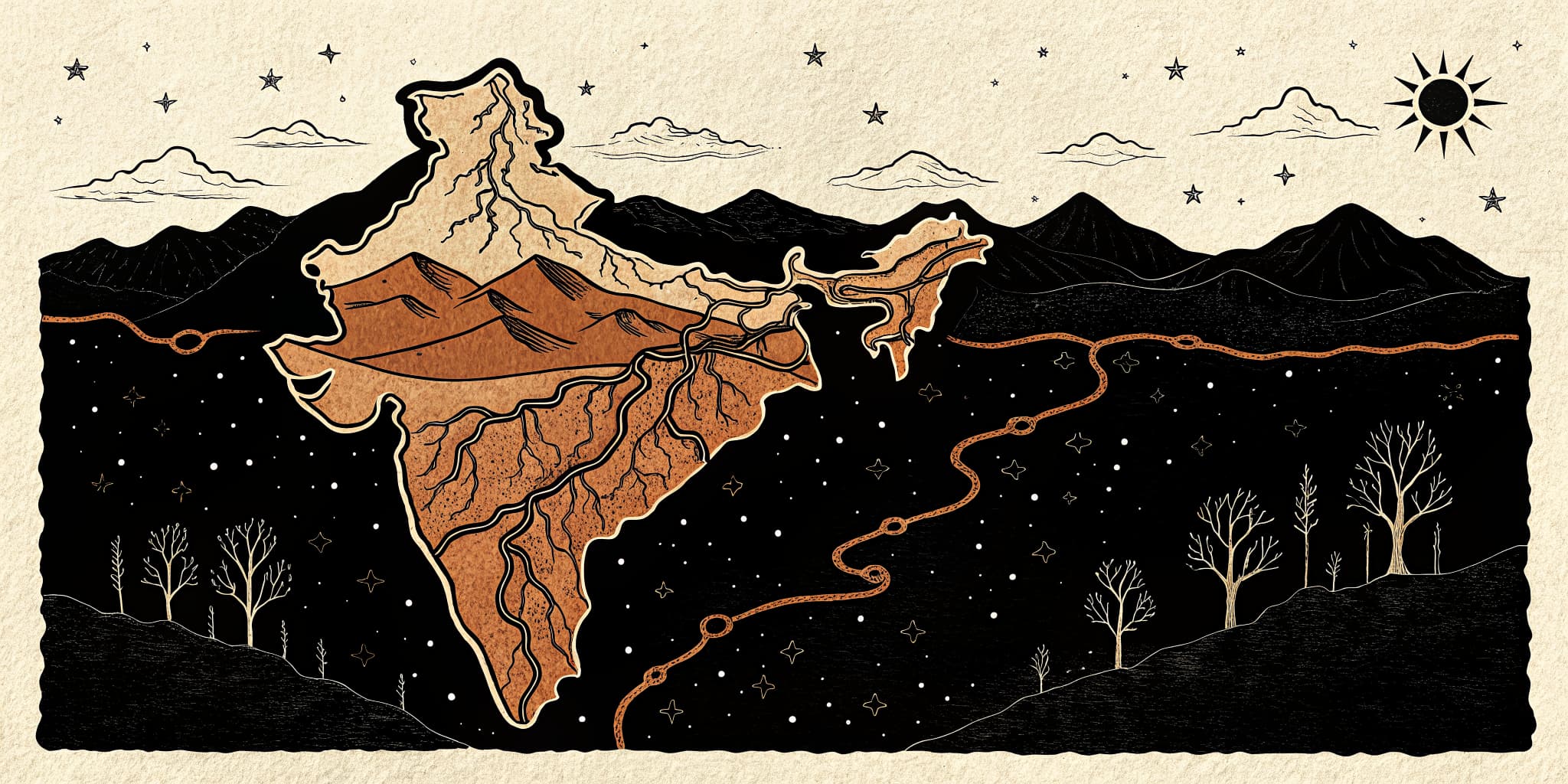
The geological structure, relief features, and drainage systems of the Indian subcontinent.
Students will identify India's geographical coordinates, its central position in Asia, and its maritime neighbors.
Students will explore the theory of plate tectonics and its role in the formation of the Indian subcontinent, including the Gondwana landmass.
Students will study the longitudinal divisions of the Himalayas (Himadri, Himachal, Shiwaliks) and their unique characteristics.
Students will investigate the formation of the Indo-Gangetic plains and their regional divisions (Bhabar, Terai, Bhangar, Khadar).
Students will explore the Central Highlands, including the Malwa Plateau and Chota Nagpur Plateau, focusing on their relief and mineral resources.
Students will study the Deccan Plateau, its slopes, the Deccan Trap, and the distinct features of the Western and Eastern Ghats.
Students will investigate the Thar Desert, its arid climate, unique landforms like Barchans, and adaptations of life.
Students will compare the Western and Eastern Coastal Plains, their regional divisions, and economic significance.
Students will study the geographical features, origin, and significance of India's island groups.
Students will explore the Himalayan river systems (Indus, Ganga, Brahmaputra), their tributaries, and their significance.
Students will study the Peninsular river systems (Narmada, Tapi, Godavari, Krishna, Kaveri), their characteristics, and drainage basins.

05Climate, Vegetation, and Wildlife
The factors influencing India's climate and the rich biodiversity of the country.
Students will analyze the various geographical and atmospheric factors that determine India's climate, including latitude, altitude, and pressure systems.
Students will investigate the influence of atmospheric pressure, surface winds, upper air circulation, and the Jet Streams on India's climate.
Students will explore the complex factors driving the Indian monsoon, including differential heating, ITCZ shift, and the El Niño effect.
Students will study the characteristics of the advancing (south-west) and retreating (north-east) monsoons and their regional variations.
Students will identify the distinct characteristics of India's cold weather, hot weather, advancing monsoon, and retreating monsoon seasons.
Students will examine the characteristics, regions, and biodiversity of India's tropical evergreen forests.
Students will study the features, distribution, and economic importance of tropical deciduous forests, also known as monsoon forests.
Students will investigate the characteristics, regions, and adaptations of vegetation in arid and semi-arid areas of India.
Students will explore the unique features of montane forests (altitude-based) and mangrove forests (tidal-influenced) in India.

06Democratic Politics
Understanding the principles of democracy, constitutional design, and institutional frameworks.
Students will analyze the core features of democracy and discuss the arguments for and against this form of government.
Students will explore the historical context, the role of the Constituent Assembly, and the guiding values embedded in the Preamble.
Students will examine the fundamental principles of the Indian Constitution, including federalism, parliamentary form of government, and secularism.
Students will understand the importance of elections in a democracy and the mechanisms that make them free and fair.
Students will study the stages of elections in India, from voter lists to the declaration of results, and discuss electoral reforms.
Students will examine the structure and functions of the Indian Parliament, including its role in law-making and accountability.
Students will understand the roles and powers of the President, Prime Minister, and the Council of Ministers in India's parliamentary system.
Students will explore the role of the Civil Services (bureaucracy) as the permanent executive in implementing government policies.
Students will understand the structure and functions of the Indian judiciary, emphasizing its role as the guardian of the Constitution.
07Economics: Production and Human Resources
The factors of production and the importance of investing in people.
Students will use the hypothetical village of Palampur to understand the basic concepts of production and factors of production.
Students will identify and define the primary factors of production: land, labor, and physical capital, with examples from rural India.
Students will investigate the Green Revolution, its technologies (HYV seeds, fertilizers), and its socio-economic and environmental consequences.
Students will explore various non-farm activities in rural India, such as dairy, small-scale manufacturing, and transport, and their importance.
Students will understand the concept of 'human capital' and how a population can become an asset through investment in education and health.
Students will examine the crucial role of education and health services in enhancing human capital and economic productivity.
Students will explore different types of unemployment in India (seasonal, disguised, educated) and their underlying causes.
08Poverty and Food Security
The challenges of poverty and the mechanisms to ensure food for all.
Students will understand how poverty is defined and measured in India, focusing on the concept of the 'Poverty Line'.
Students will explore poverty beyond income, considering indicators like illiteracy, lack of healthcare, and social exclusion.
Students will examine poverty trends in India, inter-state disparities, and compare India's progress with other countries.
Students will study government strategies for poverty reduction, including promoting economic growth and specific anti-poverty schemes like MGNREGA.
Students will understand the three critical dimensions of food security: availability, accessibility, and affordability of food.
Students will examine the role of buffer stock and the Public Distribution System (PDS) in ensuring food security in India.