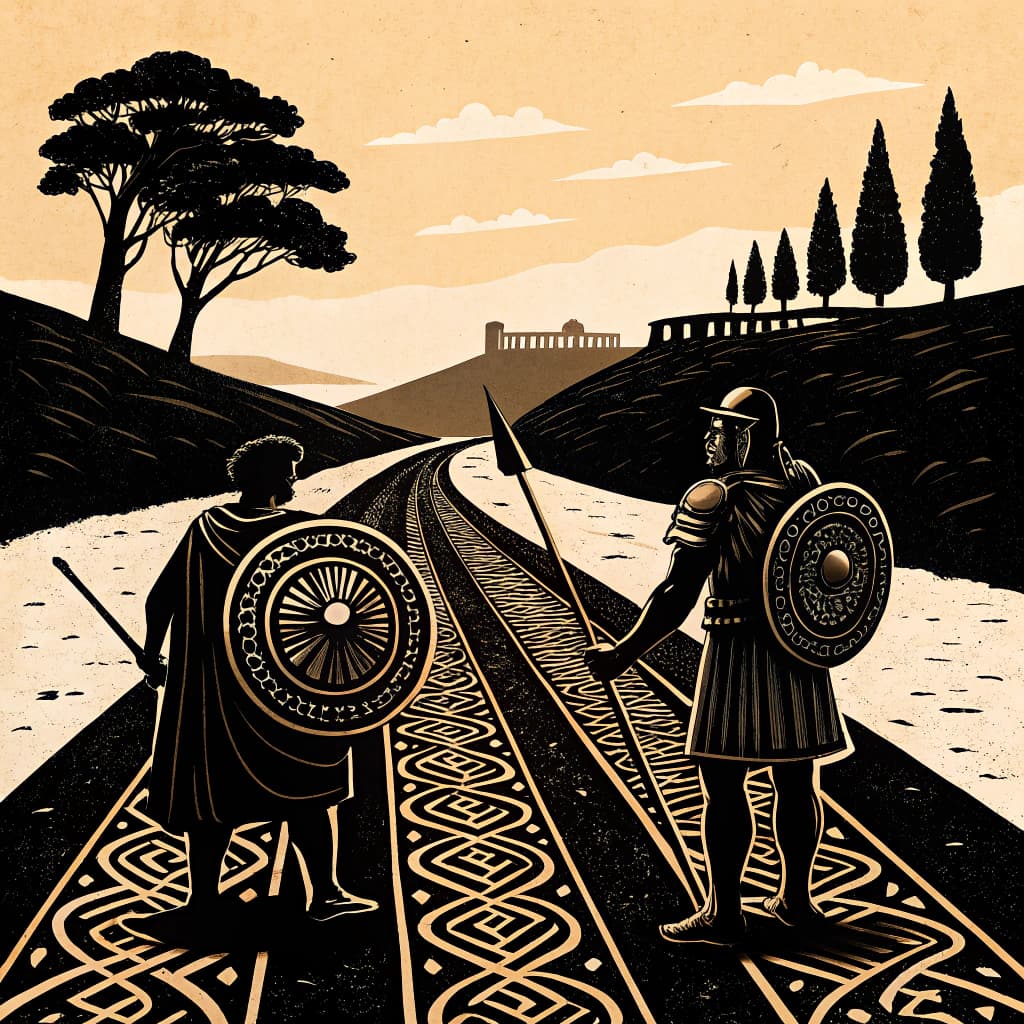
Alfred the Great and the Battle of Edington
How Alfred saved Wessex and made a peace treaty with the Vikings, establishing the Danelaw.
About This Topic
Alfred the Great's campaign against Viking invaders reached a turning point at the Battle of Edington in 878. After emerging from hiding in the Somerset marshes, Alfred rallied the men of Wessex, defeated Guthrum's Great Heathen Army, and secured a peace treaty at Wedmore. This agreement established the Danelaw, dividing England into Viking-controlled eastern territories and Anglo-Saxon Wessex, marking a shift from conquest to coexistence.
Year 4 students examine Alfred's innovative burh system of fortified towns linked by roads, which enabled rapid defense and communication against hit-and-run Viking tactics. They analyze the Danelaw's terms, including Viking baptism and territorial boundaries, and evaluate Alfred's legacy through his educational reforms, legal codes, and military successes, justifying his unique title 'the Great' among English monarchs. These inquiries develop skills in causation, significance, and interpretation central to KS2 history.
Active learning excels with this topic because students can reenact battles on playground maps, negotiate treaties in role-play, and construct burh models from recyclables. These methods make strategic thinking concrete, foster empathy for historical figures, and encourage evidence-based arguments, deepening retention and engagement.
Key Questions
- Explain how Alfred used the 'Burh' system to defend his land effectively.
- Analyze the terms and significance of the Danelaw treaty.
- Justify why Alfred is the only English monarch called 'the Great'.
Learning Objectives
- Explain how Alfred's 'burh' system facilitated rapid defense and communication against Viking raids.
- Analyze the key terms and territorial divisions established by the Danelaw treaty.
- Evaluate the evidence supporting Alfred's title 'the Great' by comparing his achievements in defense, law, and education.
- Compare the strategic advantages and disadvantages of Anglo-Saxon and Viking military tactics during the period.
Before You Start
Why: Students need a basic understanding of Viking invasions and their impact on England before studying Alfred's specific resistance.
Why: Familiarity with the political structure of Anglo-Saxon England is necessary to understand Alfred's role as King of Wessex.
Key Vocabulary
| Burh | A fortified settlement or town, often with a mint and market, built by Alfred the Great to defend against Viking attacks. |
| Danelaw | The area of England historically under Viking control, established by a treaty following the Battle of Edington. |
| Great Heathen Army | The large Viking army that invaded England in the 9th century, aiming for conquest and settlement. |
| Treaty of Wedmore | The peace agreement between Alfred the Great and the Viking leader Guthrum, which led to the establishment of the Danelaw. |
Watch Out for These Misconceptions
Common MisconceptionAlfred won through personal bravery alone, like a superhero.
What to Teach Instead
Success stemmed from organized strategy, burhs, and alliances, not solo heroism. Mapping activities and role-plays let students simulate decisions, revealing teamwork's role and correcting romanticized views.
Common MisconceptionThe Danelaw gave Vikings control over all England.
What to Teach Instead
It partitioned land, with Wessex remaining Anglo-Saxon. Boundary-drawing tasks clarify geography, while treaty role-plays highlight compromises, helping students appreciate nuanced power-sharing.
Common MisconceptionVikings were only brutal destroyers with no culture.
What to Teach Instead
They were traders, settlers, and farmers too. Source analysis in groups exposes laws and artifacts, building balanced views through collaborative discussion of primary evidence.
Active Learning Ideas
See all activities→Hot Seat
Mapping Activity: Alfred's Burh Network
Provide outline maps of Wessex. In small groups, students research and mark burh locations like Winchester and Wallingford, draw connecting roads, and label defensive features. Groups explain to the class how burhs countered Viking raids.
Hot Seat
Role-Play: Treaty Negotiations at Wedmore
Assign roles as Alfred, Guthrum, and advisors. Pairs prepare arguments for treaty terms like baptism and borders, then negotiate in front of the class. Follow with a vote on treaty fairness and record outcomes.
Hot Seat
Debate Station: Why 'the Great'?
Small groups draw evidence cards on Alfred's battles, laws, and learning. They prepare 2-minute speeches justifying his title, then debate against opposing groups. Class votes and reflects on strongest arguments.
Real-World Connections
- Military strategists today still study historical defensive fortifications like the burhs to understand principles of territorial control and rapid response, similar to how modern armies plan troop movements and establish forward operating bases.
- Modern border agreements, such as those between countries, share similarities with the Danelaw treaty in that they define territorial boundaries and establish rules for coexistence between different groups, impacting trade and cultural exchange.
Assessment Ideas
Students receive a card with a picture of a burh. Ask them to write two sentences explaining its purpose and one way it helped Alfred defeat the Vikings. Then, ask them to write one sentence about why Alfred is called 'the Great'.
Pose the question: 'Was the Danelaw a victory or a defeat for the Anglo-Saxons?' Facilitate a class discussion where students use evidence from the treaty terms and territorial divisions to support their arguments. Encourage them to consider both short-term and long-term consequences.
Present students with a map showing Anglo-Saxon Wessex and the Danelaw. Ask them to identify three key differences in how life might have been in each region based on the treaty and Viking settlement. Collect their written responses for review.
Frequently Asked Questions
How did Alfred use the burh system to defend Wessex?
What were the terms of the Danelaw treaty?
Why is Alfred the only English king called 'the Great'?
How can active learning help teach Alfred the Great to Year 4?
Planning templates for History
5E Model
The 5E Model structures lessons through five phases (Engage, Explore, Explain, Elaborate, and Evaluate), guiding students from curiosity to deep understanding through inquiry-based learning.
Unit PlannerThematic Unit
Organize a multi-week unit around a central theme or essential question that cuts across topics, texts, and disciplines, helping students see connections and build deeper understanding.
RubricSingle-Point Rubric
Build a single-point rubric that defines only the "meets standard" level, leaving space for teachers to document what exceeded and what fell short. Simple to create, easy for students to understand.
More in Viking Raids and the Struggle for England
The Viking Homeland and Culture
Exploring the origins of the Vikings, their Norse mythology, and their seafaring culture.
3 methodologies
Viking Longships: Technology and Exploration
Investigating the design and capabilities of the Viking longship and its role in their expansion.
3 methodologies
Lindisfarne: The First Raid
The shocking attack on the Holy Island and its impact on Christian Europe.
3 methodologies
The Great Heathen Army
The shift from small raids to a full-scale invasion of the English kingdoms by a large Viking force.
3 methodologies
Viking Jorvik: Trade and Life
Exploring the Viking city of York (Jorvik) and its role as a global trading hub and settlement.
3 methodologies