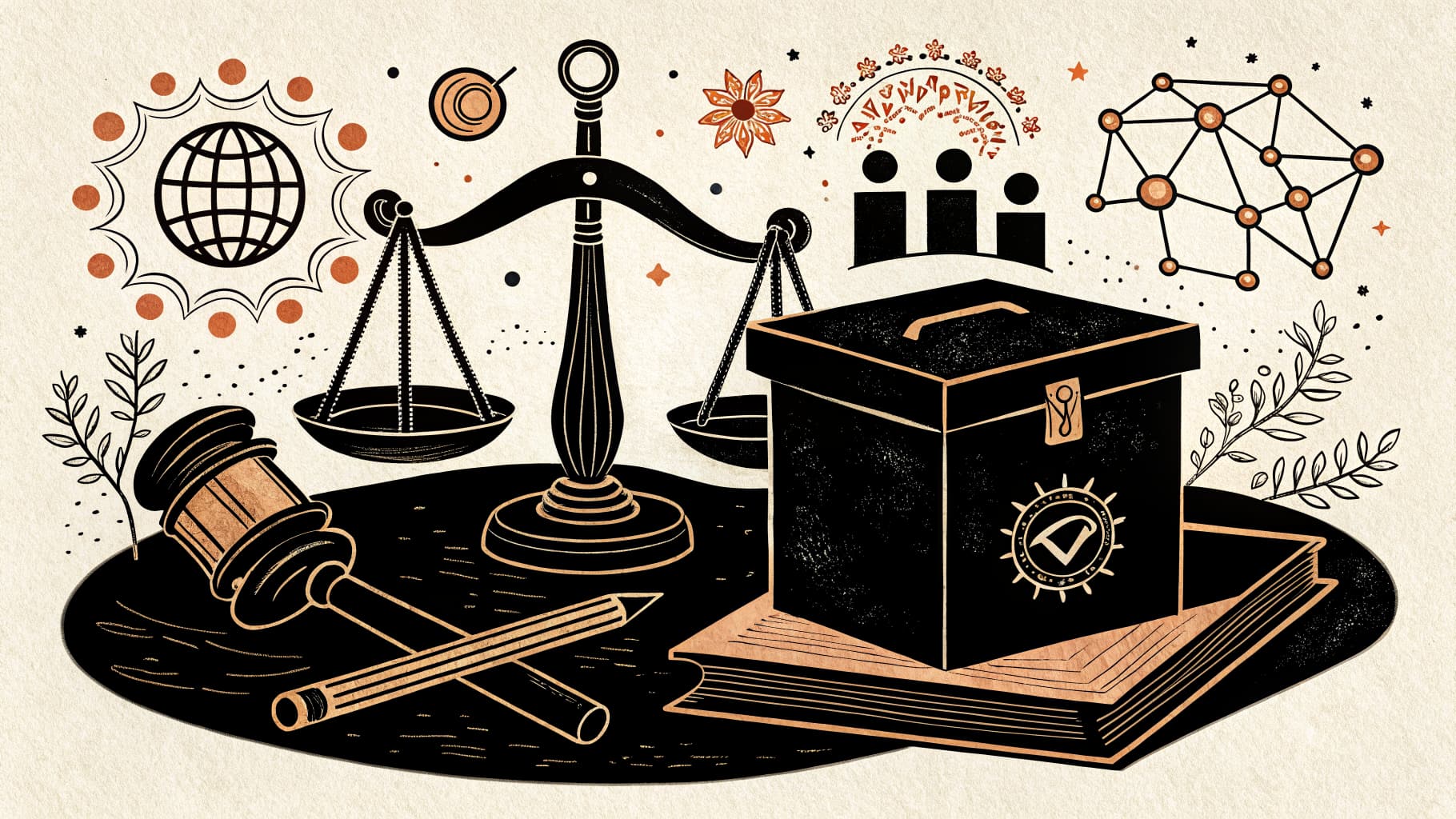
Constitutional Principles: Rule of Law & Democracy
Students will examine the core principles embedded in the Constitution, such as the rule of law, democracy, and federalism.
TL;DR:Students learn best when they can apply abstract constitutional principles to concrete scenarios they can visualize and debate. Active learning transforms the High Court’s role from a distant concept into a tangible process they can rehearse, critique, and explain to peers.
About This Topic
The High Court of Australia stands as the ultimate protector of the Constitution. This topic focuses on its role as the final court of appeal and its unique power to interpret the constitutional framework that governs our nation. Students investigate how the High Court resolves disputes between states and the Commonwealth, ensuring that all levels of government stay within their legal boundaries. This aligns with AC9C7K01 by highlighting the judiciary's role in maintaining the Australian legal system.
Learning about the High Court introduces students to the concept of judicial independence and the significance of landmark cases, such as the Mabo decision. It helps them understand that the law is not static but is interpreted by experts who must weigh historical intent against modern realities. This fosters a deeper respect for the rule of law and the mechanisms that resolve high-level conflict without violence.
Students grasp this concept faster through structured discussion and peer explanation of famous cases where the court had to make a difficult choice.
Key Questions
- Explain how the rule of law underpins the Australian Constitution.
- Differentiate between direct and representative democracy in the Australian context.
- Justify the importance of constitutional principles in protecting citizen rights.
Learning Objectives
- Explain how the principle of the rule of law is applied within the Australian Constitution.
- Compare and contrast direct democracy with representative democracy as practiced in Australia.
- Analyze the role of constitutional principles in safeguarding the rights of Australian citizens.
- Evaluate the significance of federalism in distributing power within Australia's constitutional framework.
Before You Start
Why: Students need a basic understanding of what government is and why laws exist before exploring specific constitutional principles.
Why: Familiarity with the different levels of government (Commonwealth, State, Local) is essential for understanding federalism.
Key Vocabulary
| Rule of Law | The principle that all people and institutions are subject to and accountable to law that is fairly applied and enforced. It means no one is above the law. |
| Democracy | A system of government by the whole population or all the eligible members of a state, typically through elected representatives. In Australia, this is a representative democracy. |
| Federalism | A system of government where power is divided between a central national government and regional state governments. Australia has a federal system. |
| Constitutionalism | The idea that government authority is derived from and limited by a body of fundamental law, the Constitution. It ensures government power is not absolute. |
Watch Out for These Misconceptions
Common MisconceptionThe High Court can make any new law it wants.
What to Teach Instead
The High Court only interprets existing laws and the Constitution; it cannot draft new legislation. Using a sorting activity to distinguish between 'making' and 'interpreting' helps students understand this boundary.
Common MisconceptionHigh Court judges are politicians.
What to Teach Instead
Judges are appointed, not elected, to ensure they remain impartial. Discussing the difference between an election and an appointment helps students see why judges don't campaign for votes.
Active Learning Ideas
See all activities→Mock Trial
The Constitutional Challenge
Assign students roles as High Court judges and lawyers. Present a fictional case where a state law conflicts with a federal law, and have the 'lawyers' argue their side while 'judges' ask probing questions based on the Constitution.
Gallery Walk
Landmark Decisions
Set up stations around the room detailing famous High Court cases like Mabo or the Tasmanian Dams case. Students move in pairs to summarize the conflict and the court's final ruling on a worksheet.
Think-Pair-Share
The Meaning of Words
Give students a short phrase from the Constitution and ask them to interpret it in a modern context. They compare their interpretations with a partner to see how different perspectives can lead to different legal outcomes.
Real-World Connections
- Citizens can observe the rule of law in action when police enforce traffic laws, ensuring everyone follows the same rules regardless of their status. This principle protects all road users.
- The High Court of Australia, located in Canberra, frequently interprets constitutional principles when hearing cases, such as disputes between states or challenges to federal laws. Its decisions shape how the Constitution applies to modern issues.
- Elections held every few years for federal, state, and local governments are a direct manifestation of representative democracy, allowing citizens to choose who will make laws on their behalf.
Assessment Ideas
Present students with three short scenarios. Ask them to identify which scenario best demonstrates the rule of law, which demonstrates representative democracy, and which illustrates federalism. For example, Scenario A: A politician is fined for speeding. Scenario B: Voters elect a Member of Parliament. Scenario C: The Commonwealth and Queensland governments disagree on environmental regulations.
Pose the question: 'Imagine a new law is proposed that significantly limits freedom of speech. How would the principles of the rule of law and democracy help protect citizens' rights in this situation?' Facilitate a class discussion, encouraging students to reference the definitions of the key terms.
On an exit ticket, ask students to write one sentence explaining the difference between direct and representative democracy. Then, ask them to provide one example of how the rule of law protects them personally.
Frequently Asked Questions
What does the High Court of Australia do?
How many judges are on the High Court?
Why was the Mabo case important for the High Court?
What are the best hands-on strategies for teaching the High Court?
More in The Australian Constitution and Parliament
Origins of the Australian Constitution
Students will explore the historical context, key figures, and foundational ideas that led to the drafting of the Australian Constitution.
8 methodologies
Structure of the Legislative Branch: Parliament
Students will analyze the structure and primary functions of the legislative branch (Parliament) in Australia.
8 methodologies
Roles in Parliament: Members and Senators
Students will investigate the specific roles and responsibilities of elected members in the House of Representatives and Senators.
8 methodologies
Structure of the Executive Branch: Cabinet & PM
Students will investigate the roles and responsibilities of the executive branch, including the Prime Minister and Cabinet.
8 methodologies
Structure of the Judicial Branch: Courts
Students will be introduced to the general function of courts in resolving disputes and interpreting laws at a basic level.
8 methodologies
Checks and Balances in Australian Government
Students will analyze how the legislative, executive, and judicial branches provide checks and balances on government power.
8 methodologies