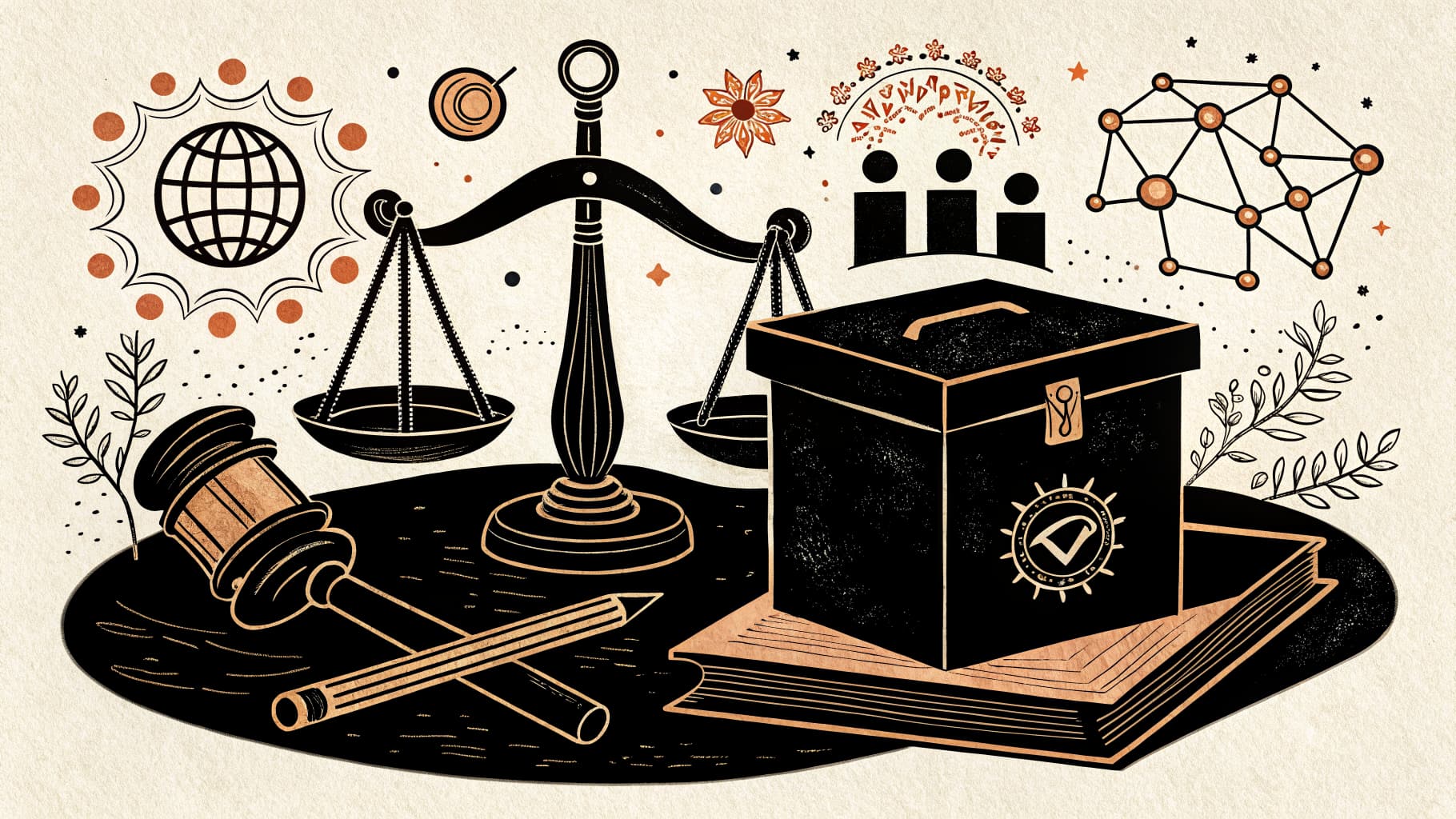
Judges: Upholding Justice
Students understand that judges are important people who make decisions in courts and must be fair and not take sides.
TL;DR:Active learning works well for this topic because students need to experience the tension between fairness and bias to grasp how judges uphold justice. By role-playing and debating, they move from abstract ideas to concrete actions, making the rule of law meaningful and memorable.
About This Topic
Judges play a central role in Australia's legal system by interpreting laws, weighing evidence, and delivering fair verdicts in courtrooms. Year 6 students explore how judges ensure justice through impartial decisions, free from personal bias or external pressure. This topic builds on their understanding of courts as places where disputes are resolved according to the rule of law, connecting to real-world examples like community safety and rights protection.
Aligned with AC9HASS6K03, the content fosters skills in critical analysis and ethical reasoning. Students examine judicial impartiality, primary responsibilities such as instructing juries and sentencing, and consequences of unfairness, like eroded public trust. These ideas link to broader civics themes of democracy and civic participation, preparing students to engage thoughtfully with legal news.
Active learning shines here because abstract notions of fairness become concrete through simulations. When students role-play courtroom scenarios or debate biased decisions, they internalize impartiality standards and predict outcomes, making the topic engaging and memorable.
Key Questions
- Explain the primary responsibilities of a judge in a courtroom.
- Analyze the concept of judicial impartiality and its significance.
- Predict the consequences if a judge failed to act fairly.
Learning Objectives
- Explain the primary responsibilities of a judge in a courtroom, such as presiding over proceedings and making rulings.
- Analyze the principle of judicial impartiality and its importance in ensuring fair trials.
- Evaluate the potential consequences of a judge demonstrating bias or failing to uphold justice.
- Compare the roles of a judge and a jury in the legal system.
- Identify specific actions a judge takes to ensure a fair hearing for all parties involved.
Before You Start
Why: Students need a basic understanding of why laws exist and how they help organize society before learning about the people who enforce them.
Why: Prior knowledge of the court system and its purpose provides context for understanding the specific role of a judge within it.
Key Vocabulary
| Judge | A public official appointed or elected to preside over court proceedings and make legal decisions. |
| Impartiality | The quality of being fair and unbiased, meaning a judge must not favor one side over another. |
| Verdict | The formal finding of fact made by a judge or jury on matters or questions submitted to them. |
| Jurisdiction | The official power to make legal decisions and judgments, defining the scope of a court's authority. |
| Rule of Law | The principle that all people and institutions are subject to and accountable to law that is fairly applied and enforced. |
Watch Out for These Misconceptions
Common MisconceptionJudges create laws in court.
What to Teach Instead
Judges apply and interpret existing laws, they do not make new ones, which is Parliament's role. Role-playing trials helps students see judges reference laws during decisions, clarifying separation of powers through practice.
Common MisconceptionJudges always side with the police or prosecution.
What to Teach Instead
Judges must remain neutral and base verdicts on evidence from both sides. Debate activities expose this by having students argue opposing views, revealing how impartiality ensures balanced justice.
Common MisconceptionJudges decide based on personal feelings.
What to Teach Instead
Impartiality requires decisions grounded in facts and law, not emotions. Scenario discussions let students test emotional influences and self-correct toward fair reasoning, building ethical judgment.
Active Learning Ideas
See all activities→Hot Seat
Role-Play: Mock Courtroom Trial
Assign roles including judge, lawyers, and witnesses for a simple dispute like playground conflict. The judge group listens to arguments, asks clarifying questions, then delivers a verdict based on evidence. Debrief on what made the decision fair.
Hot Seat
Scenario Cards: Impartiality Challenges
Distribute cards with situations where judges face bias temptations, such as knowing a defendant personally. In pairs, students decide the fairest action and justify it using impartiality rules. Share and vote on best responses class-wide.
Case Study Analysis
Famous Verdicts
Provide simplified Australian court cases highlighting judge decisions. Students in small groups chart evidence weighed, impartial steps taken, and consequences. Present findings to the class for comparison.
Real-World Connections
- Students can research the role of a judge in a local District Court or Supreme Court, observing how they manage cases involving traffic violations or property disputes.
- News reports often cover high-profile trials where a judge's sentencing decision is a key focus, illustrating the impact of judicial rulings on individuals and society.
- The work of judges is crucial for maintaining public trust in institutions like the High Court of Australia, which interprets the Constitution and resolves significant legal questions.
Assessment Ideas
Provide students with a scenario where a judge must make a decision. Ask them to write two sentences explaining what the judge's primary responsibility is in this situation and one action the judge must take to remain impartial.
Pose the question: 'What might happen to a community if its judges were not fair?' Facilitate a class discussion, prompting students to consider impacts on trust, safety, and the legal system's effectiveness.
Present students with a list of actions. Ask them to sort these actions into two categories: 'Actions of a Fair Judge' and 'Actions of an Unfair Judge'. Review their sorting as a class to check understanding of impartiality.
Frequently Asked Questions
How do judges ensure fairness in Australian courts?
What happens if a judge is not impartial?
How can active learning help students understand judges' roles?
What are the main responsibilities of a Year 6 civics judge unit?
More in Justice and the Legal System
Resolving Conflicts: Who Can Help?
Students identify different people and places that help resolve conflicts or deal with broken rules (e.g., teachers, parents, police, courts in a simple sense).
8 methodologies
Problem Solving: Different Approaches
Students explore that some problems are about fairness between people (e.g., sharing toys), and others are about breaking serious rules (e.g., stealing), requiring different ways to solve them.
8 methodologies
Fairness in Decision-Making
Students discuss what makes a process fair when trying to solve a problem or decide if a rule has been broken, focusing on listening to both sides.
8 methodologies
Juries: Community in the Court
Students learn that sometimes ordinary people from the community are chosen to help make decisions in serious court cases, and why this is important.
8 methodologies
Access to Justice: Legal Aid
Students learn that everyone should have a chance to get help if they have a problem with a rule or law, even if they don't have much money.
8 methodologies
Peaceful Problem Solving
Students explore different ways to solve disagreements peacefully, such as talking it out, compromising, or asking a trusted adult to help mediate.
8 methodologies