Mission quality just got a deeper foundation. Lessons now declare what students will learn upfront, worksheets paired with case studies require deeper analysis, exit tickets test transfer to a new situation rather than rehearsal of the one the lesson covered, and group roles each own a distinct deliverable. The next missions you generate will land differently in fourteen specific ways.
The work draws on teacher feedback from a few channels: notes from teachers we work with closely, support conversations, and our own review of the missions Flip Education generates. One specific note helped sharpen the case-study path: Catarina Marquês, a teacher in Portugal, flagged that her case-study lesson was reading as too shallow for the content it covered. That pushed us to look harder at worksheet-task depth and the exit-ticket transfer pattern.
Deeper lessons
- Every mission declares what students will learn, upfront. Two or three measurable learning objectives in your language, written with action verbs, generated before the exit ticket so the assessment is connected to a stated outcome.
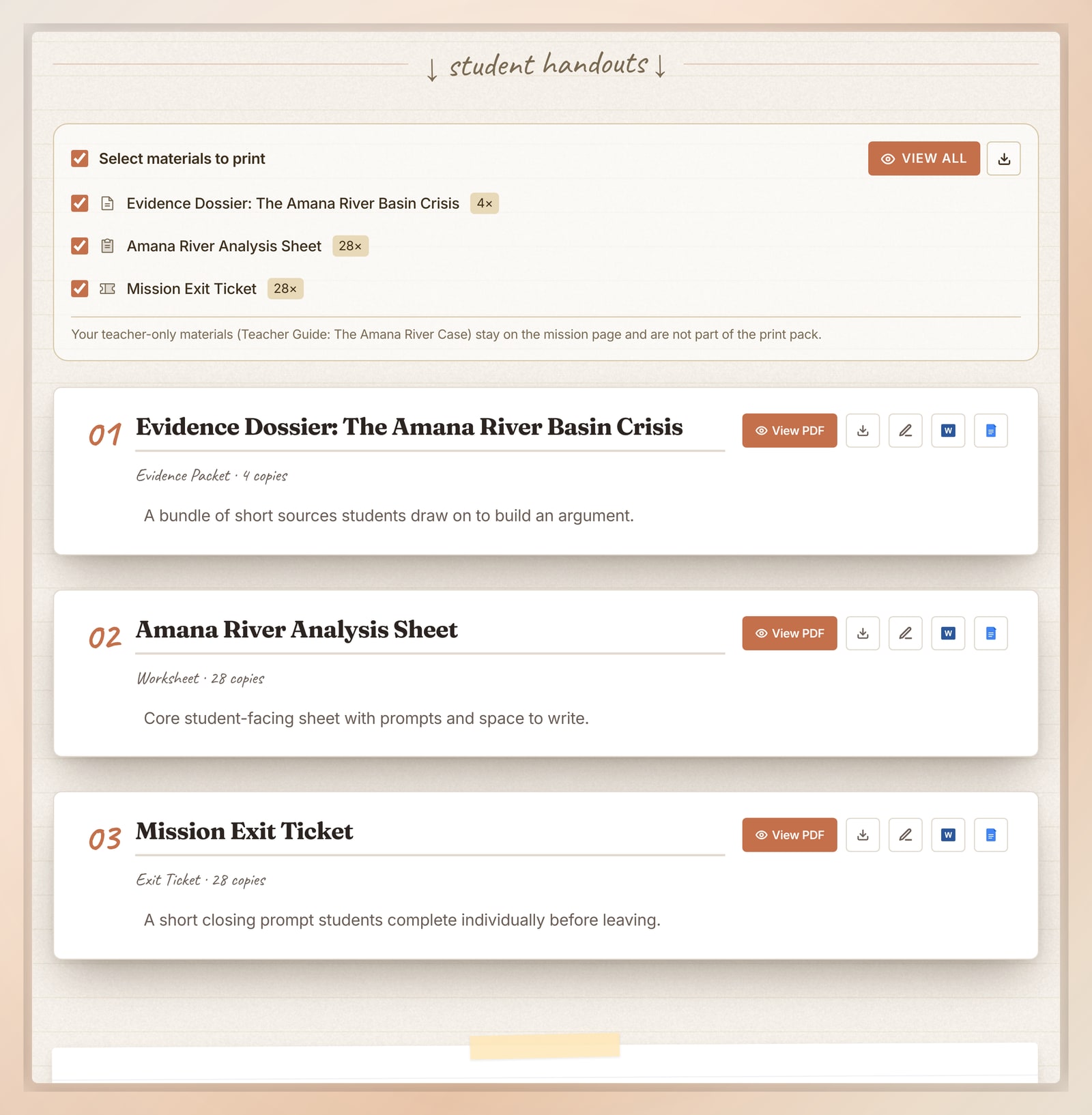
- Worksheets paired with case studies have deeper analysis tasks. When a mission includes a dossier or primary source, the worksheet now requires at least one task that asks students to defend a position with two pieces of evidence, weigh option A versus option B citing the data, or identify which evidence is strongest. The fill-in-the-blanks pattern that left students with university-level dossiers and elementary-level tasks is gone.
- Exit tickets test transfer, not rehearsal. Exit-ticket prompts now ask students to apply the lesson's framework to a new situation: a different case, a different time period, a different scenario. The previous pattern of "use evidence from the dossier to defend a different option for the case you just analyzed" is rewritten at generation time.
- Materials are connected to the lesson flow. Every printable material is referenced where the lesson actually uses it. No more poster template that the lesson never tells you to bring out.
Smarter timing

- Lesson timings actually add up. Briefing + action + debrief always sum to the total time you set. No more "60-minute lesson" that turns out to be 75 minutes when you do the math.
- Smarter default lesson lengths per methodology. Case studies default to about 50 minutes, think-pair-share to about 15, mock trials to about 75.
- Mid-lesson formative checks on longer lessons. Missions of 45 minutes or more now include at least one in-flight check for understanding, not just an exit ticket at the end.
Clearer group roles
Group roles each own a distinct deliverable now. Generic "Reporter / Note-taker / Time-keeper" patterns get replaced with named roles that each hold a piece the others cannot substitute for: "Economic Sector Analyst owns the economic dossier", "Devil's Advocate stress-tests every conclusion", "Synthesizer integrates the three sector analyses into the final position". A group really works as a group when each role holds something the others depend on, not when everyone takes turns at parallel sub-tasks.
We also tightened
- Multi-modal and metacognitive flags at generation time so lessons that lack auditory, visual, or kinesthetic access, or a debrief metacognitive prompt, get caught before you see them.
- Mission metadata is consistent across every mission, so dashboard filters and curriculum search behave reliably.
- Material types match the grade band: secondary-only types (debate prep, mock-trial briefs) are no longer generated for elementary missions, and vice versa.
- Subjects without full curriculum coverage are filtered from the public subject browser so you don't hit empty pages.
Still on the way
Two things we're working on next: bringing the same depth principles to lessons for younger learners (where the analytic worksheet shape and the dossier-style tasks don't quite fit), and extending the full quality treatment to the methodologies that haven't yet been through the rebuild.
Tell Flo or write to us if anything here lands differently in your classroom than it should. What teachers run into is what we work on next.