Inductive reasoning from a tangible artefact toward identification
Mystery Object
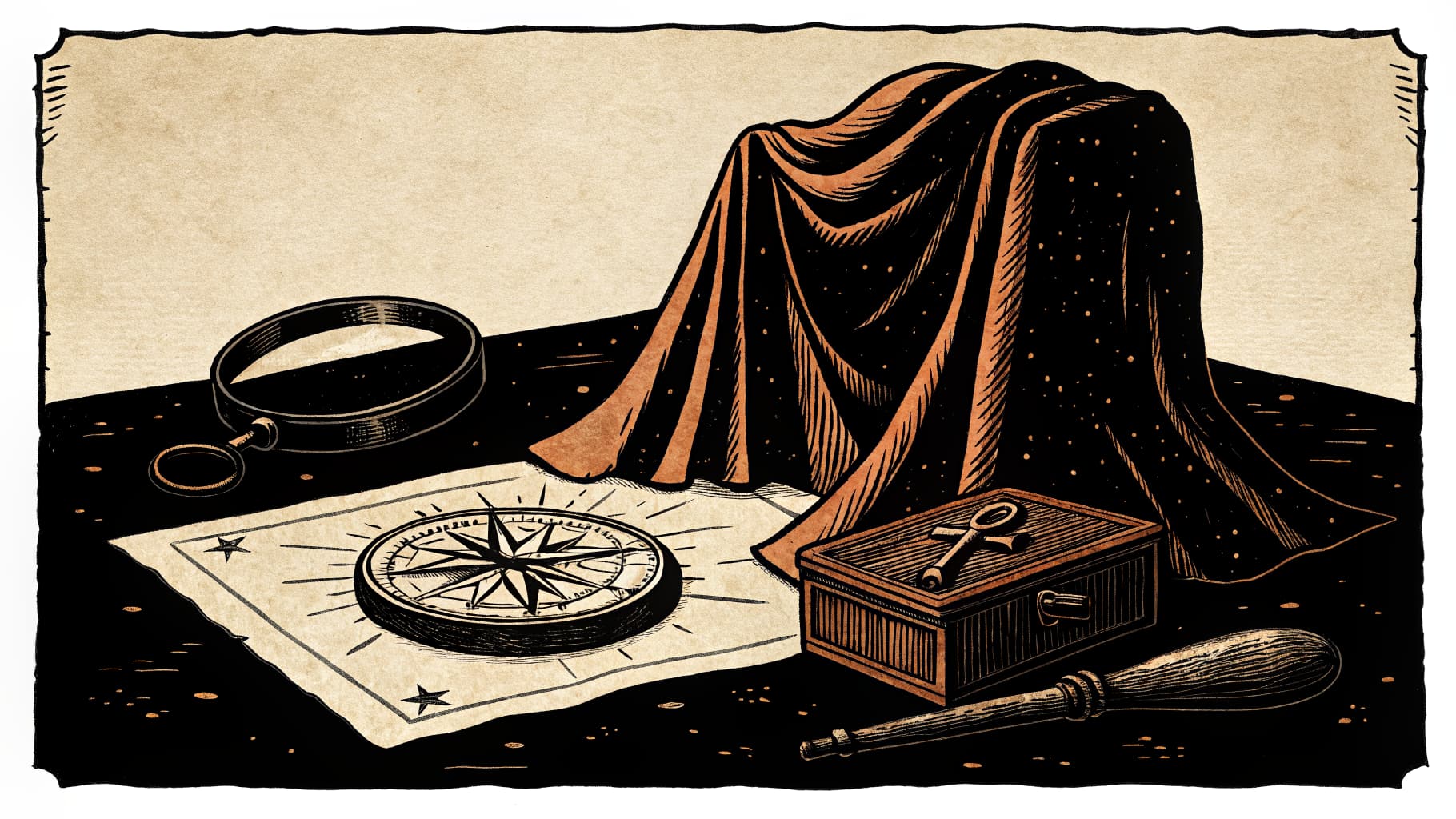
A mysterious object (real artefact or high-resolution image) is presented without context. Students systematically observe, log details, generate hypotheses about what it is and how it was used, then weigh evidence to reach a provisional identification. Teacher reveals the object's identity at the end, and students compare their reasoning to the truth. Builds inductive reasoning and the habit of evidence-based hypothesis formation.
What is Mystery Object?
Mystery Object is an inductive-reasoning routine grounded in Jerome Bruner's foundational 1961 paper 'The Act of Discovery.' Bruner's argument was that knowledge constructed inductively (through discovery from evidence) produces stronger conceptual frameworks, better transfer, and longer retention than the same content delivered didactically. The discovery process forces learners to identify which features matter and which don't, which is the cognitive work that produces durable understanding. Bruner's framing remains one of the most-cited foundations of inquiry-based pedagogies generally, and Mystery Object is its most distilled classroom application.
Eilean Hooper-Greenhill's 2007 work on museum education extended Bruner's discovery framing to artifact-based learning specifically. Her central finding is that physical objects function as 'thinking tools' that pull observation and inference out of learners who would not engage with the same content presented as text. A photograph of a plow with a caption produces yawns; the actual plow held in the hand produces questions. This object-as-thinking-tool effect is robust across age groups, from museum programs for kindergarteners through professional training for adults, and it is what gives Mystery Object its leverage in K-12 classrooms across multiple subjects.
The mechanics center on three design choices that protect the inductive routine. First, the artifact must be genuinely unfamiliar to the class. If students recognize it in 30 seconds, the routine is over before it starts; they pattern-match to a memorized fact rather than reasoning from observation. Borrowing from a different discipline (a sextant in a math class), a different era (a vintage measuring tool from a pre-digital era), or a different culture (an unfamiliar musical instrument) is what produces the unfamiliarity that the inductive routine requires. Familiar objects produce trivia, not reasoning.
Second, the structured observation protocol must run before any guessing. Students examine the artifact and record observations against a frame (color, size, material, marks, signs of wear, evidence of use) for 5-10 minutes silently. Without the frame, students jump to identification before they have evidence; with the frame, observations accumulate and the eventual hypotheses are grounded in the evidence rather than in pattern-matching. The observation phase is the engine; cap it at 5-10 minutes minimum, not maximum.
Third, the delayed-disclosure rule. The teacher does not reveal the answer until the structured guessing has run its course, even when students arrive at the wrong identification. Acknowledging the first correct guess shuts down the rest of the class's reasoning, because students at that point stop thinking and listen for confirmation. The reveal happens at the end, after every group has presented their hypothesis and their reasoning, via a disclosure script that connects the disciplinary explanation back to the student hypotheses. Naming what observation work each hypothesis did right is what makes the reflection productive.
Hypothesis-generation is structured. After observation, in small groups, students propose what the object is, citing the specific observations that support each hypothesis. Multiple competing hypotheses are the goal, not consensus; students learn that two reasonable people can look at the same evidence and reach different conclusions, and that the next move is to test which hypothesis better explains the observation set. Hypotheses that fail to account for a noted feature are revised or discarded. This is disciplinary reasoning in miniature.
Implementation in subjects without obvious artifacts requires creativity. In math, an unusual measuring tool (slide rule, sextant, foreign currency) invites mathematical observation. In literature, a primary-source object referenced in a text (an antique pen, a period costume detail) anchors an interpretive routine. In history, the canonical home, the catalog of usable artifacts is enormous. In science, natural specimens (rocks, seed pods, bones, leaves), historical instruments, and unfamiliar modern technologies all work. The constraint is unfamiliarity, not subject; teachers can find Mystery Object material for almost any topic with effort.
The methodology works best in grades 3-8 (excellent), where students have the observation discipline and the language to articulate hypotheses but have not yet formed strong identification habits that override observation. K-2 (good with simpler artifacts and more teacher scaffolding) and 9-12 (good but starts losing novelty unless artifacts are sufficiently unusual) are the wings. Subject affinity is strongest in social studies (excellent), science (excellent), and the arts (excellent), and good in math and ELA, and limited in SEL where the observe-reason-disclose structure does not naturally map. Mystery Object pays back the prep effort in a single 50-90 minute lesson, making it one of the most efficient discovery-pedagogy routines on a per-class-time basis.
How to Run Mystery Object: Step-by-Step
Select an unfamiliar artifact
5 min
Choose an object students cannot immediately identify. Borrow from a different discipline, culture, or era; the unfamiliarity is the pedagogical resource.
Set the observation protocol
5 min
Provide a structured observation frame (color, size, material, marks, evidence of use). Without it, students jump to identification before they have evidence.
Run silent observation
5 min
Students examine the object and record observations individually for 5-10 minutes. The silence prevents social proof from anchoring early hypotheses.
Share observations, not yet hypotheses
6 min
Students share what they noticed. Resist the move to identification; the observation phase is what fuels the reasoning phase.
Generate competing hypotheses
6 min
In small groups, students propose what the object is, citing the observations that support each hypothesis. Multiple competing hypotheses are the goal, not consensus.
Test hypotheses against the evidence
6 min
Each group's hypothesis is checked against the observation set. Hypotheses that fail to account for a noted feature are revised or discarded.
Reveal and reflect
5 min
Disclose the artifact's actual identity, purpose, and context. The reflection compares the disciplinary explanation to the student hypotheses, naming what observation work each one did right.
BEFORE YOU TEACH THIS
Read the Teacher's Guide first.
Flip Education's Teacher's Guide walks you through how to facilitate any active learning lesson: mindset, pre-class checklist, phase-by-phase facilitation, and a Quick Reference Card you can print and bring to class.
Read the Teacher's Guide →When to Use Mystery Object in the Classroom
- Topics with rich material culture (history, archaeology, biology)
- Building inductive reasoning from sensory evidence
- Capturing curiosity in students who don't engage with text
- Cross-disciplinary observation skill-building
Subject Fit
Principles and Practice of Mystery Object
Bruner, J. S. (1961, Harvard Educational Review, 31(1), 21-32)
Argued that knowledge constructed inductively (through discovery) produces stronger conceptual frameworks, better transfer, and longer retention than the same content delivered didactically. The discovery process forces learners to identify relevant features, which is the cognitive work that produces durable understanding.
Hooper-Greenhill, E. (2007, Routledge)
Extended Bruner's discovery framing to artifact-based learning, demonstrating that physical objects function as 'thinking tools' which pull observation and inference out of learners who would not engage with the same content presented as text. Object-based inquiry produces measurable gains in observational and inferential reasoning across age groups.
Research Evidence for Mystery Object
Mystery Object as a discrete classroom routine has no dedicated peer-reviewed RCTs of the technique in isolation. Bruner's discovery learning has been studied extensively at the program level (e.g., Mayer 2004 review of discovery-based instruction in Educational Psychologist) but not for the specific Mystery-Object routine as practiced in the classroom.
Common Mystery Object Mistakes and How to Avoid Them
Picking an artifact students recognize immediately
If the class identifies the object in 30 seconds, the inductive routine is over before it starts. Borrow from a different discipline, era, or culture. Unfamiliarity is the pedagogical resource; protect it.
Confirming the right answer mid-routine
Acknowledging the first correct guess shuts down the rest of the class's reasoning. Acknowledge ('strong hypothesis') without confirming, and reveal at the end after every group has presented.
Skipping the structured observation protocol
Without a frame (color, size, material, marks, signs of wear), students jump straight to identification before they have evidence. The observation phase is what fuels the reasoning phase; cap it at 5-10 minutes minimum.
Disclosing via a label on the artifact
A labeled photo or tagged museum specimen undercuts the inductive routine. Strip identifying labels before showing the object. The disclosure is the teacher's job at the end of the routine, not the artifact's job upfront.
Using a decorative object
Pure aesthetic objects produce only descriptive talk ('it's pretty, it's old'). Pick artifacts that invite functional inference (how was this used? where did this come from?) so the discipline's thinking shows up.
How Flip Education Helps
Curated artifact catalog (cross-disciplinary, era-shifted)
Flip Education curates artifacts cross-disciplinary and era-shifted so students cannot immediately identify them. Catalog spans museum-style objects, natural specimens, foreign currencies, vintage tools, anything genuinely unfamiliar to a typical contemporary classroom.
Structured observation protocol (color, size, material, marks, wear)
Each artifact ships with a printable observation protocol covering color, size, material, marks, and signs of wear. Without the protocol, students jump straight to identification before they have evidence; the protocol is what fuels the inductive reasoning phase.
Hypothesis-generation framework + competing-account rubric
After observation, Flip provides a hypothesis-generation framework that requires students to cite specific observations supporting each hypothesis. The competing-accounts rubric scores how well each hypothesis explains the observation set, not which hypothesis is right.
Disclosure-and-reflection script
Reveal happens at the end of the routine via a disclosure script that connects the disciplinary explanation back to the student hypotheses, naming what observation work each one did right. The reflection is the assessment; this is where Bruner's 'act of discovery' becomes durable.
Tools and Materials Checklist for Mystery Object
- Genuinely unfamiliar artifact (or high-resolution image without identifying labels)
- Structured observation protocol (color, size, material, marks, signs of wear)
- Silent-observation timer (5-10 minutes minimum)
- Hypothesis-generation framework (cite the observation that supports each hypothesis)
- Competing-accounts rubric (how well does each hypothesis explain the observation set?)
- Disclosure-and-reflection script for the reveal at unit-end
- Loan agreement with museum or collection if borrowing physical artifacts (optional)
Frequently Asked Questions About Mystery Object
What if I don't have a real artifact?
A high-resolution image works for grades 3+, particularly if students can rotate or zoom it. Avoid labeled photos; the label disclosure undercuts the inductive routine. School museum loans, family heirlooms, and natural specimens (rocks, seed pods, bones) are excellent free sources.
What if students guess the answer immediately?
Pick a different object. Mystery Object only works when the artifact is genuinely unfamiliar to the class; familiar objects produce trivia, not inductive reasoning. Borrow from a different discipline or era to find unfamiliar items.
How long is the observation phase?
5-10 minutes of structured observation (color, size, material, marks, signs of wear) before any guessing starts. Rushing observation forces students into hypotheses that aren't grounded; 5 minutes is the floor.
Should I confirm right answers as students guess?
Not until the routine has run. Confirming the first correct guess shuts down the rest of the class's reasoning. Acknowledge ('that's a strong hypothesis') without confirming, and reveal at the end after every group has presented.
Can I use this for math?
Yes, with mathematical objects: an unusual measuring tool (slide rule, sextant), a non-standard die, a foreign currency. The artifact must invite mathematical observation; pure decorative objects produce only descriptive talk.
Classroom Resources for Mystery Object
Free printable resources designed for Mystery Object. Download, print, and use in your classroom.
Observation Protocol Sheet
Students record observations against a structured frame before any guessing begins.
Download PDFHypothesis-Generation Prompts
Sentence starters that force students to ground each hypothesis in a specific observation.
Download PDFPost-Disclosure Reflection
After the reveal, students compare their hypothesis to the disciplinary explanation.
Download PDFRelated
Methodologies Similar to Mystery Object
Ready to try this?
- Read the Teacher's Guide →
- Generate a mission with Mystery Object →
- Print the toolkit after generating
Generate a Mission with Mystery Object
A complete lesson plan, aligned to your curriculum.