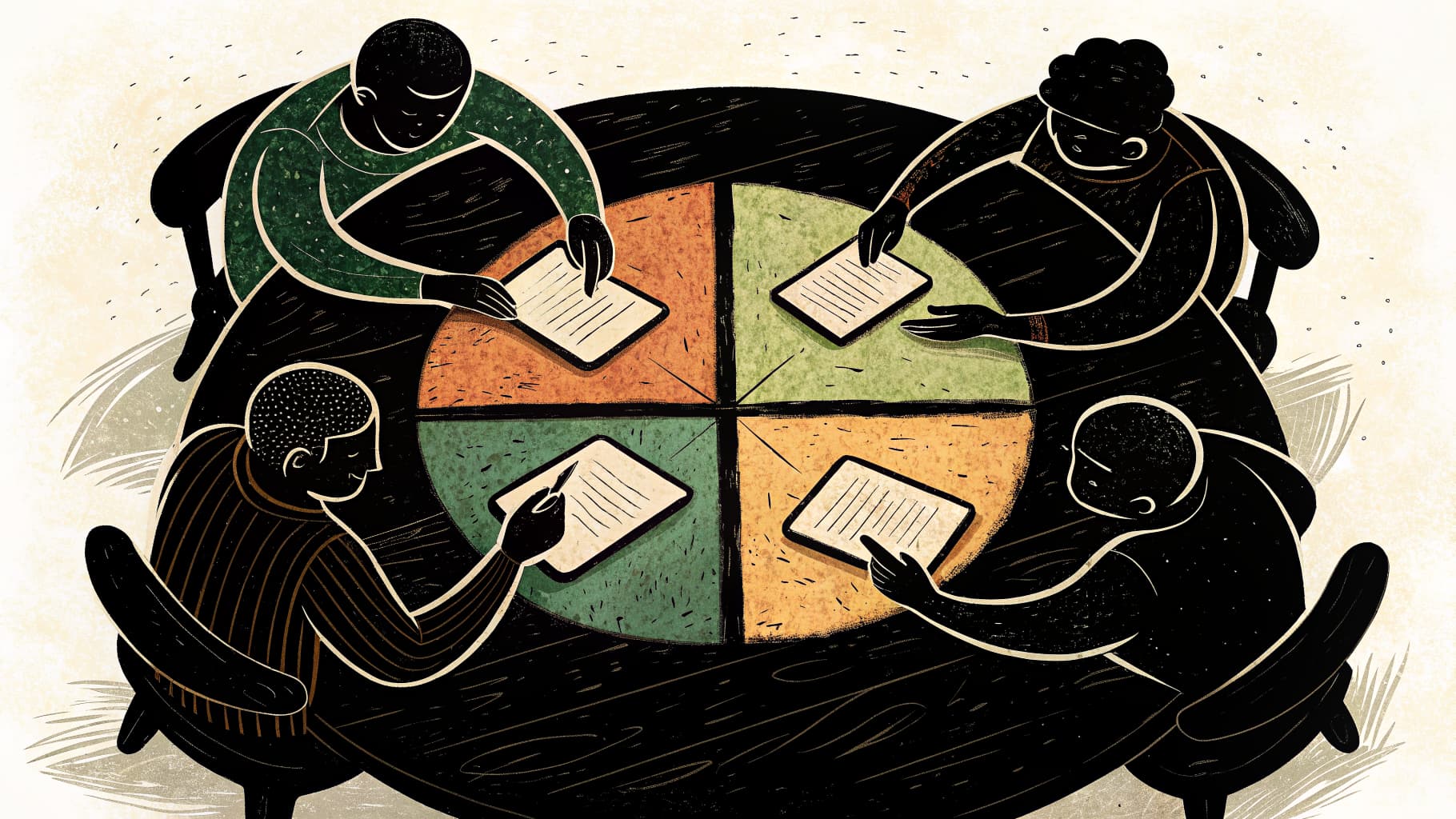
In a 7th-grade classroom, students aren't reading about the Constitutional Convention. They're living it. One student, playing a Virginia delegate, argues for proportional representation with surprising historical fluency. Another, a cautious New Yorker, defends states' rights. A pragmatic Pennsylvanian is working both sides toward compromise. The room buzzes with debate and with the kind of engaged thinking that no worksheet can produce.
That's role play working as intended.
Role play is one of the most direct paths out of passive instruction. This guide covers what it involves, how to run it well, and the specific moves that separate a memorable classroom experience from one that devolves into performance.
What Is Role Play?
Role play is an active learning strategy where students take on assigned personas within a structured scenario. Rather than reading about a historical event, a scientific dilemma, or a social conflict, students reason through it from the inside, constrained by what their character knows, motivated by what their character wants, and limited by what their character can do.
The method's roots run through John Dewey's learning-by-doing tradition. Its academic grounding came from Charles Bonwell and James Eison's landmark 1991 report, Active Learning: Creating Excitement in the Classroom, which identified role play as a superior method for developing higher-order thinking compared to lecture formats. Dinesh Rao and Ieva Stupans built on this in their 2012 study in Innovations in Education and Teaching International, finding that role play enhances student engagement and creates a safe environment for practicing empathy and professional skills that traditional instruction simply cannot replicate.
What role play adds that reading and discussion cannot is the experience of reasoning under constraint. A student can analyze a 1960s civil rights debate. But to argue as a specific person in that debate, with that person's information, fears, and objectives, requires understanding the historical forces that shaped that position from the inside. That cognitive demand is the point.
Where Role Play Fits Best
Role play is most powerful in social studies, ELA, SEL, and the arts, where perspective-taking and human motivation sit at the heart of the curriculum. It also works well in science when exploring ethical dilemmas: bioethics simulations, environmental policy negotiations, or debates over historical scientific decisions. Math is the exception; the method has limited application where content is predominantly procedural.
Grade-level fit is broad. By 3rd grade, most students have the social cognition to sustain a character perspective. The method reaches full power in middle and high school, where content complexity and social-emotional development both support sustained, nuanced simulations.
How It Works
Good role play doesn't emerge spontaneously. It's built on preparation, clear structure, and a disciplined debrief. Here's how to put it together.
Step 1: Define Your Learning Objectives
Before writing a single character card, know exactly what you want students to understand or be able to do by the end. Role play is a vehicle, not a destination. "Students will understand the Constitutional Convention" is too broad. "Students will explain why smaller states feared proportional representation and what compromises resolved that conflict" gives you something to design toward.
The learning objective drives every other decision: who the characters are, what the scenario requires, and what a good debrief question looks like.
Step 2: Develop the Scenario
The scenario is the container for the learning. It should present students with a real decision to make, a conflict to resolve, or a problem to solve, one that cannot be navigated without engaging curriculum content. Keep it bounded. The best role plays have a clear starting point, a clear decision point, and a defined endpoint. Open-ended scenarios that can go anywhere often go nowhere.
Step 3: Write Detailed Character Cards
This is the single most important preparation step. A character card that gives a student only a name and a position on an issue produces improvisation. A card that gives them objectives (what this character wants), constraints (what limits their choices), a knowledge set (what they know and don't know), and a history (how they got here) produces genuine perspective-taking.
Each card should answer four questions: Who am I? What do I want? What do I know? What am I afraid of? The richness of that information is what makes role play an academic exercise rather than a drama exercise.
Step 4: Set the Stage
Before the role play begins, explain the rules of engagement clearly. What are the physical and temporal boundaries? What's the decision or outcome students are working toward? What should a character do if they genuinely don't know what their character would say?
This is also the moment to address the distinction between representing a position and endorsing it. For any role play involving historically painful or morally complex positions, students need to hear explicitly: playing this character is an act of analytical understanding, not personal agreement. Without this framing, some students will refuse to engage, and others will conflate character reasoning with their own in the debrief.
Step 5: Step Back and Observe
Once the role play is running, your job changes. Move from instructor to observer. Take notes on key moments, surprising arguments, and misconceptions that surface in character reasoning. These notes become the raw material for the debrief.
Resist the urge to intervene every time the discussion gets complicated. That friction is often where the learning happens. Intervene when the activity goes off the rails structurally: when character breaks derail the scenario or when students stop having to engage the content to participate.
Step 6: Conduct a Structured Debrief
The debrief is where role play's learning potential is either realized or wasted. Before any discussion begins, create a formal break-out-of-character moment. Have students stand up, take three steps away from where they were sitting, and hear you say clearly: "You are no longer [character name]. You are yourself."
Without this deliberate transition, students carry character reasoning into the discussion in ways that blur the line between analysis and performance.
Then move through four stages of questioning, in order:
- Description: What happened in the role play? What choices did characters make?
- Analysis: Why did characters make those choices? What forces shaped their reasoning?
- Evaluation: What does this simulation reveal about the historical moment, ethical issue, or social dynamic that a textbook account wouldn't show?
- Reflection: What did playing this character reveal to you that reading about the topic wouldn't have?
The sequence matters. Rushing to evaluation before students have described and analyzed what happened produces shallow conclusions that don't stick.
Tips for Success
Give Students Enough Information to Think, Not Just Perform
The most common reason role play fails academically is thin character briefs. When students don't know what their character believes, wants, or fears, they improvise randomly. Improvisation produces entertainment; character knowledge produces thinking. Write detailed role cards, especially for complex simulations with multiple stakeholders.
Build In Consultation Time
When discussion gets difficult, students revert to their own voices unless you build in structured support. Give characters designated "consultation time" to confer with teammates who share their role before responding to a challenge. This keeps the role play going and gives students a moment to think before they speak in character.
Require the Content
Role play without content engagement is theatre. Every significant choice a character makes should require the student to apply curriculum knowledge: historical context, scientific evidence, textual analysis. If a character can navigate the entire simulation on common sense alone, the activity hasn't been designed to require learning.
Handle Sensitive Topics with Care
Some simulations involve difficult content, historical violence, systemic discrimination, moral dilemmas with no clean resolution. Brief students on the purpose beforehand. Establish clear opt-out procedures so no student is forced into a position that causes genuine distress. Check in during the activity.
Research on role-playing in social-emotional learning contexts confirms that the method builds empathy and self-regulation most effectively when students feel psychologically safe. Safety isn't a soft concern; it's a prerequisite for the cognitive openness the method requires.
Assess Preparation and Reflection, Not Performance
The logistical challenge of grading role play leads many teachers to skip formal assessment altogether. A better approach: assess what you can evaluate with a clear standard. Use a rubric that rewards preparation (quality of character research), content accuracy (did the character's arguments reflect the curriculum?), and reflection (how deeply did the student analyze the experience in the debrief?). A structured exit ticket or written reflection after the simulation ensures quieter students have a vehicle for demonstrating their thinking.
, Rao & Stupans, Innovations in Education and Teaching International, 2012Role play enhances student engagement and provides a safe environment for practicing professional skills and empathy that traditional instructional formats cannot replicate.
What This Looks Like in Practice
In a 10th-grade science class studying environmental policy, each student receives a character card for a water rights negotiation: a local farmer, a city water utility director, an environmental advocate, a state regulator. Each card specifies not just the character's position but their data, partially overlapping, partially conflicting information about water usage, drought projections, and economic costs.
Students spend 15 minutes preparing, then 25 minutes in a structured negotiation. The teacher observes and takes notes. In the debrief, students step out of character and spend 20 minutes analyzing why the negotiation went the way it did, what information asymmetries shaped the outcome, and what this reveals about how environmental policy actually gets made. The content learning, water systems, tradeoffs, policy process, is inseparable from the experience.
How Flip Education Supports Role Play
Flip Education generates complete, ready-to-use role play materials aligned to your curriculum and grade level. Each generation includes:
- Printable character cards with detailed role briefs covering background, objectives, constraints, and knowledge sets
- A topic-specific scenario calibrated to your learning objectives and deliverable in one class session
- A facilitation script with numbered action steps, teacher tips for managing the simulation, and intervention strategies for common breakdowns
- Debrief discussion questions that move through the description-analysis-evaluation-reflection sequence, plus a printable exit ticket for individual assessment
The materials are designed for offline, facilitator-led delivery. Put the device down and run the room.