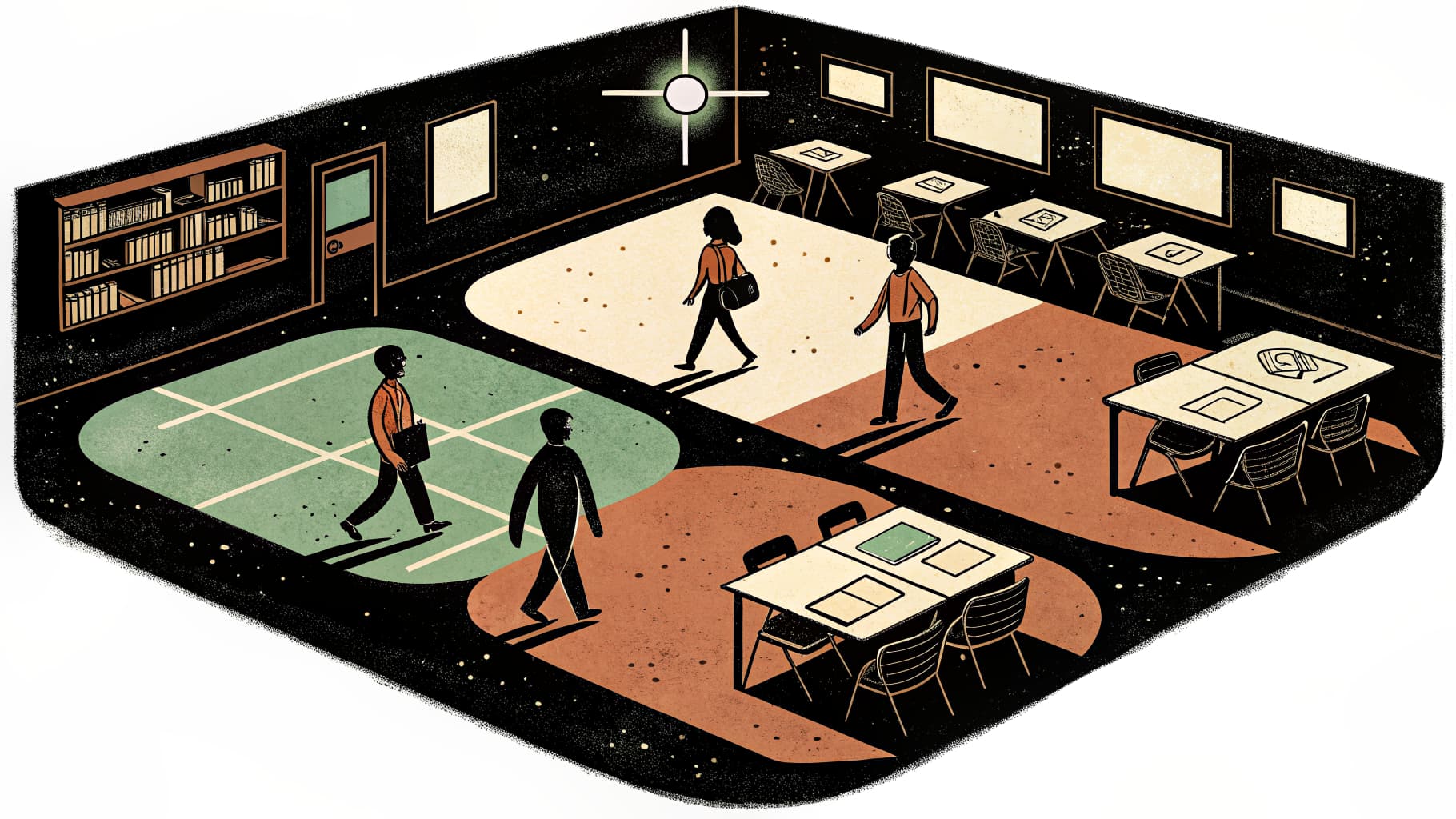
What would happen if you took your next whole-class discussion and spread it across six stations on the walls? Students would stop waiting for their turn to speak. Everyone would be writing, reading, and responding at once. And you'd end up with a room full of annotated thinking you could actually read, photograph, and build on.
That's a gallery walk: and it's one of the most practical active learning strategies available to K-12 teachers precisely because it requires no special technology, no unusual room setup, and no change to your curriculum. You post content, students move through it, and the discussion happens in writing before it happens out loud.
The catch is that a poorly designed gallery walk devolves into an expensive craft session: students wander, sticky notes fill up with single-word responses, and noise levels climb without any corresponding depth of thought. The difference between those two outcomes is almost entirely a function of preparation.
This guide walks through everything from first-time setup to nuanced adaptations, so your next gallery walk actually works.
What Is a Gallery Walk?
A gallery walk is a student-centered activity in which small groups rotate through stations posted around the classroom, examining materials and responding in writing. Gallery walks are designed to activate prior knowledge, promote higher-order thinking, and scale across subjects and grade levels.
The name borrows from the experience of moving through an art gallery: you stop at each exhibit, take it in, and react. In a classroom, the "exhibits" can be teacher-created prompts, data visualizations, student work samples, primary source documents, or open-ended scenarios. Students add sticky notes, annotations, or written responses at each station, then rotate and read what their peers left behind.
The critical distinction from a standard class discussion is simultaneity. In a whole-class format, one student talks while thirty wait. In a gallery walk, every student responds at the same time. This distributed participation is the primary engagement advantage: there's no audience, only participants.
Gallery walks also lend themselves naturally to building prior knowledge before a new unit, checking understanding mid-lesson, or synthesizing learning at the end of a topic. Theformat flexes to serve all three purposes with only minor adjustments to the prompts.
Step-by-Step Instructions for Classroom Setup
The Collaborative for Teaching and Learning is direct about what determines whether a gallery walk succeeds: thoughtful preparation of materials and unambiguous instructions before students move. Here is a reliable five-step setup process.
1. Design Your Stations Decide what students will encounter at each stop. Options include:
- Open-ended prompts ("What is the strongest argument against this position?")
- Data sets or graphs requiring interpretation
- Quotations or excerpts for analysis
- Student drafts or project prototypes for peer feedback
- Problem scenarios that require a group decision
One prompt per station is almost always better than three. Vague or overloaded prompts produce vague, scattered responses.
2. Post Materials and Label Stations Clearly
Number or letter each station in large, visible font. Use chart paper taped to walls, printed pages in clear sleeves, or sections of whiteboard. Leave enough physical space between stations so groups don't crowd into each other. Place a pen or a stack of sticky notes at each one before class starts.
3. Brief Students Before Anyone Moves
Walk students through the rotation schedule, the time allotted at each station, and what kind of response you expect. Are they adding an original idea? Responding directly to what the previous group wrote? Voting on the strongest argument with a dot sticker? Clarity here is not optional. Ambiguous instructions produce off-task behavior within the first rotation.
4. Facilitate Without Leading
Once students are moving, your job is to observe. Circulate through the room, listen to small-group conversations, note which ideas are generating disagreement, and flag any misconceptions you'll want to address in the debrief. Resist the urge to jump in and explain; this is your best window for formative assessment.
5. Debrief as a Class
Bring everyone back together and process what they saw. Anchor the conversation in specific stations: "I noticed three different groups at Station 4 disagreed about the same point. Let's look at that." This debrief converts the distributed activity into a shared body of knowledge.
Gallery Walk Variations for Modern Classrooms
The standard rotation format is a starting point. Creative ASL Teaching's documentation of gallery walk variations illustrates how much the format can flex without losing its essential character.
The Silent Gallery Walk
Students rotate and respond with zero verbal communication. This version works well for tasks that require individual analysis before group synthesis: examining primary sources, reviewing statistical claims, or giving written feedback on student work. It also substantially reduces ambient noise, which mattersfor classes where sound management is a concern.
The Digital Gallery Walk
Stations exist in a shared digital space rather than on physical walls. Tools like Padlet or Miro allow students to post text, images, links, and embedded video. Digital variations are especially useful for hybrid and online settings where physical rotation isn't possible. A secondary benefit: digital stations generate a permanent, searchable record of student thinking that physical sticky notes never can.
The Carousel Brainstorm
Each station starts completely blank, with a single generative prompt. Groups add their ideas, rotate, then build on what the previous group contributed. By the final rotation, each sheet reflects the cumulative thinking of the entire class. This format works well for idea generation at the start of a unit or for surfacing what students already know about a topic.
The Feedback Gallery
Post student work directly: essay drafts, design prototypes, lab reports, or creative projects. Ask other groups to leave structured written feedback using a sentence frame ("One thing that works well is... / One question I have is..."). This turns the gallery walk into a peer-review engine that operates more efficiently than one-on-one written feedback exchanges.
Inclusive Strategies: Adapting for Neurodivergent Students
Gallery walks carry assumptions that deserve examination. Open-ended movement, ambiguous social expectations, and elevated noise all impose cognitive demands that some students find organizing and others find dysregulating. Students with ADHD, autism spectrum disorder, or sensory sensitivities may struggle with exactly the features teachers find energizing.
Targeted modifications address each challenge directly.
Visual timers. Post a countdown at the front of the room or at each station. Knowing precisely when the group moves removes a significant source of anxiety for students who struggle with unpredictable transitions. A large projected timer visible from anywhere in the room requires no individual accommodation.
Sensory-friendly zones. Designate one station or corner as a lower-stimulation area. Students who need to process more quietly can use this space without disrupting the rotation logic. Noise-canceling headphones can support students who find ambient conversation difficult to filter.
Structured social scripts. Print a sentence frame at each station: "I think this shows... / I agree because... / A question I have is..." This reduces the cognitive overhead of navigating unstructured peer discussion and gives students something to anchor to when conversation stalls.
Explicit role assignments. Within each group, assign a reader, a recorder, and a timekeeper. Clear roles reduce the social ambiguity that can be dysregulating, and they distribute contribution more equitably than open-ended group dynamics.
Modified rotation scope. For students who find frequent transitions difficult, permit them to visit two or three stations rather than cycling through all of them. Pair these students with a known, trusted peer who can serve as a consistent social anchor across rotations.
Classroom Management: Preventing Bottlenecks
Classroom management is the most common reason gallery walks fail. When thirty students rotate simultaneously through six stations, crowding and noise follow quickly. The SERC Pedagogy in Action resource on gallery walk implementation challenges identifies space limitations and sound levels as the two primary logistical barriers.
Stagger starting points. Assign each group a different station rather than sending everyone to Station 1. This distributes the class evenly from the first rotation and prevents the pile-up that makes early stations unusable.
Use a consistent rotation signal. A bell, a projected countdown, or a verbal cue gives everyone the same clear signal to move. Rotations that happen organically tend to fragment: some groups move early and some linger, which destroys the even distribution you set up at the start.
**Define a traffic direction.**Tell students which direction to rotate, clockwise in most room layouts, and mark the path with floor arrows or wall indicators. This eliminates cross-traffic during transitions, which is where most time is lost.
Cap group size at four. Groups of three or four produce the best participation rates. Five or more students at a single station creates passenger dynamics where some students stand back while others write.
Build in overflow tasks. Some stations generate more discussion than others. Include a "bonus question" at each one for groups that finish before the signal, rather than letting them drift.
For very large classes (35 or more students), consider splitting the group: half the class rotates while the other half works independently, then switches. This halves the crowd at each station and gives you two full rounds of observation time rather than one chaotic one.
Assessment Strategies and Rubrics
The gallery walk functions as a direct window into student understanding, a formative assessment tool that lets teachers observe thinking rather than just its finished product. That observation only produces usable data if you collect it intentionally.
Carry a clipboard checklist. During the rotation, note which students contribute to discussion, which write responses, and which are mostly observing. A simple grid with student names and three columns (speaking, writing, listening) takes about thirty seconds per group pass.
Photograph station outputs before clearing them. Sticky-note walls disappear at the end of class. A photograph of each completed station creates a record you can reference when planning the next lesson, identifying patterns in misconceptions, or providing written feedback.
Exit ticket tied to peer learning. After the debrief, ask students to write one idea they encountered at a station that they wouldn't have generated on their own. This surfaces whether the collaborative dimension of the activity actually produced new thinking, or whether students mostly repeated what they already knew.
A Simple Participation Rubric
| Level | Descriptor |
|---|---|
| 4 – Exceeds | Contributes original ideas at multiple stations; builds explicitly on peer responses; poses follow-up questions in writing |
| 3 – Meets | Contributes ideas at most stations; reads and acknowledges peer responses |
| 2 – Approaching | Contributes at some stations; minimal engagement with what peers wrote |
| 1 – Beginning | Present at stations but not contributing; requires redirection to participate |
Gallery Walk vs. Four Corners vs. Socratic Seminar
Gallery walks are one of several movement-based discussion strategies available to K-12 teachers. Choosing among them depends entirely on what students need to do with the content.
Gallery walks work best when you want students to encounter multiple materials or perspectives simultaneously, generate written responses, and build on peer thinking over time. The strategy distributes participation broadly and produces a tangible artifact, the annotated stations, that can anchor future lessons. It handles synthesis, review, and formative check-ins particularly well.
Four Corners is faster and more structured. You post four response options (Strongly Agree / Agree / Disagree / Strongly Disagree) and students physically position themselves based on their answer to a prompt. Groups discuss within and across positions. The format works for surfacing opinions, setting up a debate, or gauging a class's prior stance on a contested question. It produces no written record and doesn't accommodate complex materials.
Socratic Seminar is the right choice when deep, text-anchored dialogue is the objective. It develops speaking and listening skills more directly than a gallery walk, but all participation flows through one location and through verbal communication, which concentrates the activity in students who are already verbally confident, unless the discussion is carefully structured.
| Strategy | Best for | Written output | Movement | Noise level |
|---|---|---|---|---|
| Gallery Walk | Multi-perspective synthesis, review | Yes | High | Moderate–high |
| Four Corners | Opinion polling, debate setup | No | Low | Moderate |
| Socratic Seminar | Text analysis, structured argumentation | No | None | Moderate |
No single format is universally better. A history teacher covering a contested policy decision might open with Four Corners to surface existing opinions, run a Socratic Seminar after students have read primary sources, and use a gallery walk at the end of the unit to consolidate and compare what different groups took away.
What This Means for Your Classroom
A gallery walk, done well, is a structured conversation spread across physical space. Students are not just moving, they're analyzing, responding to peers, and encountering ideas they wouldn't have reached in a lecture or a single-group discussion. Many teachers find that gallery walks increase student output and active engagement compared to static formats, and the strategy is well-regarded for building collaborative communication skills by requiring students to read, respond to, and build on peer work in real time.
The strategy is also honest about what it demands: physical space, preparation time, and a willingness to manage transitions and noise. Those challenges are real, but they're manageable with the steps above.
Start with four stations and three focused prompts before you design a twelve-station showcase. Get a sense of how long your students need at each stop, which prompt types generate substantive responses, and how your room's acoustics affect group conversation. Then adapt.
The goal is not a flawless gallery walk on the first attempt. The goal is to give students a reason to engage with content and with each other in a way that a worksheet or a slide deck simply cannot replicate, and to build the classroom culture where that kind of active, collaborative thinking becomes routine.