Most peer discussion activities have a hidden design flaw: some students do the thinking while others quietly coast. They nod, write things down, look engaged , and contribute nothing. Give one get one fixes this with a structural rule so simple it's almost elegant: you cannot receive an idea until you have given one.
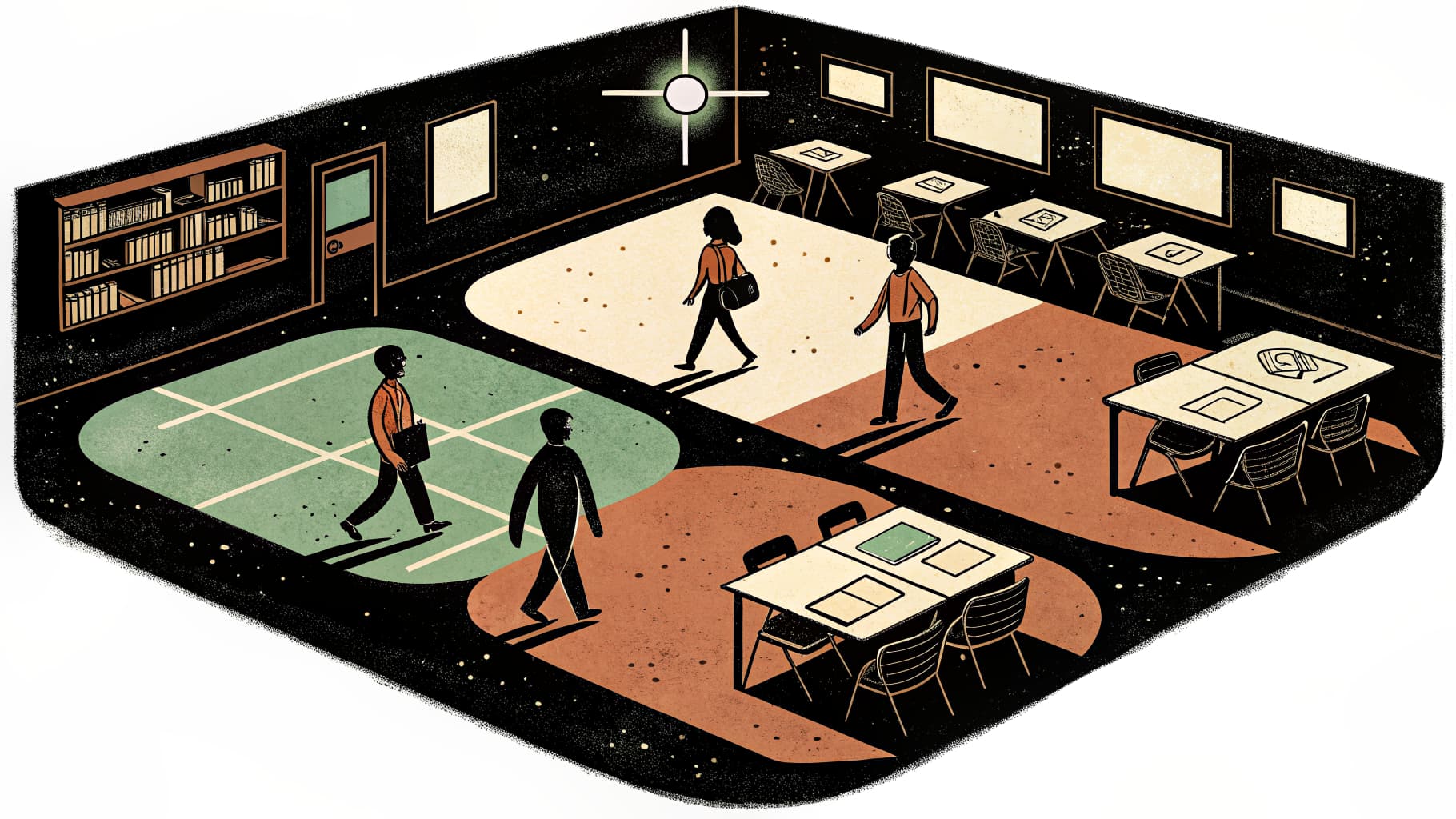
That single constraint changes the social dynamics of a classroom. Every student needs something real to offer before any exchange begins, which means every student must think first. The activity gets the whole class on their feet, moving across the room, trading ideas with a rotating series of partners. By the time the class reconvenes, the understanding that was scattered unevenly across individual students has been shared, tested, and expanded.
What Is Give One Get One?
Give one get one is a structured peer exchange activity. Each student generates a set of original ideas in response to a prompt, then circulates around the room to trade one idea for one new idea with each partner they meet. The format is bilateral by design: you share one idea, your partner shares one back, you both record what you received in your own words, then move to a new partner.
The method draws on decades of research into cooperative learning. In a 2008 meta-analysis published in Psychological Bulletin, Cary Roseth, David Johnson, and Roger Johnson found that cooperative goal structures consistently outperform competitive and individualistic ones for both academic achievement and positive peer relationships , and these effects held across subjects and grade levels. Keith Topping's 2005 review in Educational Psychology adds the key mechanism: students learn more when they must organize and communicate knowledge to peers than when they receive the same information passively. Give one get one operationalizes both findings in a format that takes 20 minutes, requires no technology, and works from grade 3 through grade 12.
How It Works
Step 1: Prepare the Recording Sheet
Before class, print a simple grid , a three-by-three or four-by-four table depending on how many exchanges you're planning. Reserve one box at the top for the student's own initial idea, and label the remaining boxes "Partner 1," "Partner 2," and so on. Keep it simple. The sheet is a tool for capturing and organizing thinking, not a traditional worksheet.
Step 2: Set the Prompt and Protect Think Time
Give students a clear, open-ended question tied to current content, then close your mouth and give them 3 to 5 minutes to write. This is the step most teachers abbreviate and most students need most. Students who enter the exchange without a developed idea become passive receivers , they collect from partners but contribute nothing substantive in return. The silent writing phase is what makes the exchange genuine, because everyone needs something real to give.
Good prompts are specific enough to generate focused responses but open enough to allow multiple valid answers. "What do you remember about the water cycle?" will produce shallower exchanges than "What would happen to life on Earth if the water cycle stopped, and why?" The second prompt requires reasoning, not just recall.
Step 3: Establish Movement Rules Before Anyone Stands
Tell students exactly how the exchange will work before anyone stands up. Describe the physical logistics: how to signal for a partner (a raised hand works), how long each exchange will last, what the rotation signal sounds like, and the rule that each exchange partner must be someone new.
For structured randomization, use colored index cards, playing card suits, or numbered slips. Students find partners with the same color or number. This small logistical step pays off considerably in the diversity of thinking students encounter, compared to letting them self-select.
Step 4: Execute the Exchange
Student A shares one idea. Student B listens, then restates it in their own words before writing it in their grid. Then B shares an idea, A listens and restates before recording. The paraphrase requirement is not optional , it is the mechanism that separates a genuine learning exchange from a transcription exercise. To restate something in your own words, you have to understand it well enough to reformulate it. That cognitive work is where the learning happens. Each exchange should run 2 to 3 minutes. If students are rotating every 45 seconds, the exchanges are too shallow to produce real thinking.
Step 5: Rotate Partners
Signal rotation (a bell, a clap pattern, a verbal cue) and have students move to a new partner. Three to five exchanges usually produces enough diversity of ideas without exhausting the activity's energy. Monitor the room as exchanges happen. Listen for ideas being restated inaccurately and intervene quietly if a misconception starts circulating , more on managing that below.
Step 6: Synthesize Before You Debrief
Bring everyone back together with a synthesis task before opening whole-class discussion. Ask students to look across everything they collected and identify the three most important ideas, the idea that surprised them most, or the connections they notice between different partners' contributions. Then surface and clarify key concepts as a class , especially any that got distorted during peer exchange.
This synthesis phase is where collected notes become organized understanding. Without it, students leave with a grid full of ideas they've never ranked, connected, or evaluated.
Tips for Success
Give Think Time Its Full Weight
The most common shortcut is cutting individual writing time short. Teachers feel the urge to keep energy moving, and sitting quietly can feel like a lull. Resist it. Students who haven't written anything substantive before the first rotation become idea collectors, not idea traders. Five minutes of silence before the first exchange produces dramatically richer sessions than two minutes. The preparation phase determines the quality of everything that follows.
Make Paraphrasing Non- Negotiable
If you see students writing their partner's exact words into their grid, stop the class briefly and reinforce the expectation: "Write what they said using your own words. If you can't explain it differently, ask your partner to say more." This single norm prevents the activity from collapsing into copying and keeps the cognitive demand where it belongs.
Design for Partner Diversity
When students self-select partners, they gravitate toward friends who think similarly. The most productive exchanges happen between students who bring different prior knowledge or perspectives. Structured randomization, meaning any system that prevents students from choosing their own partners, produces measurably richer idea sets across the class. It also builds a more equitable culture: quieter students and students with different academic profiles get into genuine intellectual contact with peers they'd otherwise never exchange ideas with.
Adapt for Multilingual Learners
Give one get one has a particular advantage for students learning English as an additional language. The low-stakes bilateral structure lets students test phrasing, ask for clarification, and refine their ideas in a paired conversation before any whole-class exposure. Consider allowing multilingual learners to sketch ideas rather than write them, to use sentence starters, or to record in their home language and translate during synthesis.
Build In a Stationary Station for Students with Limited Mobility
For students who cannot circulate, create a fixed station in the room. Mobile students rotate to include them as one of their exchange partners. Students at the stationary station often end up with the richest exchanges of anyone in the room, having spoken with the widest range of partners by the end of the activity.
When to Use Give One Get One
The format works at multiple points in a lesson sequence, but the use case should shape the prompt.
Before New Instruction
Use it to activate prior knowledge. Ask students what they already know about the topic. The exchange surfaces what the class brings to the lesson and lets you calibrate where to begin.
Mid-Unit
Use it to consolidate partial understanding. Students exchange what they've learned so far, and the gaps in what circulates tell you what hasn't yet been understood.
Before a Test
Use it as a review structure. Students trade key concepts, definitions, or examples. The bilateral obligation means everyone reviews actively rather than passively rereading notes.
As an Alternative to Debate
When you want students to encounter multiple perspectives on a question without the competitive dynamic of formal debate, give one get one surfaces diverse viewpoints in a lower-stakes format.
FAQ
What This Means for Your Classroom
Give one get one works because it doesn't ask students to be naturally collaborative. It builds the conditions that make collaboration productive: individual thinking before any exchange, a bilateral obligation that eliminates passive participation, a paraphrase norm that requires comprehension rather than transcription, diverse partner assignment that exposes students to a genuine range of thinking, and a synthesis task that converts a list of collected ideas into organized understanding.
The format requires a printed grid, a clear prompt, and a teacher willing to hold the paraphrase norm consistently. The intellectual result, a classroom where every student has thought, shared, listened, reformulated, and synthesized, is what the research on cooperative learning and active engagement says produces durable understanding.
Flip Education generates curriculum-aligned give one get one sessions with prompt cards, rotation scripts, and exit tickets built for your specific topic and grade level. If you want a ready-made version for your next lesson, your students are already equipped to run this activity. The only variable is the prompt.