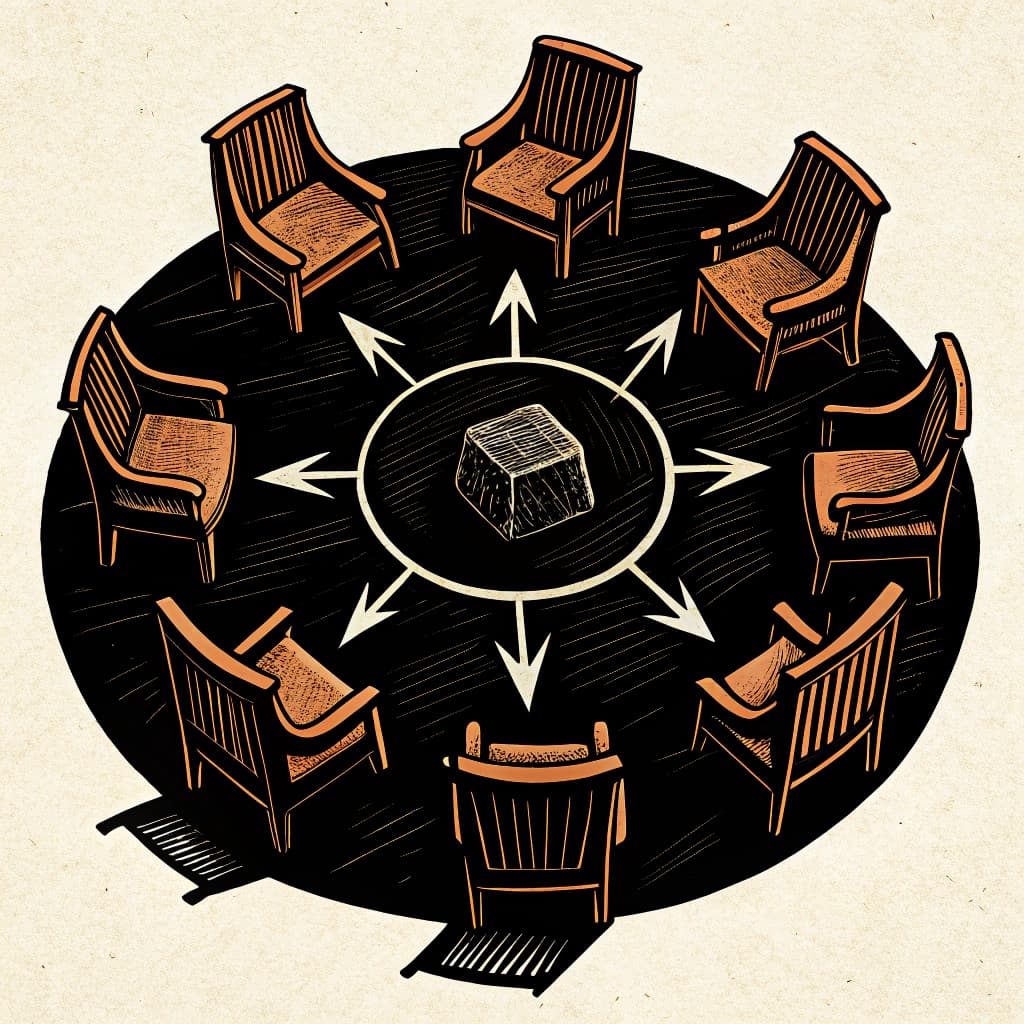
Each person contributes in turn, no skipping
Round Robin
Students sit in a circle (or small groups). A prompt is given, and each person must contribute an idea, response, or question in turn. No one can skip, and no one can interrupt. Creates equal airtime and prevents dominant voices from taking over. Simple structure, powerful for equity and inclusion.
What is Round Robin?
Round Robin is one of the most structurally simple cooperative learning methods: each participant contributes in turn, sequentially, with no participant contributing twice until everyone has contributed once, and one of the most effective for its primary purpose: ensuring that all students have an equal opportunity to participate in a group exchange. The structure's simplicity is also its limitation: without thoughtful implementation, it can produce a series of individual monologues rather than genuine collaborative dialogue.
The method's origins are in parliamentary procedure and collective decision-making, the principle that a group's collective intelligence is best served when all members' perspectives are heard before synthesis and decision-making begin. Applied to learning contexts, this translates to: before any student's idea dominates, every student's idea should be on the table. The sequential contribution structure enforces this principle by design, preventing the natural emergence of dominant voices and ensuring that every student's thinking is counted.
The individual writing or thinking time before the round begins is the variable that most reliably determines the quality of contributions. Students who are put on the spot in a Round Robin, asked to contribute without any preparation time, produce whatever comes first: familiar ideas, social performance, or anxious deflection. Students who have spent 2-3 minutes writing their own response before the round begins arrive with something genuine to say, and the round becomes an authentic exchange of developed thinking rather than a sequential performance of availability.
The 'pass with return' norm, any student may pass their turn and be revisited at the end of the round, is a simple facilitation technique that substantially reduces the anxiety associated with sequential contribution. When students know they can defer without penalty, the performance pressure of knowing "my turn is coming in three people" decreases enough that students actually listen to what their peers are saying rather than rehearsing their own upcoming contribution. The pass option also removes the awkward power dynamic of forcing a student to speak who genuinely has nothing to say.
Round Robin's parallel structure, multiple small groups doing rounds simultaneously rather than one full-class sequential round, dramatically increases the efficiency of the method for large classes and produces richer content for the synthesis phase. When four groups of 6-8 students each run their own rounds simultaneously, all 30 students have contributed in 10 minutes rather than 30, and the synthesis phase can compare across the groups' contributions: What ideas appeared in multiple groups? What ideas were unique to one group? What does the variation across groups tell us about the diversity of perspectives in the class?
The synthesis after the round is where the list of contributions generated by Round Robin is converted into understanding rather than inventory. Without synthesis, Round Robin produces a series of individual contributions that coexist without interacting, informative but not transformative. The synthesis asks: Which of these contributions are similar? How can we group them? Which are in tension with each other? Which is most important and why? These questions turn a collection of individual thinking into collective understanding.
How to Run Round Robin: Step-by-Step
Form Small Groups
2 min
Divide the class into heterogeneous groups of 3-5 students to ensure a variety of perspectives and manageable turn-taking.
Pose an Open-Ended Prompt
2 min
Provide a question or problem that has multiple possible answers or facets to ensure the activity doesn't end prematurely.
Provide Silent Think Time
2 min
Give students 30-60 seconds of 'wait time' to process the question and formulate their individual thoughts before speaking.
Designate a Starting Student
3 min
Identify one student in each group to begin the sharing process to avoid confusion and delays in starting.
Facilitate Sequential Sharing
3 min
Instruct students to share one idea at a time, moving clockwise or counter-clockwise, while others listen without interrupting or debating.
Monitor and Record
3 min
Circulate the room to ensure groups are following the turn-taking rules and have one student per group act as a recorder for the shared ideas.
Conduct a Whole-Class Debrief
3 min
Transition from small groups to a full-class discussion to synthesize the best ideas and address any common misconceptions discovered during the rounds.
BEFORE YOU TEACH THIS
Read the Teacher's Guide first.
Flip Education's Teacher's Guide walks you through how to facilitate any active learning lesson: mindset, pre-class checklist, phase-by-phase facilitation, and a Quick Reference Card you can print and bring to class.
Read the Teacher's Guide →Common variants
Classic round-robin
Students take turns in order, each contributing one idea. No one speaks twice until everyone has spoken once. Protects the quiet voices.
Pass-option round-robin
Students may pass, but the facilitator comes back to them. Keeps the inclusion norm without forcing on-the-spot answers.
Research Evidence for Round Robin
Kagan, S. (1994, Kagan Publishing, San Clemente, CA (Book))
The Round Robin structure promotes equal participation and individual accountability, which are core components of the PIES (Positive Interdependence, Individual Accountability, Equal Participation, and Simultaneous Interaction) framework.
Johnson, D. W., Johnson, R. T. (2009, Educational Researcher, 38(5), 365-379)
Structured turn-taking in cooperative groups significantly increases the level of cognitive processing and social support compared to unstructured group discussions.
Slavin, R. E. (2011, Handbook of Research on Learning and Instruction)
Structured group interactions like Round Robin improve student achievement by ensuring that all learners engage in the elaboration of ideas rather than remaining passive observers.
Common Round Robin Mistakes and How to Avoid Them
Students who repeat what others said
Once an idea is spoken, subsequent speakers often default to agreement or minor variation. After the first few contributions, require that each new response adds something not yet mentioned. Post a running list of ideas on the board so students can check uniqueness before speaking.
Thinking time that's too short
When students are put on the spot, they say whatever comes first rather than their best thinking. Give 1-2 minutes of individual writing time before the round begins. This levels the playing field between fast processors and reflective thinkers.
Awkward silences that derail the flow
A student who blanks during their turn can freeze the entire activity. Establish a 'pass with return' norm: any student can pass and will be revisited at the end of the round. This removes performance pressure while maintaining full participation.
Rounds that are too long
Round-Robin with 30 students in a full-class circle exhausts energy long before everyone speaks. Keep rounds to 8-10 students, run multiple simultaneous small-group rounds, and report out key ideas rather than having every group repeat everything.
No synthesis after the round
The list of ideas generated by Round Robin is raw material. What do you do with it? Categorize the responses, identify the most surprising or challenged ideas, or use the list as the starting point for a class discussion. The round generates; the debrief analyzes.
How Flip Education Helps
Printable prompt cards and response scaffolds
Get a set of printable prompt cards designed to guide students through a structured round-robin discussion, along with response scaffolds to ensure everyone contributes. These materials provide a clear framework for equal participation. Everything is ready to print and use for a quick, focused activity.
Curriculum-aligned prompts for equal participation
Flip generates prompts that are directly tied to your lesson topic and grade level, ensuring the activity supports your curriculum standards. The round-robin process is designed to fit into a single class period, allowing every student to share their thoughts on the subject. This alignment keeps the focus on your learning goals.
Facilitation script and numbered timing steps
The generation includes a briefing script to set the stage and numbered action steps with teacher tips for managing the timing and flow of the discussion. You receive intervention tips for encouraging quieter students and ensuring the conversation stays on topic. This structure keeps the activity moving smoothly.
Reflection debrief and exit tickets for closure
End the session with debrief questions that help students identify common themes and diverse perspectives shared during the round-robin. The printable exit ticket provides a way to assess individual understanding of the topic. A final note links the activity to your next curriculum goal.
Tools and Materials Checklist for Round Robin
- Timer (for pacing)
- Whiteboard or projector (for prompt display)
- Markers or pens
- Chart paper or digital document (for recording ideas, optional) (optional)
- Index cards (for student notes or prompts) (optional)
- Digital collaboration tool (e.g., Jamboard, Padlet for recording ideas) (optional)
- Seating arrangement flexibility
Frequently Asked Questions About Round Robin
What is the Round Robin teaching strategy?
Round Robin is a cooperative learning technique where students take turns sharing ideas orally in a small group setting. It is designed to promote equal participation and ensure that every student's voice is heard during the brainstorming process.
How do I use Round Robin in my classroom?
To use Round Robin, pose a question with multiple possible answers and have students sit in small groups. Each student shares one idea at a time in a circle, continuing until all ideas are exhausted or a time limit is reached.
What are the benefits of Round Robin for students?
The primary benefits include increased engagement, improved social skills, and the development of active listening. It specifically helps shy or marginalized students contribute without having to compete for airtime with more dominant peers.
What is the difference between Round Robin and Round Table?
Round Robin is primarily an oral sharing strategy, whereas Round Table involves students passing a single piece of paper and writing their responses. Both share the same goal of sequential participation but utilize different modalities of communication.
How can I prevent students from passing during Round Robin?
Allowing a 'pass' is acceptable to reduce anxiety, but you can encourage participation by providing 'think time' before the sharing begins. If a student passes, the group should return to them at the end of the round to see if the other ideas sparked a new thought.
Classroom Resources for Round Robin
Free printable resources designed for Round Robin. Download, print, and use in your classroom.
Round Robin Contribution Tracker
Students record each idea shared around the circle, noting who contributed it and what connections they see between ideas.
Download PDFRound Robin Reflection
Students reflect on how the structured, sequential sharing changed the quality of the group's collective thinking.
Download PDFRound Robin Facilitation Roles
Assign roles to keep the round robin structured, inclusive, and productive.
Download PDFRound Robin Discussion Prompts
Prompts designed for sequential sharing, organized by the type of thinking they generate.
Download PDFSEL Focus: Social Awareness
A card focused on listening, patience, and equitable participation during round robin sharing.
Download PDFReady to try this?
- Read the Teacher's Guide →
- Generate a mission with Round Robin →
- Print the toolkit after generating
Generate a Mission with Round Robin
A complete lesson plan, aligned to your curriculum.