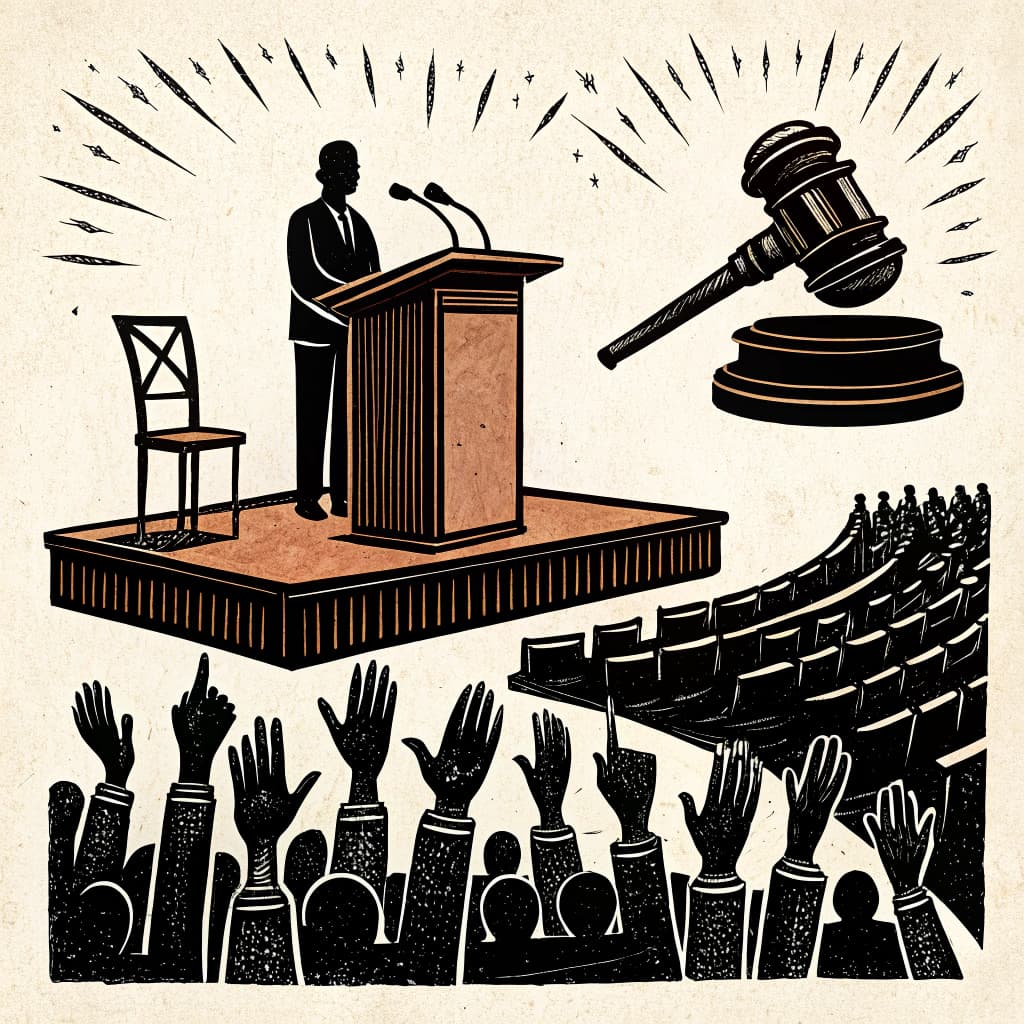
A structured simulation in which students represent competing stakeholders to deliberate a civic or curriculum issue and reach a community decision, directly developing the multi-perspective analysis and evidence-based argumentation skills assessed in CBSE, ICSE, and state board examinations.
Town Hall Meeting
The Town Hall Meeting adapts India's own democratic deliberation traditions, Gram Sabha, Panchayati Raj, and parliamentary procedure, into a classroom simulation in which student groups represent diverse stakeholders debating a real curriculum issue. Grounded in NEP 2020's emphasis on civic engagement and competency-based learning, the format asks students in Classes VI to XII to research a specific position, present evidence-backed testimony, respond to counter-arguments, and work toward a community resolution. Designed for Indian class sizes of 35 to 50 students using a stakeholder bloc structure, it develops the evaluative reasoning, persuasive communication, and multi-perspective analysis that board examinations increasingly test in analytical and source-based questions.
What Is Town Hall Meeting? Definition, Origins, and Why It Works
The Town Hall Meeting arrives in Indian classrooms with a remarkable indigenous precedent that most international descriptions of the methodology completely miss. The Gram Sabha , the constitutionally mandated village-level assembly in which every adult member of a gram panchayat may speak and vote on local governance , is one of the oldest living democratic deliberation formats in the world, codified in the 73rd Constitutional Amendment of 1992. Panchayati Raj institutions, the Lok Sabha's Question Hour, and the tradition of public hearings before infrastructure projects all embody the core logic of the Town Hall: multiple stakeholders, competing interests, and a structured process for reaching a decision that the community can live with. When introducing this methodology, situating it within this constitutional and civic tradition , rather than presenting it as an imported North American format , typically produces an immediate shift in student engagement and perceived legitimacy.
For NCERT Social Science and Political Science teachers, the alignment is direct and deep. Class VI Social and Political Life introduces panchayats and urban local bodies; Class IX Democratic Politics explores electoral processes, federalism, and democratic institutions; Class XI Political Theory includes chapters on rights, liberty, and justice that generate genuine stakeholder conflicts; Class XII Politics in India Since Independence covers policy decisions , the Green Revolution, dam displacement, environmental regulation , that are inherently multi-stakeholder problems. ICSE Civics from Class VI through X builds systematically toward understanding government at local, state, and national levels. State board Social Studies syllabi, while varying considerably, almost universally include chapters on democratic governance and civic responsibility. The Town Hall is not supplementary to this content; it is a way of enacting it.
The structural challenge in Indian schools is class size and time. A classroom of 40 to 50 students cannot function as a single Town Hall , the format breaks down when more than 15 to 20 people hold distinct speaking roles. The solution is stakeholder blocs rather than individual stakeholders. In a class of 45, assign five stakeholder groups of eight or nine students each: one group represents farmers, another represents the state government, a third represents environmental activists, a fourth represents the industrial lobby, and a fifth acts as the Gram Panchayat or municipal council. Each group deliberates internally, selects a spokesperson for formal testimony, and prepares written position statements so that all members contribute regardless of speaking time. This bloc structure scales the methodology to Indian class realities without diluting its civic logic.
The 45-minute period is insufficient for the full Town Hall arc, and Indian teachers should plan the activity explicitly as a multi-period sequence. A workable structure across three periods: the first period for issue introduction, stakeholder assignment, and initial group research using NCERT chapters, newspaper extracts, or teacher-prepared briefing sheets; the second period for group preparation, drafting opening statements, and anticipating counter-arguments; the third period for the formal hearing and resolution vote, followed by a 10-minute debrief. For schools where curriculum completion pressure makes three periods difficult to justify, a compressed two-period format works if written stakeholder position cards are prepared in advance as homework, with the first period used for in-class group finalisation and the second for the hearing itself.
Board exam culture creates a specific dynamic that Town Hall facilitators must manage explicitly. CBSE's shift toward competency-based assessment, reflected in the restructured Class X and XII Social Science papers since 2020, increasingly rewards students who can evaluate competing perspectives, construct evidence-based arguments, and analyse the trade-offs in policy decisions , exactly the cognitive moves the Town Hall demands. Making this connection explicit before the simulation dramatically increases student investment: 'The skills you are practising today , presenting evidence, acknowledging counter-arguments, proposing reasoned compromises , are the skills the new board paper examines in its five-mark analytical questions.' Frame the activity as examination preparation done through immersive experience, not in spite of it.
The teacher's neutrality is the hardest cultural adaptation this methodology requires in Indian schools. Students from Classes VI through XII have been socialised to seek the teacher's approval signal before committing to a position. When students present their stakeholder testimony and then glance at the teacher for confirmation, the teacher's job is to look down at an observation sheet and record notes. Do not nod. Do not raise an eyebrow. Do not signal that one group is performing better than another until the post-simulation debrief. Indian students interpret any teacher signal , however subtle , as indicating the 'correct' position, and this ends genuine deliberation. The structured observational role , writing notes on argument quality, evidence strength, and deliberative process , gives the teacher something purposeful to do while maintaining the neutrality the format requires.
Language deserves particular attention in the Indian Town Hall. In Hindi-medium and regional-language state board schools, the simulation can and should run in the medium of instruction. The civic vocabulary it develops , stakeholder, testimony, deliberation, resolution, consensus , is itself part of the content, and students who learn it in their first language will transfer it to formal English contexts more readily than students who encounter it first in a second language. In English-medium schools, many students will naturally code-switch to Hindi or a regional language when arguing with peers within their stakeholder group, which is fine , the formal testimony before the 'council' can still be conducted in English. This bilingual dynamic mirrors how real Indian civic institutions actually function, which is itself worth noting in the debrief.
How to Facilitate Town Hall Meeting: Step-by-Step Implementation Guide
Select a Compelling Issue
6 min
Choose a controversial, multi-sided topic relevant to your curriculum that has no single 'right' answer, such as a local zoning law or a historical policy decision.
Assign Stakeholder Roles
6 min
Distribute roles to students representing diverse interests, including community members, experts, government officials, and affected minority groups.
Conduct Evidence-Based Research
6 min
Provide time for students to research their assigned role's perspective, requiring them to find at least three pieces of evidence to support their likely testimony.
Prepare Opening Statements
7 min
Have each stakeholder group draft a concise 2-minute speech outlining their position and their specific 'asks' or recommendations for the town council.
Facilitate the Public Hearing
7 min
Arrange the room in a semi-circle and have the 'Town Council' or moderator call on stakeholders to present their testimony and answer questions from the floor.
Deliberate and Vote
7 min
Allow the decision-making body to deliberate publicly before casting a final vote on the resolution or proposed policy change.
Debrief and Reflect
6 min
Lead a whole-class discussion where students step out of their roles to analyze which arguments were most persuasive and how the process felt.
BEFORE YOU TEACH THIS
Read the Teacher's Guide first.
Flip Education's Teacher's Guide walks you through how to facilitate any active learning lesson: mindset, pre-class checklist, phase-by-phase facilitation, and a Quick Reference Card you can print and bring to class.
Read the Teacher's Guide →When to Use Town Hall Meeting: Best Classes, Subjects, and Group Sizes
- Classes VI to XII in CBSE, ICSE, and state board schools studying civics, governance, and democratic institutions
- Social Science, Political Science, History, Geography, and Environmental Studies units involving policy trade-offs or competing community interests
- Science ethics contexts: industrial development versus environmental protection, public health mandates, land use conflicts
- Schools implementing NEP 2020 civic education and competency-based learning goals requiring documented evidence of critical thinking and communication pedagogy
Subject Fit
Common variants
Issue town hall
Students take constituency roles and debate a single policy question with a neutral moderator. Works well as the capstone of a civics unit.
Panel-plus-questions town hall
A panel of role-holders answers questions from a citizen audience (the rest of the class). The audience role is active because they prepared the questions.
Why Town Hall Meeting Works: Research and Impact on Student Learning
Kahne, J., Crow, D., & Lee, N. J. (2012, Political Psychology, 34(3), 419-441)
Interactive civic learning opportunities, including simulations and discussions of civic issues, significantly increase students' later political engagement and efficacy.
Avery, P. G., Levy, B. L. M., & Simmons, A. M. M. (2013, The Social Studies, 104(3), 105-114)
Engaging in structured deliberations on public issues increases students' civic competence and their willingness to participate in community decision-making.
Common Mistakes Teachers Make with Town Hall Meeting (and How to Avoid Them)
Students arguing from general knowledge rather than assigned stakeholder interests
Indian students with strong general knowledge , common in competitive-exam-oriented schools , often abandon their assigned stakeholder role and argue from their personal view or from facts they know independently of the case. A student representing a displaced tribal community will argue using Supreme Court judgement data she memorised for a General Studies competition, rather than inhabiting the perspective of someone whose village is about to be submerged. Require stakeholder groups to submit a written position card before the hearing begins: who they are, what they specifically want, what constraints they face, and what evidence they are drawing on. This card anchors the performance to the assigned role rather than to general knowledge performance.
Unequal participation along gender and social lines
In many Indian classrooms, boys, students from economically privileged backgrounds, and students from dominant-caste groups disproportionately take formal speaking roles while others within the same stakeholder group remain silent. Left unmanaged, the Town Hall reproduces rather than challenges these patterns. Assign the formal spokesperson role by rotation rather than by group self-selection. Require that every student contributes a written line to the group's opening statement. In the hearing itself, the council chair , played by a student , should be required to direct at least two questions to members of the stakeholder group who have not yet spoken, ensuring that the quieter students in each group have a structured speaking moment.
The hearing collapses into a debate competition rather than civic deliberation
India's strong tradition of elocution competitions, Model United Nations, and inter-school debate means that many students default to performance mode the moment they are in front of an audience , eloquent rhetoric, dramatic gestures, and 'winning' over the opposing group. This defeats the Town Hall's purpose, which is deliberation toward a decision, not competitive oratory. Establish explicitly before the hearing begins that the goal is not to defeat opponents but to persuade the council toward a resolution the community can accept. Award marks for listening and responding to other stakeholders, not just for the quality of one's own speech. Require that each stakeholder's second statement must directly reference and respond to a specific claim made by a different stakeholder group.
Choosing issues that do not connect to prescribed syllabus content
Under pressure to make the activity 'interesting', teachers sometimes choose current affairs topics , a local municipal road dispute, a recent state government policy , that are genuinely engaging but disconnected from the Class's prescribed syllabus. Students cannot draw on their NCERT chapters to prepare their positions, the activity does not build content mastery, and the time cannot be defended to school administrators or parents. Every Town Hall issue should be directly mapped to a prescribed chapter: Narmada dam displacement for Class X History and Geography; urban local body governance for Class VIII Social Science; forest rights versus industrial development for Class IX civics; public health versus economic freedom for Class XI Political Theory. The issue is more compelling, not less, when students must engage with what they have studied.
No resolution mechanism, leaving the hearing feeling unfinished
Indian students accustomed to lessons with clear conclusions , the correct answer on the board, the chapter summary in the textbook , find a Town Hall that ends without a decision deeply unsatisfying, and this dissatisfaction often registers as the activity having been pointless. Even when the stakeholders cannot genuinely agree, the council must produce something: a majority vote on a specific resolution, a written statement that acknowledges the competing claims and explains the basis for the decision, or a formal record of unresolved disagreements and what further evidence would be needed to resolve them. This resolution document mirrors how real panchayat and municipal council decisions are recorded, connecting the simulation to actual civic processes students are learning about in their NCERT chapters.
How Flip Education Helps
Indian civic scenarios mapped to NCERT, CBSE, ICSE, and state board syllabi
Flip generates Town Hall scenarios drawn directly from prescribed Indian curriculum content: a Panchayati Raj hearing on water allocation for Class VIII Social Science, an urban development tribunal for Class X Geography, a Constituent Assembly debate scenario for Class XI Political Theory, or a forest rights conflict tied to Class IX History. Every stakeholder role, piece of evidence, and proposed resolution is designed so students must draw on their prescribed NCERT or textbook content to argue effectively. The scenario includes a direct mapping to the relevant chapter and learning outcome, making the session's place in the syllabus sequence immediately clear.
Stakeholder bloc role cards scaled for 35 to 50 students
Rather than individual stakeholder roles that work only for small classes, Flip generates stakeholder bloc cards designed for groups of seven to ten students, each with a shared identity, set of interests, internal role distribution (spokesperson, researcher, scribe, question-poser), and preparation tasks. Every student in a class of 45 carries a substantive responsibility throughout the activity. The printable cards include a structured position-drafting template so each group arrives at the hearing with a written opening statement, ensuring preparation quality is not dependent solely on group dynamics.
Multi-period facilitation guide and neutral moderator script
Flip produces a three-period facilitation plan with time-blocked action steps for each phase , issue introduction and research, group preparation, formal hearing and resolution , calibrated to the 45-minute period. The guide includes a neutral moderator script for the student council chair, intervention protocols for when debate becomes personal, and teacher observation prompts so the facilitator can document formative assessment evidence without accidentally signalling a preferred outcome. Common Indian classroom dynamics , code-switching, inter-group disputes, dominant voices , are addressed in specific facilitation notes.
NEP 2020 competency mapping and board exam skill connections
Every generated Town Hall mission includes an explicit mapping of session skills to NEP 2020 graduate profile competencies and to the competency-based question formats in current CBSE and ICSE board papers. The debrief questions are written in the style of five-mark analytical board questions , 'Analyse the competing interests in this hearing and explain which stakeholder's position was best supported by evidence' , giving students structured practice in the written form that examinations reward. A printable exit ticket combines reflective and content-based items for individual assessment.
Tools and Materials Checklist for Town Hall Meeting
- Role cards with character background and interests
- Policy brief (1 page) with the proposal details
- Moderator script (for the teacher or a student moderator)
- Timer for each speaker
Town Hall Meeting FAQs: Questions Teachers Actually Ask
What is a Town Hall Meeting in the classroom?
A Town Hall Meeting is a role-play simulation where students represent different community stakeholders to discuss and vote on a specific issue. It serves as an active learning strategy to teach civic engagement, public speaking, and multi-perspective analysis. Teachers use it to transform abstract curriculum topics into tangible, debated problems.
How do I assess student performance during a Town Hall Meeting?
Assessment should focus on the quality of evidence used during testimony and the alignment of the student's arguments with their assigned role. Use a rubric that evaluates research preparation, oral communication, and the ability to respond to cross-examination. You can also include a post-simulation reflection paper to assess individual content mastery.
What are the benefits of Town Hall Meeting for students?
The primary benefits include increased empathy, improved critical thinking, and the development of collaborative problem-solving skills. Students learn to see issues from diverse viewpoints, which reduces polarization and encourages evidence-based reasoning. It also provides a high-stakes, authentic audience for practicing persuasive writing and speaking.
How do I manage classroom behavior during a heated Town Hall debate?
Establish clear 'Rules of Civil Discourse' and appoint a student moderator to enforce time limits and speaking turns. Providing students with specific sentence stems for respectful disagreement can prevent personal attacks. The teacher should remain a neutral observer, only intervening if the established decorum is breached.
Can Town Hall Meetings be used for science or math topics?
Yes, they are highly effective for exploring socio-scientific issues like climate change policy, public health mandates, or land use ethics. In these contexts, students must use data and mathematical modeling to support their stakeholder's position. This demonstrates the real-world application of STEM concepts in public decision-making.
Classroom Resources for Town Hall Meeting
Free printable resources designed for Town Hall Meeting. Download, print, and use in your classroom.
Town Hall Preparation Sheet
Students prepare their position, supporting evidence, and potential counterarguments before the class town hall meeting.
Download PDFTown Hall Reflection
Students evaluate their participation in the structured class meeting and reflect on how the deliberative process shaped their views.
Download PDFTown Hall Meeting Roles
Assign formal roles to run the town hall meeting with structure and civic purpose.
Download PDFTown Hall Discussion Prompts
Structured prompts for each phase of a classroom town hall, from opening to deliberation.
Download PDFSEL Focus: Responsible Decision-Making
A card focused on civic reasoning and evidence-based deliberation during classroom town hall meetings.
Download PDFRelated
Methodologies Similar to Town Hall Meeting
Formal Debate
Students argue opposing positions on a curriculum-linked resolution, building critical thinking, evidence literacy, and oral communication skills, directly aligned with NEP 2020 competency goals.
Socratic Seminar
A structured, student-led discussion method in which learners use open-ended questioning and textual evidence to collaboratively analyse complex ideas, aligning directly with NEP 2020's emphasis on critical thinking and competency-based learning.
Fishbowl Discussion
Small-group discussion observed by the class, builds critical dialogue and analytical listening across CBSE, ICSE, and state board schools.
Ready to try this?
- Read the Teacher's Guide →
- Generate a mission with Town Hall Meeting →
- Print the toolkit after generating
Generate a Mission with Town Hall Meeting
A complete lesson plan, aligned to your curriculum.