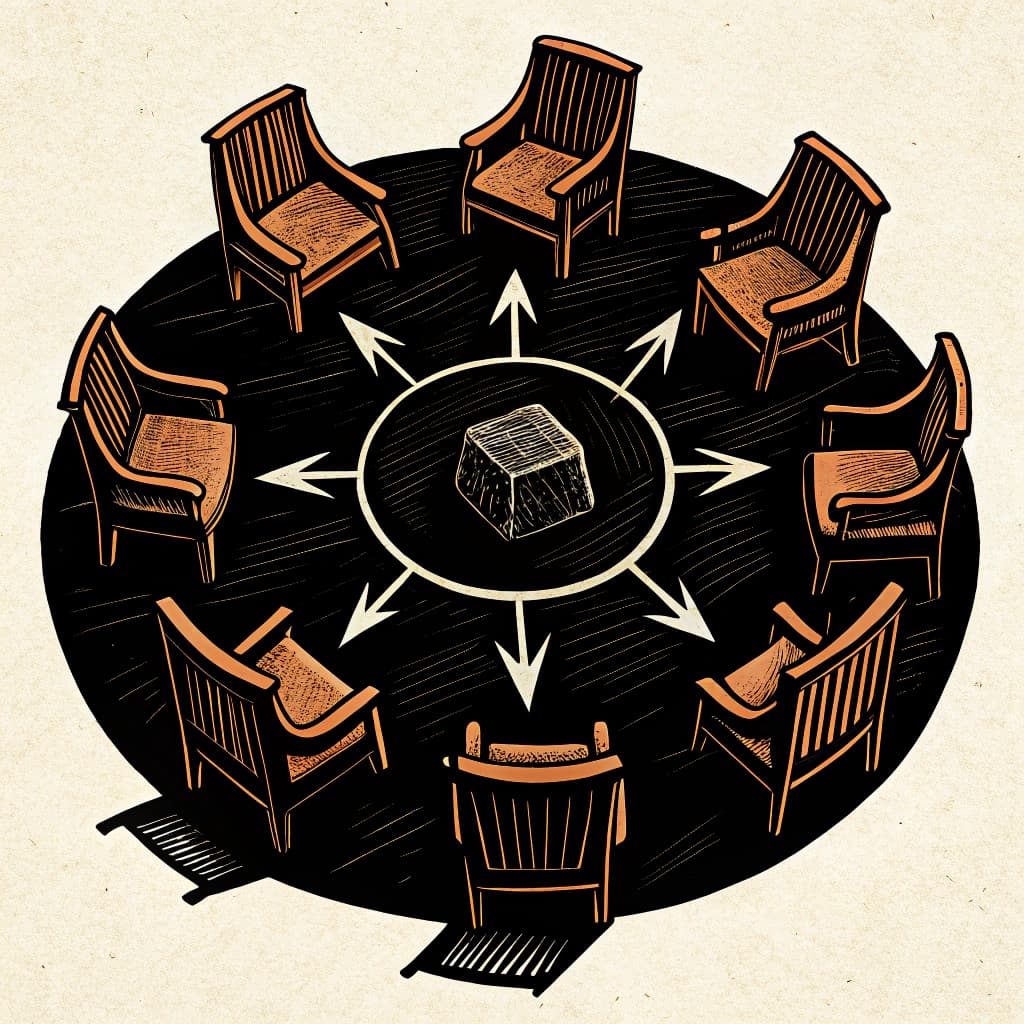
Sequential peer sharing that ensures every student contributes, adapted for Indian classrooms where large class sizes and board exam culture typically concentrate discussion among a few confident voices.
Round Robin
A structured cooperative learning method where students share one idea at a time in sequence around a small group. Run in parallel groups of 6-8, it manages sections of 40-50 students within a single 45-minute period, converts NEP 2020 competency goals into everyday classroom practice, and builds the articulation skills that board exam paragraph and essay responses require.
What Is Round Robin? Definition, Origins, and Why It Works
In Indian classrooms , whether CBSE, ICSE, or state board , the dominant instructional model has historically been teacher-led explanation followed by individual written practice. This model produces students who are skilled at receiving and reproducing information but who have had limited structured practice in articulating their own thinking to peers. Round Robin addresses this gap directly: it creates a structured occasion for every student to speak, in a culture where raising one's hand voluntarily is reserved for students who are confident they have the 'correct' answer.
The large class sizes typical of Indian secondary schools , 40 to 50 students in a single section , make full-class sequential rounds impractical. The solution is parallel small-group rounds: divide the class into groups of 6-8 students and run simultaneous rounds. In a Class 9 section of 45 students, six parallel groups of 7-8 can complete a round in 8-10 minutes, with every student having contributed. The synthesis phase then becomes a cross-group comparison: which ideas appeared across all six groups? Which idea appeared in only one group? This parallel structure is not a compromise from the full-class model , it produces richer data for synthesis.
NEP 2020's emphasis on competency-based education and holistic development explicitly calls for pedagogical methods that develop communication, critical thinking, and collaborative skills alongside content knowledge. Round Robin is one of the most accessible implementations of this vision for Indian teachers: it requires no technology, no materials beyond paper and a prompt, and fits within a single 45-minute period. The structure is also compatible with NCERT's activity-based learning recommendations, which have appeared in textbook margins and teacher guides since the mid-2000s but have been inconsistently implemented in practice.
The board exam pressure that shapes teaching and learning in Classes 10 and 12 creates a specific challenge for Round Robin: students have been trained to produce the 'syllabus answer,' and an open-ended brainstorming round can feel disorienting. The solution is framing. When a teacher introduces Round Robin as preparation for board-type questions , 'We are going to brainstorm all the factors that contributed to this event before we organise them for a paragraph response' , students understand the activity as useful rather than recreational. The round generates the raw material; the board-exam paragraph synthesises it.
Language is a dimension of Round Robin that Indian classrooms must address explicitly. In English-medium schools, students from homes where English is not the primary language may find oral sharing more anxiety-producing than written responses. The think-time phase can permit students to jot notes in any language before sharing , a small accommodation that substantially reduces the performance pressure of oral contribution in a second or third language. State board teachers working in regional-medium classrooms face no such constraint and can run Round Robin entirely in the language of instruction.
How to Facilitate Round Robin: Step-by-Step Implementation Guide
Form Small Groups
2 min
Divide the class into heterogeneous groups of 3-5 students to ensure a variety of perspectives and manageable turn-taking.
Pose an Open-Ended Prompt
2 min
Provide a question or problem that has multiple possible answers or facets to ensure the activity doesn't end prematurely.
Provide Silent Think Time
2 min
Give students 30-60 seconds of 'wait time' to process the question and formulate their individual thoughts before speaking.
Designate a Starting Student
3 min
Identify one student in each group to begin the sharing process to avoid confusion and delays in starting.
Facilitate Sequential Sharing
3 min
Instruct students to share one idea at a time, moving clockwise or counter-clockwise, while others listen without interrupting or debating.
Monitor and Record
3 min
Circulate the room to ensure groups are following the turn-taking rules and have one student per group act as a recorder for the shared ideas.
Conduct a Whole-Class Debrief
3 min
Transition from small groups to a full-class discussion to synthesize the best ideas and address any common misconceptions discovered during the rounds.
BEFORE YOU TEACH THIS
Read the Teacher's Guide first.
Flip Education's Teacher's Guide walks you through how to facilitate any active learning lesson: mindset, pre-class checklist, phase-by-phase facilitation, and a Quick Reference Card you can print and bring to class.
Read the Teacher's Guide →When to Use Round Robin: Best Classes, Subjects, and Group Sizes
- Classes 6-12 across CBSE, ICSE, and state boards
- Brainstorming before essay and paragraph writing tasks
- Prior knowledge activation at the start of a new chapter or unit
- Revision sessions in the lead-up to board examinations
Common variants
Classic round-robin
Students take turns in order, each contributing one idea. No one speaks twice until everyone has spoken once. Protects the quiet voices.
Pass-option round-robin
Students may pass, but the facilitator comes back to them. Keeps the inclusion norm without forcing on-the-spot answers.
Why Round Robin Works: Research and Impact on Student Learning
Kagan, S. (1994, Kagan Publishing, San Clemente, CA (Book))
The Round Robin structure promotes equal participation and individual accountability, which are core components of the PIES (Positive Interdependence, Individual Accountability, Equal Participation, and Simultaneous Interaction) framework.
Johnson, D. W., Johnson, R. T. (2009, Educational Researcher, 38(5), 365-379)
Structured turn-taking in cooperative groups significantly increases the level of cognitive processing and social support compared to unstructured group discussions.
Slavin, R. E. (2011, Handbook of Research on Learning and Instruction)
Structured group interactions like Round Robin improve student achievement by ensuring that all learners engage in the elaboration of ideas rather than remaining passive observers.
Common Mistakes Teachers Make with Round Robin (and How to Avoid Them)
Full-class rounds collapse with 40+ students
In a section of 45 students, a single sequential round requires 45 individual contributions before anyone can speak a second time. By the time the 40th student speaks, attention has collapsed and contributions are repetitions or social performances. The fix is non-negotiable: run parallel small-group rounds of 6-8 students. Never attempt a full-class Round Robin with more than 12-15 students in the circle.
Board exam culture produces 'textbook answer' contributions
Students trained for CBSE or ICSE board exams will, when asked to brainstorm, produce the answer they believe the teacher wants , the chapter summary restated. This collapses Round Robin from divergent thinking into sequential recitation. Prevent this by explicitly framing the prompt as one with no single correct answer: 'There is no textbook answer here , I want your thinking, not the chapter answer.'
Classroom hierarchy suppresses contributions from non-'toppers'
Indian classroom social hierarchies around academic rank can suppress contributions from students who do not see themselves as strong students. When the class topper speaks first, subsequent speakers may self-censor rather than risk comparison. Address this by seating rounds heterogeneously and starting rounds with students who are not the section's designated academic leaders.
Language anxiety in English-medium schools
In English-medium schools serving students from regional-language homes, oral sharing in English is a performance task that can trigger anxiety independent of a student's actual content knowledge. Allow students to jot ideas in any language during think time, and consider permitting brief code-switching during sharing if the school's language policy allows. The goal of Round Robin is thinking , not English fluency assessment.
Teacher recapping after every student breaks peer-to-peer flow
A common Indian classroom facilitation habit is for the teacher to repeat, validate, or add to each student's contribution before moving to the next. In Round Robin, this re-centres the teacher as sole authority and destroys the peer-to-peer exchange. Remain silent during the round: your role is to circulate, observe, and record. Reserve your response for the synthesis phase.
How Flip Education Helps
NCERT- and board-aligned prompts for Indian syllabi
Flip generates Round Robin prompts directly aligned to CBSE, ICSE, and state board syllabi by Class and subject. Rather than adapting a generic prompt to your textbook chapter, you receive prompts that reference the specific concept, event, or process in your syllabus , so the activity directly supports what students need to know for their assessments. Prompts are calibrated to produce the multi-perspective brainstorm that feeds directly into board-exam paragraph and essay responses.
Large-class facilitation structure for 40-50 student sections
The Flip-generated mission includes a parallel group structure designed for Indian class sizes: group formation instructions, simultaneous round facilitation notes, and a synthesis protocol that compares contributions across groups rather than replaying them all. The timing guide is calibrated for a 45-minute period, with sufficient time for both the rounds and a meaningful whole-class synthesis. No phase is sacrificed for the other.
NEP 2020 competency rationale for school documentation
Each Flip mission includes a brief rationale connecting the Round Robin activity to NEP 2020 competency goals , useful for teachers who need to document pedagogical choices for school leadership or board compliance. The rationale references specific NEP 2020 language on communication skills, collaborative learning, and critical thinking, framing the activity in terms that align with current curriculum policy across boards.
Think-time scaffolds with bilingual note-taking space
Flip's printed materials include think-time scaffolds that allow students to jot ideas before the round begins , in English, or with space alongside for mother-tongue notes before the English contribution. The scaffolds are designed for the range of English proficiency levels found in Indian English-medium classrooms, supporting genuine thinking rather than privileging fluency over content knowledge.
Tools and Materials Checklist for Round Robin
- A clear question or prompt
- Optional: recording sheet for each group to log their list (optional)
Round Robin FAQs: Questions Teachers Actually Ask
What is the Round Robin teaching strategy?
Round Robin is a cooperative learning technique where students take turns sharing ideas orally in a small group setting. It is designed to promote equal participation and ensure that every student's voice is heard during the brainstorming process.
How do I use Round Robin in my classroom?
To use Round Robin, pose a question with multiple possible answers and have students sit in small groups. Each student shares one idea at a time in a circle, continuing until all ideas are exhausted or a time limit is reached.
What are the benefits of Round Robin for students?
The primary benefits include increased engagement, improved social skills, and the development of active listening. It specifically helps shy or marginalized students contribute without having to compete for airtime with more dominant peers.
What is the difference between Round Robin and Round Table?
Round Robin is primarily an oral sharing strategy, whereas Round Table involves students passing a single piece of paper and writing their responses. Both share the same goal of sequential participation but utilize different modalities of communication.
How can I prevent students from passing during Round Robin?
Allowing a 'pass' is acceptable to reduce anxiety, but you can encourage participation by providing 'think time' before the sharing begins. If a student passes, the group should return to them at the end of the round to see if the other ideas sparked a new thought.
Classroom Resources for Round Robin
Free printable resources designed for Round Robin. Download, print, and use in your classroom.
Round Robin Contribution Tracker
Students record each idea shared around the circle, noting who contributed it and what connections they see between ideas.
Download PDFRound Robin Reflection
Students reflect on how the structured, sequential sharing changed the quality of the group's collective thinking.
Download PDFRound Robin Facilitation Roles
Assign roles to keep the round robin structured, inclusive, and productive.
Download PDFRound Robin Discussion Prompts
Prompts designed for sequential sharing, organized by the type of thinking they generate.
Download PDFSEL Focus: Social Awareness
A card focused on listening, patience, and equitable participation during round robin sharing.
Download PDFRelated
Methodologies Similar to Round Robin
Think-Pair-Share
A three-phase structured discussion strategy that gives every student in a large Class individual thinking time, partner dialogue, and a structured pathway to contribute to whole-class learning, aligned with NEP 2020 competency-based outcomes.
Snowball Discussion
A structured discussion that grows from individual reflection to pairs, groups of four, and finally whole-Class sharing, building every student's confidence to speak before the full section.
Inside-Outside Circle
Two concentric circles rotate for rapid peer-to-peer exchange, every student simultaneously active across multiple partners within a single 45-minute period.
Ready to try this?
- Read the Teacher's Guide →
- Generate a mission with Round Robin →
- Print the toolkit after generating
Generate a Mission with Round Robin
A complete lesson plan, aligned to your curriculum.