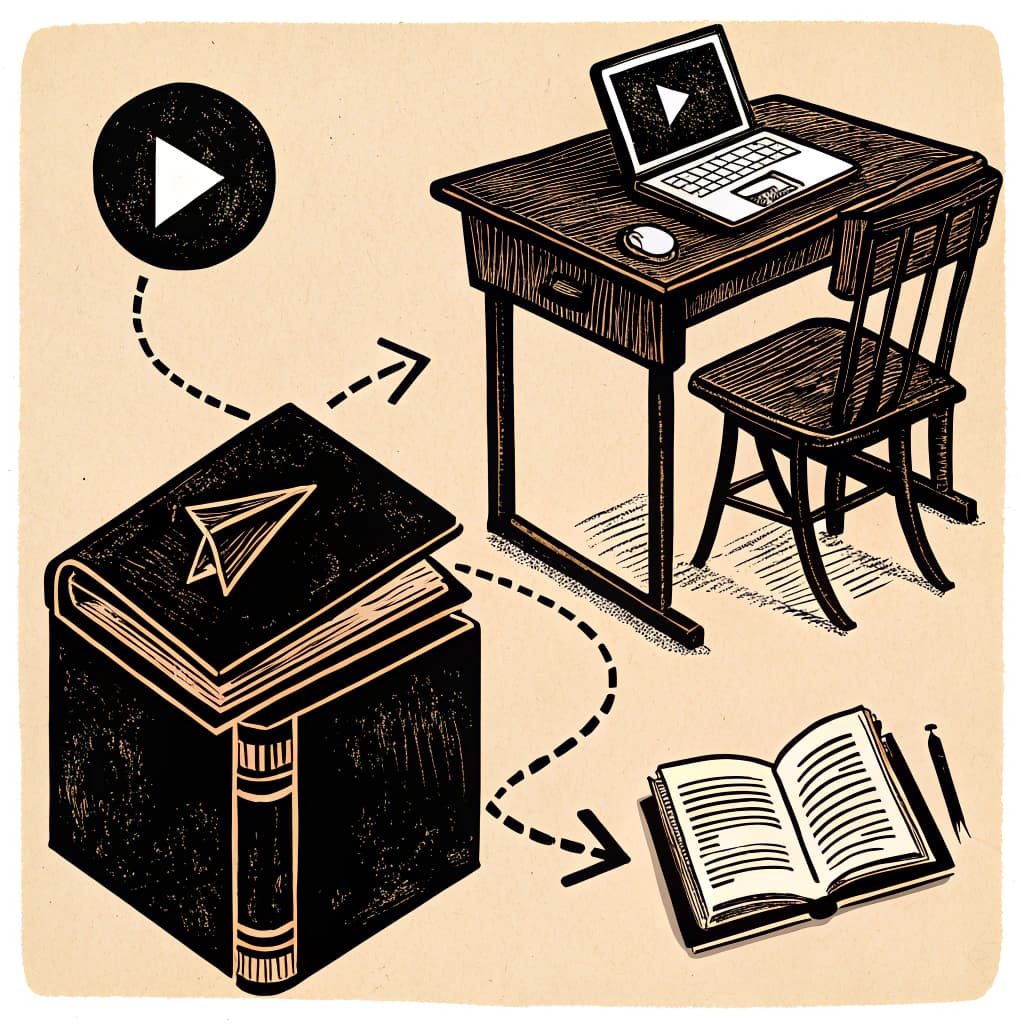
Move direct instruction to home preparation and use class time for application, discussion, and problem-solving, aligned to NEP 2020 and board exam competency demands.
Flipped Classroom
The Flipped Classroom inverts the traditional lecture-homework structure: students engage with new content (via video, reading, or NCERT textbook tasks) before class, freeing the 45-minute period for collaborative application, higher-order problem-solving, and targeted teacher support. Designed for large Indian classrooms, this approach aligns with NEP 2020's shift from rote learning to competency-based education across CBSE, ICSE, and state board contexts.
What Is Flipped Classroom? Definition, Origins, and Why It Works
The Flipped Classroom carries particular promise in Indian school contexts, and also faces particular pressures that require deliberate adaptation. Indian classrooms are shaped by a set of structural realities that the flipped model must work with rather than against: class sizes of 30 to 50 students, 45-minute period slots, NCERT textbooks as the curriculum spine across CBSE schools, board examination culture that powerfully shapes student motivation, and a deeply entrenched association between teaching quality and the completeness of the teacher's verbal explanation.
The case for flipping in Indian classrooms is strong precisely because of these pressures, not despite them. A Class 9 Science teacher covering Chemical Reactions with 45 students has, realistically, about 30 minutes of usable time after settling the class, taking attendance, and distributing materials. If that time goes to delivering direct instruction on balancing equations, there is nothing left for the application work that actually builds understanding. If students have watched a 10-minute NCERT-aligned video the night before and answered three guided questions, that 30 minutes becomes a problem-solving session where the teacher can circulate, identify misconceptions, and give the targeted help that 45 one-to-one minutes could never provide.
NEP 2020 explicitly calls for a shift from rote learning to competency-based education, from content transmission to higher-order thinking skills. The flipped classroom is one of the most operationally concrete ways to honour that shift within existing school timetables. Rather than requiring schools to redesign their entire schedule, the flip achieves within a standard 45-minute period what NEP's vision calls for: less time on recall, more time on application, analysis, and creation.
The pre-class component in an Indian context benefits from being tightly aligned to the prescribed syllabus. Students and parents are more likely to engage with pre-class video or reading material when it is visibly connected to the NCERT chapter or the ICSE/state board textbook unit. A physics teacher flipping a lesson on Ohm's Law should reference the Class 10 CBSE chapter explicitly in the video, use the NCERT diagram, and frame the guided questions around the terminology students will encounter in their board paper. This alignment is not a compromise of the flip's ambition; it is the prerequisite for its adoption in a board exam context.
The in-class time freed by the flip is where the model's Indian-context advantages become most visible. With 40 students and 30 usable minutes, a teacher cannot run truly differentiated instruction. But they can run structured peer collaboration: groups of four working through an application problem while the teacher circulates to the three or four groups that the pre-class quiz identified as struggling. This is a version of personalisation achievable at Indian scale, which pure lecture format cannot offer.
The equity dimension of the flipped classroom must be addressed with Indian realities in mind. Digital access is uneven: students in urban private schools may have reliable smartphone and data access, while government school students in rural or semi-urban areas may not. The flip must never make internet access a prerequisite for class participation. Downloaded videos, printed summary sheets, or textbook reading with guided questions are all legitimate pre-class formats. Many Indian students also attend private tuition or coaching classes outside school hours; this can be an unexpected asset (students may have already encountered the concept) or a source of confusion (coaching may have framed the concept differently). Teachers should treat the pre-class component as establishing a shared framework, not assuming it delivers mastery.
One cultural dynamic unique to Indian classrooms is the high degree of deference to the teacher as the authoritative explainer. Students and parents may initially perceive the flip as the teacher 'not teaching,' shifting the burden of learning to students. This perception must be proactively addressed. Framing the model honestly , 'I want to use our class time for the harder thinking, not the initial introduction' , and demonstrating that in-class sessions are more demanding and more supported than traditional ones will shift perception over time. Teachers who flip consistently report that students come to prefer the model once they experience that class time is genuinely useful rather than a second rehearsal of a lecture they already heard.
How to Facilitate Flipped Classroom: Step-by-Step Implementation Guide
Identify Key Concepts
7 min
Select a specific unit or lesson where students often struggle with application and would benefit from more in-class support.
Curate or Create Content
7 min
Develop short (5-10 minute) instructional videos or select targeted readings that cover the foundational 'remembering' and 'understanding' phases.
Establish an Accountability Mechanism
7 min
Create a brief pre-class assessment, such as a 3-question Google Form or a guided notes sheet, to verify students engaged with the material.
Design Active Learning Activities
8 min
Plan in-class tasks like Socratic seminars, lab experiments, or collaborative problem sets that require students to apply the pre-learned concepts.
Facilitate Small Group Support
7 min
Use class time to circulate among groups, providing targeted interventions for students who struggled with the pre-class content.
Synthesize and Review
7 min
Conclude the lesson with a brief whole-group reflection or 'exit ticket' to solidify the connections between the home study and class application.
BEFORE YOU TEACH THIS
Read the Teacher's Guide first.
Flip Education's Teacher's Guide walks you through how to facilitate any active learning lesson: mindset, pre-class checklist, phase-by-phase facilitation, and a Quick Reference Card you can print and bring to class.
Read the Teacher's Guide →When to Use Flipped Classroom: Best Classes, Subjects, and Group Sizes
- Classes 6–12 across CBSE, ICSE, and state boards preparing for board examinations
- Science and Mathematics lessons requiring procedural application alongside conceptual understanding
- Schools implementing NEP 2020 competency-based learning within standard 45-minute timetables
- Teachers managing large classes of 35–50 students who need structured peer-work protocols
Common variants
Video-pre-class flip
Content delivered by short video before class; class time is application and discussion. The most common flip, and the easiest to start.
Reading-pre-class flip
Pre-reading with guiding questions replaces the video. Works better for text-heavy subjects and students with strong literacy.
Task-pre-class flip
Students attempt a small problem or exploration before class. Class opens by diagnosing what went wrong, then teaches into the gap. Higher cognitive load, more diagnostic value.
Why Flipped Classroom Works: Research and Impact on Student Learning
Akçayır, G., Akçayır, M. (2018, Computers & Education, 126, 334-345)
The study found that the flipped model significantly improves student learning performance and satisfaction compared to traditional lecture-based formats.
Hew, K. F., Lo, C. K. (2018, BMC Medical Education, 18(1), 38)
A meta-analysis revealed that flipped classrooms are more effective than traditional classrooms for achieving higher-level learning outcomes across various disciplines.
Cheng, L., Ritzhaupt, A. D., Antonenko, P. (2019, Educational Technology Research and Development, 67(4), 793-824)
This research confirms that the flipped classroom strategy has a moderate positive effect on student learning outcomes across diverse educational levels and subjects.
Common Mistakes Teachers Make with Flipped Classroom (and How to Avoid Them)
Board exam culture reducing pre-work to 'not on syllabus'
Students and parents in CBSE, ICSE, and state board systems filter all learning activities through a single question: will this help in the board exam? Pre-class videos that are not explicitly tied to syllabus chapters or board question formats will be deprioritised or skipped. Anchor every pre-class component to a specific textbook chapter, use NCERT/prescribed textbook terminology, and show students how the in-class application directly prepares them for the application and analysis questions on board papers.
Large class sizes overwhelming the in-class facilitation model
A flipped classroom with 45 students and one teacher cannot function if the in-class activity requires the teacher to be present everywhere at once. Structure in-class time into self-directing group tasks with clear printed instructions so groups can proceed without constant teacher input. Assign group roles (reader, recorder, presenter, timekeeper) and design activities where four or five groups can work simultaneously while the teacher focuses on the two groups that the pre-class quiz flagged as needing support.
Assuming uniform digital access for pre-class videos
In Indian school contexts, smartphone and data access varies significantly across socioeconomic groups, school types, and regions. A pre-class component that relies solely on streaming video creates equity gaps that will appear as 'student laziness' but are actually access gaps. Always prepare an offline alternative: a printed summary, a textbook page with guided questions, or a brief downloadable PDF. Government school implementations especially should plan offline-first.
Coaching class overlap creating misconceptions rather than preparation
Many Indian students, particularly in Class 9-12, attend private tuition or coaching institutes that may have already 'covered' the same topic using different methods, different notation, or different problem-solving approaches. Students may arrive in class having 'done' the pre-class material but with a framework that conflicts with the school teacher's approach. Build a brief unifying orientation into the opening five minutes of in-class time to establish shared vocabulary before launching into application work.
45-minute period leaving insufficient time for meaningful application
After settling a class of 40 students, checking pre-class completion, and giving a brief orientation, a 45-minute period can shrink to 25 usable minutes for application work. This is not enough for complex collaborative tasks. Design in-class activities that can produce a meaningful outcome in 20-25 minutes: a solved problem set, a completed graphic organiser, a short written response. Save extended projects for double periods or block scheduling.
How Flip Education Helps
Syllabus-mapped activity cards aligned to NCERT and board curricula
Flip generates in-class application activity cards that are explicitly mapped to the prescribed syllabus , whether CBSE, ICSE, or state board , and reference the relevant NCERT chapter or textbook unit. Activities are designed to move students from the factual recall they completed in pre-class preparation towards the application and analysis levels that board exam papers increasingly demand under NEP 2020. Every card includes the curriculum reference so teachers and students can see the alignment immediately.
Large-class facilitation scripts with group role assignments
The generated facilitation plan is designed for Indian classroom realities: 30 to 50 students, one teacher, and 45-minute periods. It includes a structured group-work protocol with assigned roles (reader, recorder, checker, presenter), a timed activity sequence that fits within 25 to 30 usable minutes, and a teacher circulation guide that prioritises which groups need direct support based on common misconceptions. The plan keeps groups self-directing so the teacher can focus attention where it matters most.
Pre-class accountability check integrated into the opening routine
Flip includes a 5-minute class-opening accountability activity , a printed entry slip or a short oral question , designed to quickly surface which students engaged with the pre-class material and which did not. This check doubles as a bridge between the home preparation and the in-class application, activating prior knowledge before collaborative work begins. It also gives the teacher real-time data on comprehension gaps without requiring digital quiz tools.
Board exam question bridge and exit assessment
Each generated session ends with a structured reflection that connects the in-class application work back to the board paper question formats students will encounter , whether CBSE long-answer, ICSE structured response, or state board application questions. A printable exit ticket frames the concept in board-paper language, reinforcing for students that the active learning they did in class is directly building the skills assessed in examinations. This bridge is critical for sustaining student and parent buy-in for the flipped approach.
Tools and Materials Checklist for Flipped Classroom
- Pre-recorded or curated concept video (10–15 minutes maximum)
- Entry quiz (3–5 questions, submitted before or at the start of class)
- In-class problem set from NCERT exercise and board paper archives
- Platform for distributing videos (WhatsApp, Google Classroom, DIKSHA)
Flipped Classroom FAQs: Questions Teachers Actually Ask
What is the Flipped Classroom model?
The Flipped Classroom is an instructional strategy where students learn foundational content at home through videos or readings and use class time for active problem-solving. This reversal ensures that teachers are present when students are performing the most difficult tasks. It prioritizes active learning over passive listening.
What are the benefits of Flipped Classroom for students?
The primary benefit is increased student agency, as learners can pause, rewind, and review instructional content at their own pace. It also provides more opportunities for peer collaboration and immediate teacher feedback during class. This leads to deeper conceptual understanding and higher engagement levels.
How do I start a Flipped Classroom with no technology?
While often associated with video, a 'flip' can be achieved using physical readings, guided workbooks, or observation tasks completed before class. The core requirement is that the 'input' happens independently so the 'output' can happen collaboratively. Teachers can use printed packets or textbook sections as the primary pre-class material.
How do I ensure students do the pre-class work?
Incentivize completion by using low-stakes entrance tickets, online quizzes, or required note-taking templates that are checked at the door. If students realize class activities are impossible to complete without the background knowledge, compliance naturally increases. Consistency in the routine is key to building student accountability.
Is the Flipped Classroom effective for all subjects?
The model is highly effective for subjects requiring procedural knowledge or heavy analysis, such as Math, Science, and Social Studies. In ELA or Arts, it allows for more time dedicated to writing workshops and creative critiques. However, it requires careful adaptation for younger students (K-2) who may lack the independent study skills required.
Classroom Resources for Flipped Classroom
Free printable resources designed for Flipped Classroom. Download, print, and use in your classroom.
Flipped Classroom Preparation Tracker
Students track what they watched or read at home, key concepts they identified, and questions they still have before in-class work begins.
Download PDFPost-Flip Reflection
Students reflect on the self-paced learning experience at home and how the in-class application deepened their understanding.
Download PDFIn-Class Collaboration Role Cards
Assign roles for the active learning portion of a flipped classroom session so every student contributes meaningfully.
Download PDFFlipped Classroom Discussion Prompts
Ready-to-use prompts that connect pre-class content to in-class activities, organized from check-in through extension.
Download PDFSEL Focus: Self-Management
A card focused on the self-directed learning skills students need to succeed in a flipped classroom environment.
Download PDFRelated
Methodologies Similar to Flipped Classroom
Stations Rotation
Rotate small groups through distinct learning zones, teacher-led, collaborative, and independent, to manage large, ability-diverse classes within a single 45-minute period.
Peer Teaching
Students teach each other to consolidate understanding, highly effective in large Indian classrooms and directly aligned with NEP 2020 competency goals and NCERT's shift toward active learning.
Jigsaw
Students become curriculum experts and teach each other, structured for large Indian classrooms and aligned to CBSE, ICSE, and state board syllabi.
Ready to try this?
- Read the Teacher's Guide →
- Generate a mission with Flipped Classroom →
- Print the toolkit after generating
Generate a Mission with Flipped Classroom
A complete lesson plan, aligned to your curriculum.