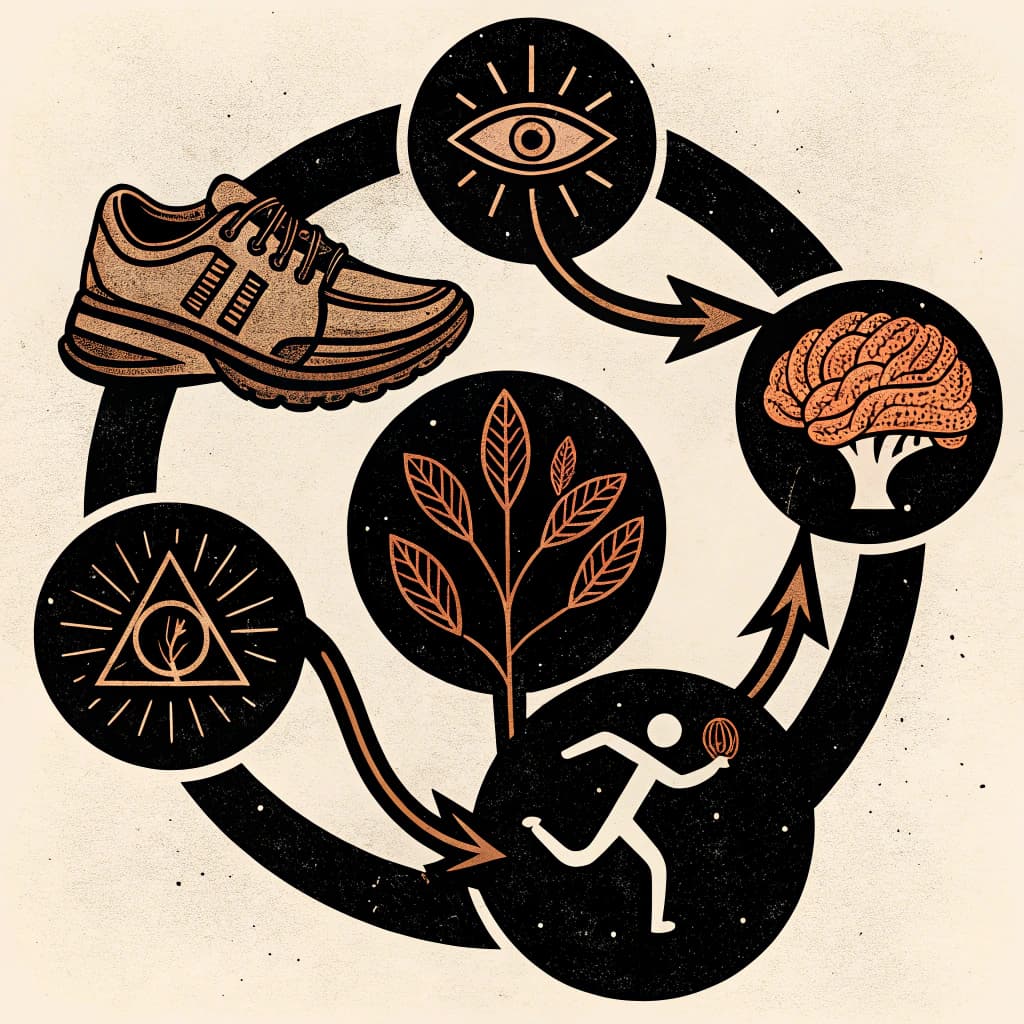
Learning through doing and structured reflection, aligned to NEP 2020 and competency-based education across CBSE, ICSE, and state boards.
Experiential Learning
Experiential learning develops deep conceptual understanding by guiding students through a four-stage cycle: a hands-on activity, structured reflection, conceptualisation, and application. In Indian classrooms, this methodology supports NEP 2020's shift away from rote learning towards competency-based education, and develops precisely the analytical and application-level thinking assessed in CBSE, ICSE, and state board examinations. Suitable for Classes 1–12 across all subjects.
What Is Experiential Learning? Definition, Origins, and Why It Works
Experiential learning arrived in Indian classrooms through multiple channels , laboratory work in science education, activity-based learning (ABL) programmes in government primary schools, and the progressive strand of NCERT's curriculum frameworks going back to the National Curriculum Framework of 2005. The NCF 2005 explicitly critiqued the culture of 'textbook knowledge' and called for learning that connected to the child's lived experience, foreshadowing what NEP 2020 would later mandate as a foundational principle.
NEP 2020 places experiential learning at the centre of its pedagogical vision, directing all boards , CBSE, ICSE, and state boards alike , to shift towards competency-based education where students demonstrate understanding through application rather than recall. CBSE's Competency Based Education (CBE) initiative, introduced from Classes 6–10, is a direct institutional expression of this mandate: questions that require students to apply concepts to unfamiliar contexts, not merely reproduce definitions. State boards across Maharashtra, Tamil Nadu, Karnataka, and Kerala have introduced similar competency frameworks, though implementation varies considerably.
For Indian teachers, the challenge of Kolb's four-stage cycle is primarily one of time and scale. A 45-minute period in a school with 40–48 students per section leaves limited room for the unhurried reflection that experiential learning requires. The solution practised by effective Indian teachers is not to compress all four stages into a single period but to distribute them , the concrete experience in one session, structured reflection in the next, with conceptualisation and application woven into subsequent lessons. This distributed model aligns well with the NCERT chapter-based structure, where each chapter can be treated as an experiential arc rather than a sequence of facts to be covered.
The board examination system creates a genuine tension that Indian teachers must navigate honestly. Boards assess primarily through written examinations that reward conceptual articulation , but experiential learning, when implemented well, develops precisely the conceptual understanding that written examinations test. Students who can explain why photosynthesis matters or apply the concept of opportunity cost to a local example are better prepared for analytical board questions than students who have memorised definitions. The pedagogical argument for experiential learning in India is not 'despite the boards' but 'because of what the boards actually assess.'
The guru-shishya tradition in Indian education, which places the teacher as the primary authority on knowledge, can create a cultural resistance to the facilitator role that experiential learning requires. Teachers moving towards this methodology sometimes encounter student scepticism ('Are you actually teaching us anything?') and parental concern ('Is the syllabus being completed?'). Both concerns are legitimate and should be addressed proactively , through visible connections between the activity and the textbook, and through explicit communication to parents about how the activity maps to the curriculum and prepares students for examinations.
How to Facilitate Experiential Learning: Step-by-Step Implementation Guide
Design a Concrete Experience
7 min
Create a hands-on activity, simulation, or field-based task that aligns with your learning objectives and forces students to interact with the core concept.
Facilitate the Activity
7 min
Launch the experience while acting as a coach or observer, resisting the urge to provide answers or intervene unless safety or total disengagement occurs.
Conduct Reflective Observation
7 min
Lead a debrief session using open-ended questions that ask students to describe what they saw, felt, and did during the experience.
Guide Abstract Conceptualization
8 min
Help students connect their observations to formal theories or academic concepts, identifying the 'why' behind the patterns they noticed.
Plan Active Experimentation
8 min
Assign a new, slightly different task where students must use the theories they just developed to solve a new problem.
Assess Through Performance
8 min
Evaluate student growth based on their ability to apply concepts to the new situation and the depth of their reflective insights, rather than a multiple-choice test.
BEFORE YOU TEACH THIS
Read the Teacher's Guide first.
Flip Education's Teacher's Guide walks you through how to facilitate any active learning lesson: mindset, pre-class checklist, phase-by-phase facilitation, and a Quick Reference Card you can print and bring to class.
Read the Teacher's Guide →When to Use Experiential Learning: Best Classes, Subjects, and Group Sizes
- Science practicals and concept introduction across Classes 6–10
- Social Science and History lessons linking curriculum concepts to local community contexts
- Mathematics problem-solving using manipulatives and real-world scenarios
- Environmental Studies in primary classes (Classes 1–5)
Common variants
Kolb-cycle experiential learning
Concrete experience, reflective observation, abstract conceptualization, active experimentation. The original four-stage cycle, run in full.
Field-based experiential learning
The experience happens outside the classroom (field site, community, workplace). Reflection structures are what turn the trip into learning.
Why Experiential Learning Works: Research and Impact on Student Learning
Kolb, A. Y., Kolb, D. A. (2005, Academy of Management Learning & Education, 4(2), 193-212)
The study validates the four-stage experiential learning cycle and emphasizes that creating 'learning spaces' for reflection is critical for converting experience into higher-order knowledge.
Burch, G. F., Giambatista, R. C., Batchelor, J. H., Hoover, J. G., & Heller, N. A. (2019, Decision Sciences Journal of Innovative Education, 17(3), 239-273)
Experiential learning pedagogies have a significant positive effect on both knowledge acquisition and the development of practical 21st-century skills across various disciplines.
Common Mistakes Teachers Make with Experiential Learning (and How to Avoid Them)
Sacrificing the reflection phase to syllabus pressure
In Indian schools, the pressure to complete the syllabus before pre-board or unit tests is real and relentless. When time is short, reflection is the first thing cut , leaving students with an activity but no learning. Protect the reflection phase by treating it as non-negotiable: if there is only time for either the activity or the reflection, do a shorter activity with full reflection rather than a full activity with none.
Designing activities for 25 students in a Class of 45
Many experiential learning resources assume class sizes of 20–30 students. In CBSE, ICSE, and state board schools with 40–48 students per section, poorly adapted activities produce noise, off-task behaviour, and the impression that the methodology does not work in Indian classrooms. Design explicitly for large groups: use structured group roles, staggered activity stations, and peer facilitators from within each group to keep all students productively engaged.
Treating NEP 2020 compliance as the goal rather than learning
Following NEP 2020, many schools have introduced 'experiential learning periods' that are filled with activity for activity's sake , craft projects, video viewing, or group games that generate engagement without cognitive demand. An experience becomes experiential learning only when guided reflection extracts transferable principles from it. An activity log submitted to the principal is not the same as learning.
Failing to connect the activity to board examination formats
Students and parents in India reasonably ask how an activity helps in the examination. This question deserves a direct answer, not dismissal. After the reflection phase, explicitly show students how the understanding they developed maps to the kinds of analytical questions asked in CBSE, ICSE, or state board papers. This bridge is not a compromise of the methodology , it is a valid application phase that completes Kolb's cycle and demonstrates the real value of active learning.
Assuming uniform resource access across school types
A single-teacher government primary school in rural Rajasthan and a well-resourced ICSE school in Bengaluru have fundamentally different material and infrastructure realities. Experiential activities that assume a science laboratory, internet access, or commercially produced materials will exclude teachers who lack these resources. Effective Indian experiential learning design defaults to activities that work with locally available, low-cost materials , and this constraint often produces more culturally relevant activities than resource-rich alternatives.
How Flip Education Helps
Large-class activity design for 40–50 students
Flip generates experiential activities explicitly structured for the large class sizes typical of CBSE, ICSE, and state board schools. Each activity includes group role cards, staggered station instructions, and a peer facilitator guide so that the teacher can manage eight to ten groups simultaneously without losing structure. The design keeps all students actively engaged rather than waiting for a turn.
NEP 2020 competency mapping and board exam connection
Every generated activity is mapped to the relevant NEP 2020 learning outcomes and NCERT chapter objectives, so teachers can demonstrate curriculum alignment to school leadership. A built-in exam connection section shows students how their reflective insights correspond to competency-based questions in CBSE CBE papers, ICSE analytical questions, and state board application-level items , making the case for experiential learning within the board system rather than in opposition to it.
Low-resource design using locally available materials
Flip designs activities that work within the material realities of Indian classrooms , no laboratory equipment, no internet access, no printed worksheets beyond what a teacher can produce on a basic printer. Activities use everyday objects, newspaper, chart paper, or role-play scenarios. This ensures the methodology is accessible to government school teachers and private school teachers alike, across urban and rural contexts throughout India.
45-minute period planning with distributed reflection option
The generated session plan is structured for a single 45-minute period, with a clearly marked option to distribute the reflection phase across two periods when syllabus pressure demands it. Teacher notes flag exactly where to pause if the activity runs over, ensuring the reflection phase is protected. A homework reflection prompt extends the cycle without requiring additional class time, completing Kolb's four stages across the school week.
Tools and Materials Checklist for Experiential Learning
- Data recording sheet
- Simple measuring tools (ruler, measuring tape)
- Graph paper or digital graphing tool
- Reflection question connecting the experience to NCERT concepts
Experiential Learning FAQs: Questions Teachers Actually Ask
What is the definition of experiential learning in education?
Experiential learning is the process of learning through reflection on doing, specifically defined as knowledge created through the transformation of experience. It requires students to engage in a cycle of experiencing, reflecting, thinking, and acting. This approach prioritizes the learner's direct engagement with the subject matter over passive instruction.
What are the four stages of the experiential learning cycle?
The cycle consists of Concrete Experience, Reflective Observation, Abstract Conceptualization, and Active Experimentation. Students first participate in an activity, then look back on the experience to identify patterns or problems. They use these insights to form new theories and finally test those theories in a new, practical context.
How do I implement experiential learning in my classroom?
Start by designing an authentic task or simulation that requires students to apply specific curriculum standards to a real-world problem. Facilitate the experience without over-instructing, then provide structured time for students to journal or discuss what occurred. Finally, challenge them to apply their new insights to a different but related scenario to solidify understanding.
What are the benefits of experiential learning for students?
This methodology increases long-term retention and student engagement by making abstract concepts tangible and relevant. It fosters critical thinking and problem-solving skills as students must navigate real-world complexities and failures. Additionally, it builds social and emotional competencies like empathy and collaboration through shared group experiences.
Is experiential learning the same as hands-on learning?
No, experiential learning is broader than hands-on learning because it requires a specific phase of cognitive reflection and conceptualization. While hands-on learning involves physical activity, experiential learning ensures that the activity leads to new mental models through deliberate analysis. Without the reflection and abstraction stages, a hands-on activity is just 'doing' rather than 'learning.'
Classroom Resources for Experiential Learning
Free printable resources designed for Experiential Learning. Download, print, and use in your classroom.
Experiential Learning Cycle Tracker
Students document each stage of Kolb's learning cycle as they move through the experience.
Download PDFExperiential Learning Reflection
Students reflect on how the hands-on experience connected to deeper learning through Kolb's cycle.
Download PDFExperiential Learning Group Roles
Assign roles aligned with each stage of Kolb's experiential learning cycle.
Download PDFExperiential Learning Cycle Prompts
Prompts aligned with each stage of Kolb's experiential learning cycle.
Download PDFSEL Focus: Self-Awareness
A card focused on developing self-awareness through the reflective observation stage of experiential learning.
Download PDFRelated
Methodologies Similar to Experiential Learning
Project-Based Learning
Student-led inquiry into real-world challenges, mapped to your board syllabus and NEP 2020 competency goals.
Simulation Game
Place students inside the systems they are studying, historical negotiations, resource crises, economic models, so that understanding comes from experience, not only from the textbook.
Role Play
Students take on specific roles within a structured scenario, applying curriculum knowledge through the perspective of a character to develop empathy, critical analysis, and communication skills.
Ready to try this?
- Read the Teacher's Guide →
- Generate a mission with Experiential Learning →
- Print the toolkit after generating
Generate a Mission with Experiential Learning
A complete lesson plan, aligned to your curriculum.