How many students in your last lesson sat quietly while one or two voices dominated the discussion? In a typical Indian classroom of 40-50 students, if the answer is "most of them," you're not alone. Think-pair-share (TPS) was designed precisely to solve this problem of passive learning.
First developed by Professor Frank Lyman in 1981, the think pair share strategy gives every student a structured moment to process, talk, and contribute. As we align our teaching with the NEP 2020 focus on conceptual understanding rather than rote learning, TPS remains one of the most effective cooperative learning techniques for Class 1-12 education. This guide covers how it works, what the research says, and how to adapt it for the unique scale of Indian school settings.
What Is the Think-Pair-Share Strategy?
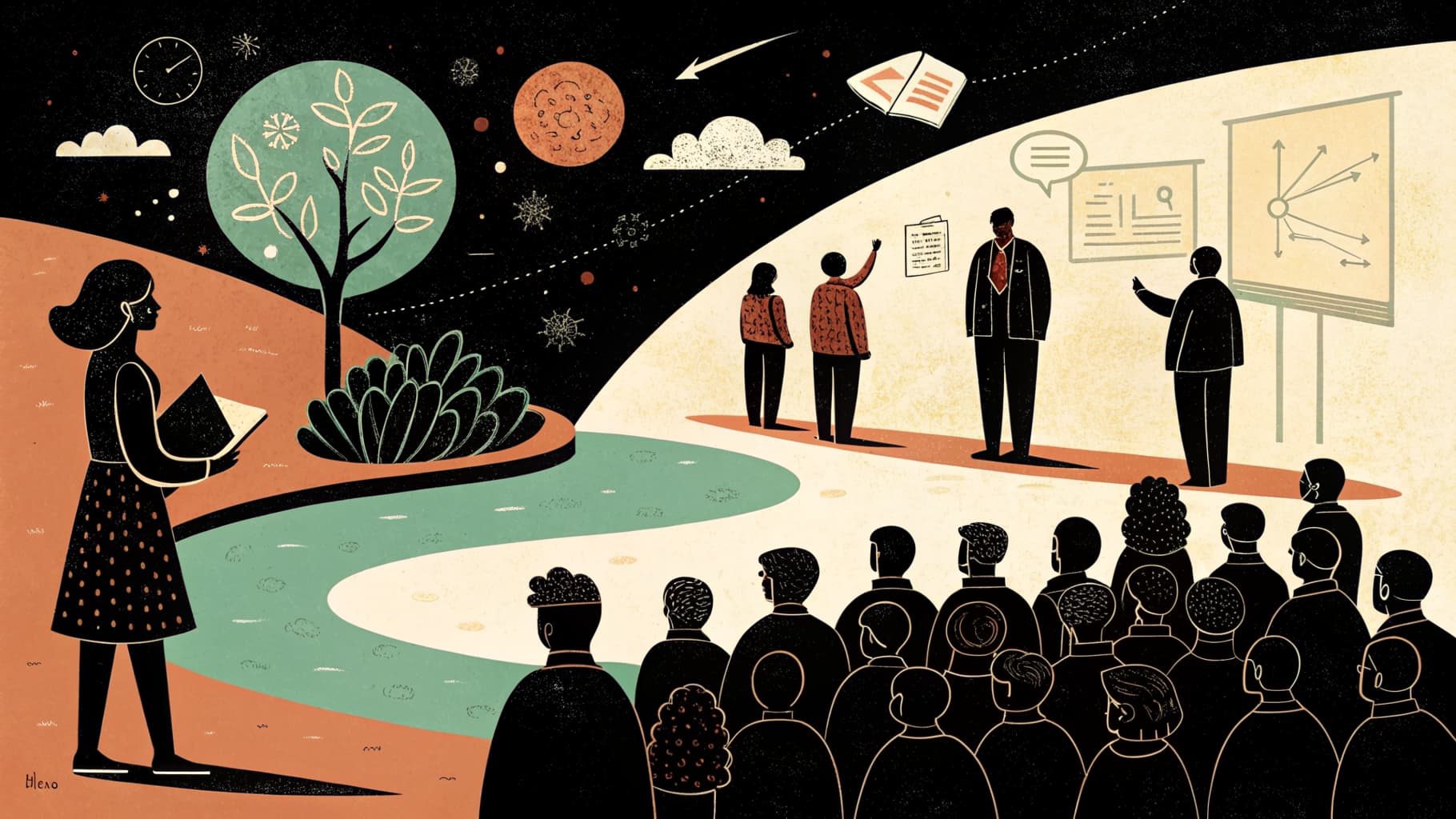
Think-pair-share is a three-phase discussion protocol. In the context of the NCERT framework, the mechanics are straightforward:
- Think: The teacher poses a question or board exam-style prompt. Students reflect individually, in silence, for a set amount of time.
- Pair: Students turn to a designated partner (usually their bench-mate) and discuss their responses.
- Share: Pairs report key ideas to the whole class.
What separates TPS from a generic "talk to your neighbor" instruction is the structure. In a large class of 50, structure is survival. The Think phase forces individual accountability before social pressure kicks in. The Pair phase lowers the stakes for students who hesitate to speak publicly. The Share phase brings the room together around synthesized ideas rather than a single raised hand.
The Benefits of Think-Pair-Share for Student Engagement
The case for TPS in Indian schools rests on several well-documented mechanisms:
Active processing over passive reception. Traditional lectures ask students to receive information. TPS asks them to retrieve, connect, and articulate it,cognitive acts that deepen encoding for long-term retention, essential for board exam preparation.
Higher-order thinking. When students must explain a concept like 'Photosynthesis' or 'The Great Revolt of 1857' to a peer, they quickly discover gaps in their understanding. This productive friction drives the kind of analysis and evaluation encouraged by the NEP 2020.
Confidence for quieter learners. Students who would never raise a hand in a crowded room get to rehearse their thinking with one person first. This low-stakes rehearsal is especially valuable for students who are still gaining fluency in English, providing them with a safe space to model academic language.
Formative assessment in large sections. During the Pair phase, a teacher circulating a room of 50 students can overhear multiple conversations in minutes. This surfaces misconceptions faster than any weekly test or exit ticket.
Deepening the Research: Why It Works
The pedagogical foundation of Think-Pair-Share is rooted in the social construction of knowledge. Lyman demonstrated that providing structured thinking time significantly increases the number of students willing to participate in whole-class discussions.
Research indicates that the 'Think' phase is the most critical component. Without it, the 'Pair' phase often results in one dominant student (the "topper") taking over the conversation. Quantitative analysis shows that TPS significantly improves learning outcomes in complex technical subjects like Physics and Maths compared to traditional lecture formats.
Grade-Level Adaptations: From Primary to Secondary School
While the core mechanics remain constant, the implementation must shift to meet the developmental needs of students across the Indian school system.
Primary School (Class 1-5): Visuals and Physicality
At the primary level, "thinking" is an abstract concept.
- Think: Use visual prompts or picture cards. Ask students to put a "thinking finger" on their temple to show they are working.
- Pair: Use "knee-to-knee" positioning. In many Indian schools with fixed benches, this means simply turning shoulders toward their partner.
- Share: Use a physical object, like a "sharing ball," to designate whose turn it is to speak.
Upper Primary (Class 6-8): Building Synthesis
Students are moving toward more complex CBSE/state board syllabus topics.
- Think: Encourage students to jot down one "key word" in their rough notebook during silent time.
- Pair: Introduce the "Agree/Disagree" task. They must find one point of agreement and one difference in their answers.
- Share: Focus on the "Reporter" role. Ask students to share what their partner said to build active listening.
Secondary School (Class 9-12): Board Exam Rigour
In secondary school, TPS should be used to tackle high-weightage concepts and conflicting evidence.
- Think: Extend the time to 2 or 3 minutes. Ask students to find a specific reference from their NCERT textbook to support their thought.
- Pair: Use the "Steel Man" technique. Ask students to try and improve their partner's argument before they critique it.
- Share: Move toward "Think-Pair-Square," where two pairs (four students) combine to synthesise their findings before the whole-class discussion.
Step-by-Step: How to Implement TPS Effectively
Before the Lesson
Write your prompt before class. A weak prompt ("What do you know about democracy?") produces weak pairs. A strong prompt asks students to apply or evaluate: "Which feature of the Indian Constitution is most important for a diverse country like ours, and why?"
During the Think Phase (1–3 minutes)
Signal silence. In a busy Indian school, the corridor noise can be distracting; ensure the classroom is quiet. Students who finish early can be prompted to write their thoughts in their notebooks.
During the Pair Phase (3–5 minutes)
Move around the room. In large classes, you may only reach a few rows, but your presence encourages students to stay on task. Listen for common errors that you can address during the Share phase.
During the Share Phase
Avoid simply calling on the same three students in the front row. Ask for the most surprising idea that came up, or a point where the partners disagreed.
Common Pitfalls and How to Fix Them
1. Rushing the "Think" Phase Teachers often feel the pressure to "complete the syllabus." However, cutting the Think phase short leads to shallow answers.
- The Solution: Use a watch. Tell the students, "I am giving you exactly 60 seconds of silence."
2. Using Rote-Learning Questions If a question has a single "right" answer from the textbook, there is no reason for a pair to discuss it.
- The Solution: Use open-ended questions. Instead of "What is the capital of India?", ask "Why was the capital moved from Calcutta to Delhi?"
3. The "Topper" Dominating In many pairs, the more confident student does all the talking.
- The Solution: Assign roles. "The student with the shorter hair speaks first for 30 seconds, then the other responds."
Think-Pair-Share 2.0: Digital Tools and AI Integration
Even in classrooms with limited tech, digital integration can enhance TPS.
Think phase with AI. Before a board exam revision session, students can use an AI tool to generate a counter-argument to their initial thought, pushing them to think like an examiner.
Share phase without bottlenecks. If your classroom has a smartboard or students have access to a computer lab, tools like Padlet let every pair submit their key idea simultaneously. This ensures no voice is lost in a class of 50.
Inclusive TPS: Supporting Neurodiversity and Social Anxiety
For Students with Social Anxiety
Replace verbal sharing with "Think-Pair-Write-Share." Having a written sentence in their notebook gives anxious students a script to read from, reducing the fear of public speaking.
For English Language Learners
Sentence stems are vital. Post these on the board:
- "I think ___ because ___."
- "My partner pointed out that ___."
- "We both agreed that ___."
Subject-Specific Prompts: STEM vs. Humanities
Mathematics
- "I solved this quadratic equation using one method. Think if there is a shortcut or a different formula we could use."
- "Look at this theorem. Where else in real life might this apply?"
Science
- "Based on the NCERT lab activity, why did the colour change? Defend your answer with a chemical property."
- "Predict what happens to the circuit if we add another resistor in parallel."
Social Science / English
- "If you were a leader during the Independence movement, would you have chosen a different strategy? Why?"
- "The poet uses this metaphor. What does it tell us about the mood of the poem?"
FAQ
What This Means for Your Classroom
Think-pair-share earns its place in Indian pedagogy because it addresses the "silence of the back bench." It moves us away from a teacher-centric model toward the student-centric vision of the NEP 2020.
The core question to ask yourself: what happens in your class after you pose a question? If the answer is "the same three students answer while the rest wait for the bell," think-pair-share gives you a practical, evidence-supported way to change that pattern,starting tomorrow.