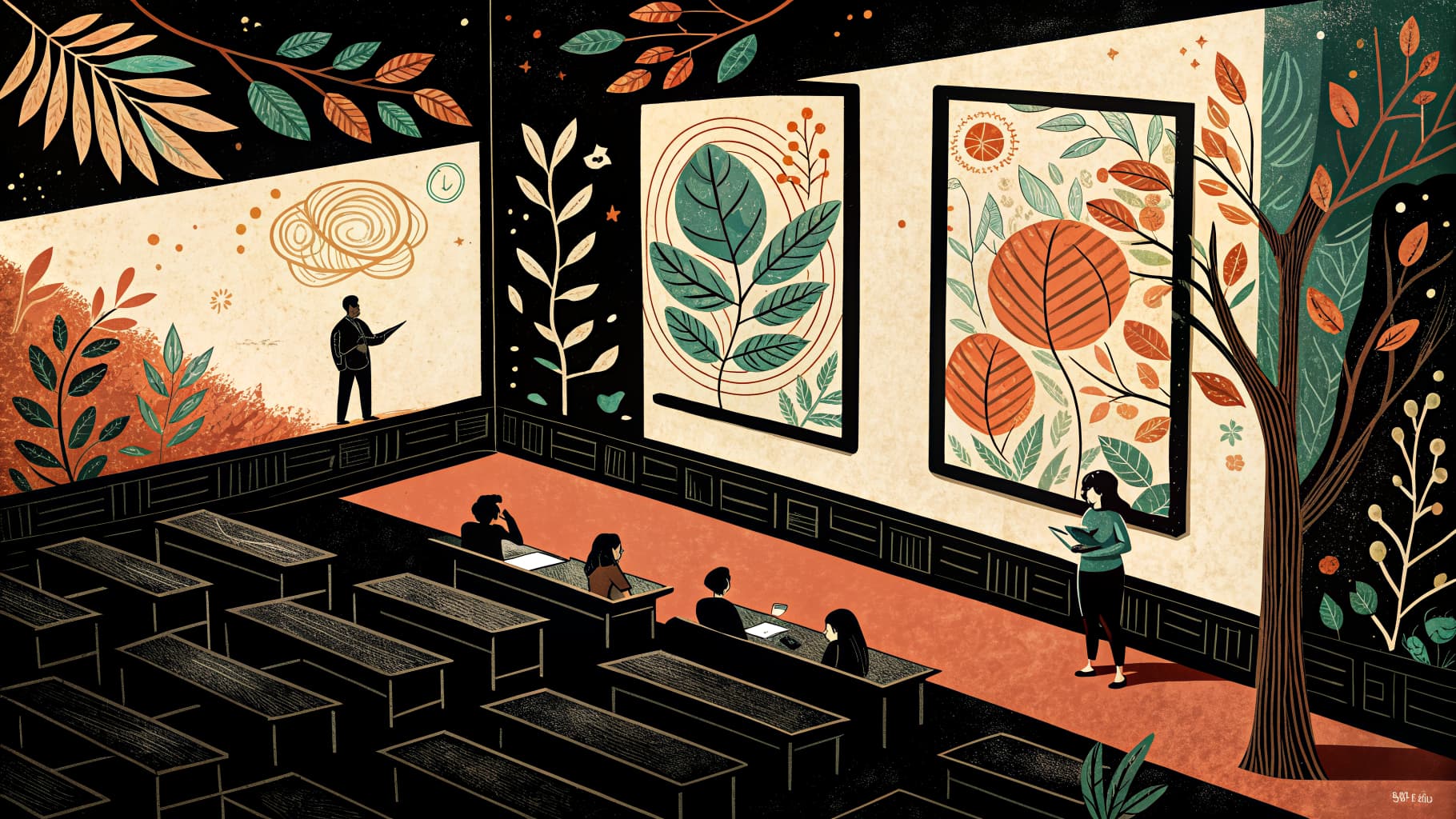
Think about the last class discussion you facilitated. Who talked? Probably the same four or five students who always do. In a typical Indian classroom of 40 to 60 students, the quiet child in the back row often has brilliant insights but lacks the confidence to shout over their peers. By the time they gather the courage to raise their hand, the conversation has moved on.
Chalk Talk was designed for exactly that moment.
Developed by educator Hilton Smith and later popularized through the National School Reform Faculty, Chalk Talk is a silent discussion protocol where students write their responses to a prompt and to each other's ideas on a shared surface. No talking. No hand-raising. No social hierarchy. Just thinking made visible, on paper, by everyone in the room,perfect for ensuring every student meets the competency-based learning goals of NEP 2020.
What Is Chalk Talk?
Chalk Talk belongs to a family of approaches often called visible thinking routines. The central idea: when students externalize their thinking through writing or mapping, teachers can spot misconceptions in real time. In the Indian context, where board exam preparation often focuses on rote recall, Chalk Talk forces students to engage deeply with the NCERT framework by building on each other's ideas.
What sets Chalk Talk apart is the silence. Students write. They read what peers have written. They draw lines connecting related ideas, add follow-up questions, or write "building on this..." next to a classmate's contribution. The whole discussion happens on paper, without a single word spoken aloud.
That silence is the mechanism that makes Chalk Talk equitable, especially in large classrooms.
In a typical secondary school class, the fastest or loudest thinkers dominate. Students who process more slowly, or those for whom English is a second or third language, often contribute less. Many teachers find that removing verbal pressure significantly broadens the range of students who contribute meaningfully to shared discussions.
The written nature of the conversation also changes the quality of the thinking. When students have to write rather than speak, vague impressions become articulable ideas. This crystallization is essential for moving students from basic understanding to the higher-order thinking required by the CBSE and state board syllabus.
Chalk Talk works best across Class 3 through 12, with particular power in upper primary and secondary school when students are most sensitive to social judgment. It excels in English, Science, Social Studies, and even Mathematics,any subject where you want students wrestling with open questions rather than just memorising formulas.
How It Works
Chalk Talk doesn't require elaborate preparation. You need chart paper (or your green/blackboard), chalk or markers, an open-ended prompt, and the willingness to protect the silence.
Step 1: Prepare the prompts
Write a provocative question, a quote from a poem, or a historical dilemma in the center of several large sheets of chart paper. If you have a class of 50, place 5-6 stations around the room to prevent crowding.
Strong Chalk Talk prompts look like: "Was the partition of India inevitable?" or "What does this poem suggest about the conflict between tradition and modernity?" or "Why does this scientific law fail in extreme conditions?" They invite disagreement and complexity,things with no single "correct" answer found in a textbook.
Step 2: Set the rule of silence
Before students pick up a marker, explain that the entire activity happens in silence. Absolute silence. Students will expect you to relax that rule after two minutes. Make clear you won't. Maintaining silence is what allows every student's written contribution to receive equal weight, regardless of their social standing in the class.
Step 3: Give everyone a marker
Distribute markers or chalk before students move. If you are using the main blackboard, divide it into sections. In large Indian classrooms, assigning different coloured pens to different rows can help you track participation during the debrief.
Step 4: Begin the silent interaction
Invite students to move to the prompts. Some will move immediately; others will hang back and read. Let that happen. The reading and thinking that occur before the first pen touches paper are vital parts of the process.
Step 5: Connect and respond
As students fill the page, direct them to read what their peers have written and respond directly. Draw a line to a peer's idea. Write a question. Add a piece of evidence from the NCERT textbook that supports or complicates it. This is where it becomes a dialogue rather than just a brainstorming session.
Step 6: Add your presence as a teacher
Circulate through the room. Don't talk, but you can write. Add a circle around a key theme. Put a question mark next to an idea that needs more evidence. Your written participation signals that this conversation matters.
Step 7: Debrief the written conversation
After 15 to 20 minutes, close the silence and gather students. Read key ideas aloud. Ask students to explain connections they drew. This synthesis is the richest part of the lesson,students seeing their collective thinking as a "map" of the topic.
Tips for Success in Indian Classrooms
Manage the space
With 50 students, movement can be chaotic. Use all available wall space. Tape chart papers to the walls, use the front board, and even the back board if available. If space is too tight, pass the chart papers around the rows (a "Silent Pass") to maintain the protocol.
Require responses, not just reactions
Ensure students don't just write "I agree." Make the expectation explicit: at least one contribution must be a direct reply to a classmate,draw a line, write "building on this...", or pose a follow-up question.
Protect the silence
Indian classrooms are rarely silent. Teachers often break the silence because a quiet room feels like "no teaching" is happening. Resist that instinct. The silence is creating space for the "back-benchers" who are usually crowded out.
Choose prompts that sustain disagreement
If a prompt is too narrow (e.g., "What is the formula for photosynthesis?"), the conversation will die. Use prompts that align with the NEP 2020 focus on critical inquiry.
FAQ
Bring Chalk Talk Into Your Next Lesson
Chalk Talk works because it slows the discussion down to the speed of thought. In the rush to finish the CBSE/state board syllabus, we often forget to let students think. The quiet room isn't empty,it's where careful thinking gets room to breathe.
If you want to run Chalk Talk without building the materials from scratch, Flip Education generates curriculum-aligned prompt cards and response scaffolds designed for the silent format. The AI creates prompts mapped to your specific NCERT topic and grade level, includes a facilitation script, and wraps up with debrief questions. You arrive to class with everything you need to run a structured, purposeful written conversation,and you leave with a rich artifact of your students' collective thinking.