Ask most teachers what they mean by "group work," and they'll describe dividing a project into parts: one student researches, another writes, a third designs the slide deck. That's coordination. Collaborative problem solving is something harder, and considerably more valuable.
In genuine collaborative problem solving, no student can crack the problem alone. The task requires multiple knowledge sets, competing perspectives, and more information than any one mind holds. Students have to think together, not just work alongside each other. That distinction sounds subtle, but it changes everything about how you design the activity, structure the groups, and assess the outcome, and in Indian classrooms of 40 to 50 students, that design work becomes even more consequential.
What Is Collaborative Problem Solving?
Collaborative problem solving sits at the intersection of three research traditions: cooperative learning (which establishes the conditions for productive group work), problem-based learning (which uses real-world challenges as learning vehicles), and social cognition (which shows that thinking together can produce outcomes individual thinking cannot reach).
PISA, the international student assessment run by the OECD, added collaborative problem solving as a measured domain in 2015. This was a signal that education systems worldwide now treat the capacity to think effectively with others as a core academic skill, not a soft add-on. NEP 2020 makes the same argument from an Indian policy perspective, explicitly calling for pedagogical approaches that develop critical thinking, communication, and collaborative capacities alongside subject knowledge.
The pedagogical claim is precise: some problems cannot be effectively solved by any individual alone, and the process of solving them together develops capacities that solo work never builds. Arthur Graesser and colleagues at the University of Memphis, writing in Psychological Science in the Public Interest (2018), found that collaborative problem solving outperforms individual problem solving on complex tasks because it distributes cognitive load and integrates diverse perspectives. Neither of those mechanisms is available when a student works alone.
This is why problem design is the most critical planning decision you'll make. A problem any competent student can solve alone won't create conditions for genuine collaboration. It'll create conditions for one student to solve while others watch.
How to Use Collaborative Problem Solving in Your Classroom
Step 1: Design an Ill-Structured Problem
Start with a challenge that has no single obvious solution and genuinely requires multiple angles to crack. One example suited to Indian classrooms: ask groups to evaluate three proposed solutions to a local water scarcity issue, perhaps one affecting their own district, and recommend one, accounting for cost, community impact, and available data. No student holds all three knowledge sets. That's the point.
Good ill-structured problems are specific enough to be tackled in one session but complex enough that genuine negotiation is required to reach an answer. If you can imagine one strong student finishing it quietly in ten minutes, redesign it. This is especially important in secondary school where board exam preparation tends to reward individual recall, collaborative problems should feel genuinely different from anything on a question paper.
Step 2: Form Heterogeneous Groups
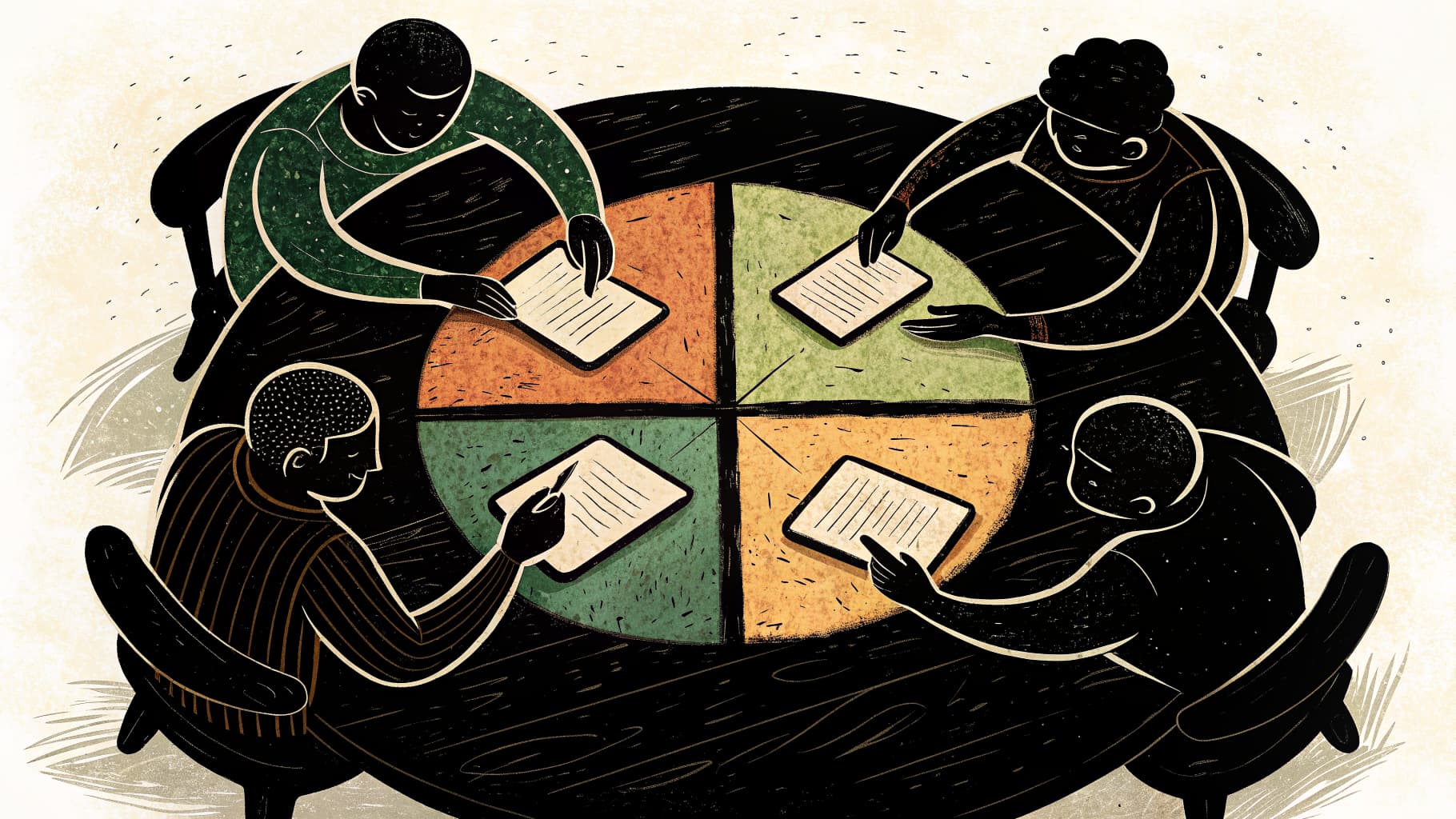
Groups of three or four work best. Mix ability levels, backgrounds, and thinking styles deliberately. David Johnson and Roger Johnson at the University of Minnesota documented across decades of meta-analysis that cooperative groups with diverse members consistently outperform homogeneous ones on complex tasks, both in academic achievement and in the quality of interpersonal reasoning.
Avoid letting students self-select into friend groups for collaborative problem solving. Social comfort can suppress the productive disagreement that makes the methodology work. In Indian classrooms, also be mindful of grouping across perceived academic streams, a student marked as "weak" in board exam terms often brings practical knowledge and contextual insight that changes the group's thinking entirely.
Step 3: Establish Social Norms and Roles Before the Problem Begins
Spend the first five to ten minutes establishing how the group will operate. Post three questions on the board: How will we make decisions when we disagree? What do we do if one person is dominating? How do we make sure every idea gets heard?
Then assign roles: a Facilitator (keeps the group moving), a Skeptic (challenges assumptions), a Recorder (tracks the group's reasoning, not just its conclusions), and a Synthesizer (looks for connections between different contributions). Rotate roles across sessions so students build fluency in each.
Step 4: Build a Shared Mental Model of the Problem
Before groups start generating solutions, have them spend five minutes answering two questions in writing: What do we know about this problem? What do we need to find out?
This step sounds basic, but it prevents the most common failure mode in collaborative problem solving: groups that race to solutions before they've agreed on what problem they're actually solving. Graesser et al. (2018) identify shared problem representation as the single most important precondition for effective CPS. Groups that skip this step routinely produce fragmented solutions where each student answered a different question.
Step 5: Facilitate Without Solving
During the working phase, circulate and listen. Your job is to maintain productive struggle, not eliminate it. When a group is stuck, resist the urge to reframe the problem for them. Instead, ask: "What's the thing you're most uncertain about right now?" or "Are there any assumptions you're making that you haven't tested?"
In large Indian classrooms, you won't be able to visit every group in depth. A practical solution: assign a written log to the Recorder role, so you can review each group's reasoning after the session even when you couldn't observe them directly. Set a visible countdown on the board, seven minutes, not "take some time", and assign each student a specific contribution role. Both moves improve focus. Vague time signals produce vague effort.
Step 6: Run a Whole-Class Synthesis
When groups share their solutions, structure the debrief around process and divergence, not just outcomes. Which group took a different path to a similar conclusion? Where did two groups agree on the problem but disagree on the solution? What information did one group use that others overlooked?
This synthesis phase is where individual learning consolidates. Students hear how other groups reasoned, encounter frameworks they hadn't considered, and begin to generalise from their specific group experience to broader principles. For large classes, having two or three groups share rather than all of them keeps the debrief focused and prevents it from running into the next period.
Step 7: Reflect on the Collaborative Process
End every session with a structured reflection: a brief written response or small-group conversation using questions like: What was the moment when your group's thinking shifted? What did a teammate contribute that you couldn't have contributed yourself? What would you do differently next time?
, Hesse, Care, Buder, Sassenberg & Griffin (2015), Assessment and Teaching of 21st Century SkillsCollaborative skills must be explicitly taught and assessed alongside subject matter. They do not develop automatically through exposure to group tasks.
This metacognitive step is not optional. Hesse et al. (2015) define five core social and cognitive dimensions of collaborative problem solving, and argue that collaborative capacity develops only when students reflect on how they worked together, not just on what they produced.
Grade-Level Adaptations
Primary School (Classes 3–5)
Collaborative problem solving works well from Class 3, but problems need tight constraints. Use concrete, scenario-based challenges: "The school garden committee has ₹800 to spend on supplies. Here are eight options and their costs, agree on the best combination." Roles should be simple: Facilitator, Recorder, Reporter. Devote at least as much time to teaching group norms as to the problem itself.
Classes 1 and 2 have limited capacity for the sustained joint reasoning CPS requires. Brief structured partner work and turn-and-talk formats are more developmentally appropriate at this level.
Upper Primary (Classes 6–8)
This is the sweet spot for collaborative problem solving. Students in Classes 6 to 8 are developing formal reasoning and are intensely social, which means both the cognitive demand and the social stakes are high enough to make genuine collaboration engaging. Problems that connect to local community issues or NCERT framework topics work especially well. The Skeptic role is particularly valuable here: it gives students a structured, legitimate way to push back, which they'll do anyway.
Secondary School (Classes 9–12)
At the secondary level, problems can carry genuine disciplinary complexity. A Class 11 Environmental Science group can work through real data sets from a local source. A Class 10 History class can evaluate primary sources with competing interpretations aligned to the CBSE syllabus. Secondary students are also capable of more sophisticated process reflection, including peer evaluation rubrics and written self-assessments that examine their own contribution to group dynamics.
One important consideration for Classes 10 and 12: board exam pressure is real, and students and parents will rightly ask how collaborative work connects to individual performance. Frame CPS explicitly as board exam preparation for the reasoning and analytical writing components, because it is. The capacity to integrate multiple perspectives and construct a well-reasoned argument is exactly what high-scoring board answers require.
Common Mistakes to Avoid
Skipping Group Norms
Groups that jump straight into problem-solving without establishing how they'll make decisions and manage conflict fragment under pressure. The dominant student takes over; quieter members disengage. Five minutes of norm-setting at the start of a session prevents thirty minutes of dysfunction during it. In Indian classrooms where hierarchies, academic rank, caste, gender, can quietly shape who speaks and who defers, explicit norm-setting is not a formality. It's a structural intervention.
Letting One Student Drive
The most common equity failure in collaborative problem solving is the student who solves while others observe. Structured protocols break this pattern. One approach: each student writes their initial analysis independently before any group discussion begins. Another is "talking chips", each student gets three chips and spends one with every contribution; the group can't conclude until all chips are spent.
Using Problems That Don't Require Collaboration
If one competent student can solve the problem in five minutes, they will. Design complexity is what makes collaboration necessary rather than optional. Problems should be information-rich enough, or cross-disciplinary enough, that no individual student holds everything needed to reach a good solution.
Grading Only the Final Product
When students know their grade depends entirely on what they submit, they optimise for the product and ignore the process. Include a process component in every CPS assessment: teacher observation notes, a peer evaluation of collaboration, or a self-assessment of contribution. The Nesta report Solved! Making the Case for Collaborative Problem-Solving identifies assessment design as one of the primary structural barriers to CPS implementation. Schools that assess only outputs create incentives that actively undermine collaborative learning.
Treating It as a One-Off Activity
A single well-designed CPS session gives students a partial experience. Genuine collaborative capacity develops across multiple sessions, with structured reflection after each one. Build collaborative problem solving into your curriculum as a recurring format, not a standalone event. NEP 2020's competency-based progression model explicitly supports this kind of spiral approach, skills deepen through repeated, structured practice, not one-time exposure.
The Research Behind Collaborative Problem Solving
The empirical case for collaborative problem solving is both deep and specific. Roseth, Johnson, and Johnson's 2008 meta-analysis in Psychological Bulletin, covering 148 studies with early adolescent participants, found that cooperative goal structures produced higher academic achievement and stronger peer relationships than either competitive or individualistic structures. The effect was consistent across subjects, school settings, and countries.
Graesser and colleagues (2018) identify two mechanisms behind the cognitive advantage. First, the distribution of cognitive load: a group can collectively hold and process more information than any individual working alone. Second, the integration of diverse perspectives: collaborative work surfaces errors and blind spots that no solo reasoner would catch in their own thinking.
The Think:Kids programme at Massachusetts General Hospital, which applies CPS principles to behaviour management in schools, has documented that explicitly teaching students to recognise problems, generate solutions, and evaluate outcomes reduces disruptive behaviours while building the same self-awareness and decision-making skills that academic CPS targets. The overlap is not coincidental: both applications develop the same underlying cognitive and social capacities.
The Nesta report reinforces the practical case: structured CPS reduces teacher stress and cuts disciplinary incidents when applied consistently. The operative word is consistently. Intermittent exposure produces intermittent results.
What This Means for Your Practice
Collaborative problem solving rewards investment. The first time you run it, expect friction: groups will struggle with norms, problems will need calibration, and the debrief will feel awkward. That's normal, and it's particularly normal in classrooms where whole-class instruction has been the default for years. By the third session, students know the format and you know your facilitation pressure points. By the fifth, most groups have internalised the process and get to work quickly.
The payoff is a classroom where students are genuinely thinking together, not just sitting together. That's a harder thing to build, and a more durable one, and in the context of NEP 2020's vision for holistic, competency-based education, it's also exactly where Indian schooling needs to go.
If you want to bring collaborative problem solving into your next lesson without starting from scratch, Flip Education generates complete CPS sessions aligned to the CBSE/NCERT framework and Indian classroom realities: a curriculum-aligned problem card, role cards and group norm templates sized for classes of 40 to 50, a facilitation script with intervention tips for groups that stall, and a closing debrief with exit tickets. Everything is formatted for immediate classroom use.