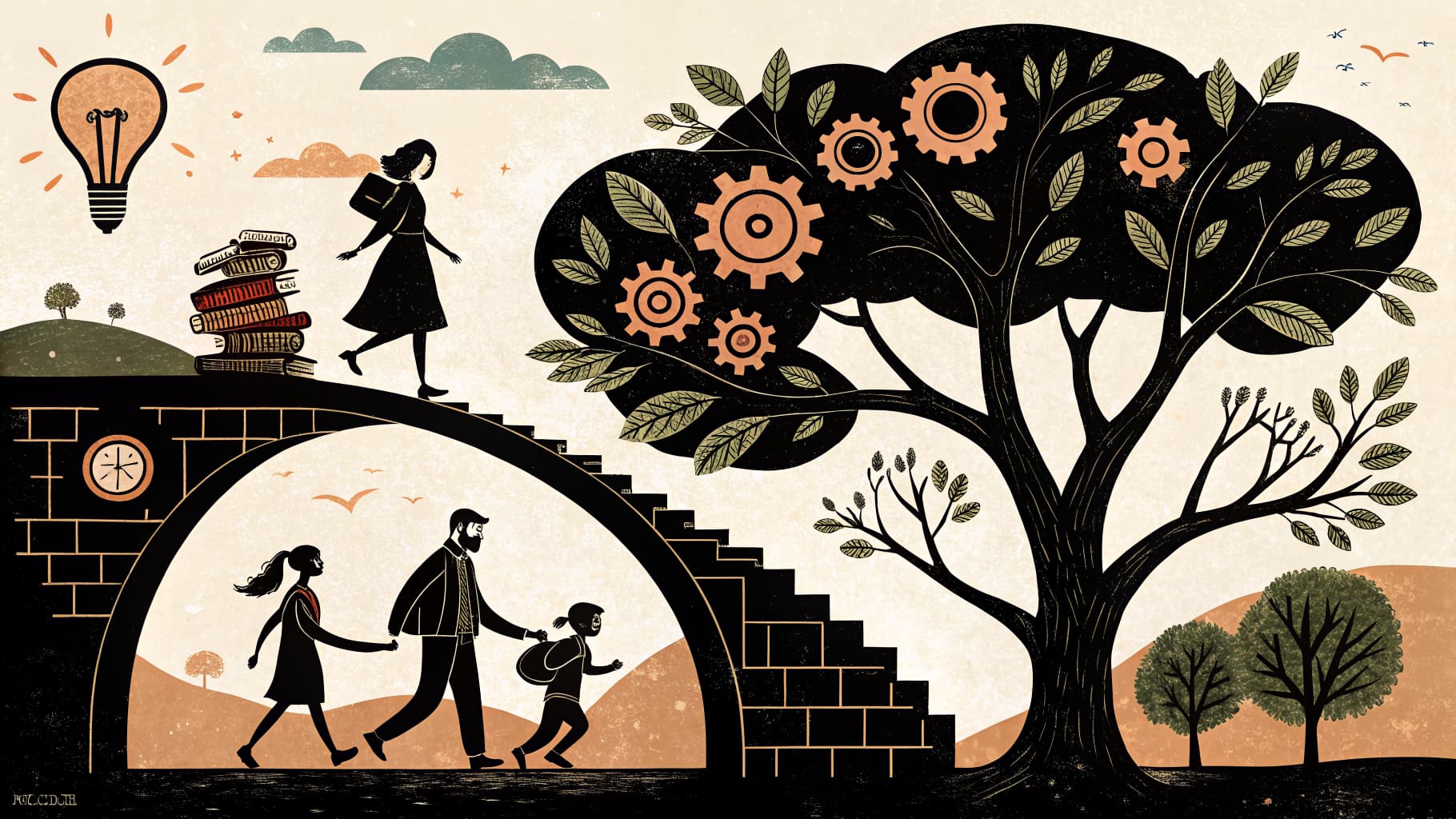
Ask most Class 8 students in India what photosynthesis is, and they can recite the definition perfectly. Ask them what a plant actually needs to survive, and many will hesitate. That gap, between memorized words and genuine understanding, is exactly what activity based learning strategies are designed to close.
The National Education Policy 2020 did not invent this insight. But it formalized it into law. Across CBSE schools, the mandate is no longer simply to teach content, it is to build competencies, and that requires students to do something with what they learn.
This article gives you 14 concrete strategies you can use in a CBSE classroom tomorrow, along with the policy grounding that makes the case to skeptical parents and administrators.
What is Activity-Based Learning in the Indian Context?
Activity-based learning (ABL) is a pedagogical approach in which students acquire knowledge and skills primarily through structured tasks, inquiry, collaboration, and hands-on application rather than passive listening and rote recall.
In the Indian context, ABL is not a foreign import. The approach has deep roots in the work of Gijubhai Badheka and the Nai Talim philosophy articulated by Mahatma Gandhi. What is new is the formal institutional backing.
NEP 2020 mandates a shift from "rote learning and teaching-to-the-test" to "critical thinking, creativity, and analysis." The policy's 5+3+3+4 curricular structure directly embeds ABL at each level: the Foundational Stage (ages 3–8) is designated for play-based learning, and the Preparatory Stage (ages 8–11) for activity-based learning. According to the National Curriculum Framework for Foundational Stage, learning must be structured around children's active participation, not adult transmission.
NCERT's revised textbooks reflect this. Content overload is being reduced, and integrated activity tasks are woven into chapters rather than relegated to end-of-unit exercises. The direction of travel is clear, and CBSE has reinforced it through circulars on experiential learning, art-integrated projects, and the DIKSHA platform for teacher training.
14 Proven Activity Based Learning Strategies for CBSE Classrooms
These strategies range from five-minute warm-ups to full-period structures. Each one is mapped to common CBSE subjects so you can see how it translates to your timetable.
1. Think-Pair- Share
Students think independently about a question, discuss with a partner, then share with the class. Takes three to five minutes and works in any subject.
In practice: Before teaching fractions in Class 4 Mathematics, ask: "If you split a roti into three equal pieces and eat one, what part is left?" Students reason individually, compare answers with a partner, and surface misconceptions before instruction begins.
2. Jigsaw Method
Divide the class into home groups, then expert groups. Each expert group studies one aspect of a topic, then returns to teach their home group. Every student is both learner and teacher.
In practice: In Class 9 Social Science, assign different expert groups to the causes, events, consequences, and legacy of the French Revolution. When students reassemble, the synthesis happens peer-to-peer, not from a single lecture.
3. Gallery Walk
Post student work, data sets, or provocative statements around the room. Students walk through, read, and add written responses with sticky notes or markers.
In practice: For Class 6 EVS, display printed images of different ecosystems. Students annotate: what animals live here? What do humans do here? What threats do they see? The walk generates discussion material for a full lesson.
4. Socratic Questioning Circles
Students sit in two concentric circles. The inner circle discusses an open question while the outer circle observes and takes notes. Then they switch.
In practice: In Class 10 English, use a passage on environmental degradation as the discussion text. Inner-circle students debate whether individual responsibility or government policy matters more. Outer-circle students track which claims are supported by evidence in the text.
5. Role Play and Simulation
Students take on assigned roles and work through a scenario. This is particularly powerful for social sciences, civics, and language development.
In practice: In Class 7 Civics, set up a mock Gram Sabha. Assign students roles as the sarpanch, a farmer facing land issues, a health worker, and an NGO representative. Let them negotiate a budget decision. Abstract concepts like local governance become visceral.
6. Hands-On Science Experiments
Hypothesis, method, observation, conclusion, the scientific method embedded in a physical task rather than described in a chapter.
In practice: For Class 8 Science (microorganisms), students prepare two bread slices: one kept moist and covered, one kept dry. After 72 hours, they record observations and draw conclusions about conditions required for fungal growth. No lab equipment required.
7. Concept Mapping
Students draw a visual map showing how ideas connect, using arrows and linking words. This externalizes their mental models and makes gaps visible.
In practice: At the start of a Class 9 Physics chapter on motion, ask students to map everything they already know about speed, distance, and time. Collect the maps. At the end of the chapter, ask them to update or redo the map. The comparison shows learning concretely.
8. Mathematical Games and Manipulatives
Games with dice, cards, or grid boards turn procedural practice into active engagement. Manipulatives, even newspaper strips folded into fractions, make abstract quantities concrete.
In practice: For Class 5 Mathematics, a "fraction war" card game where students compare fractions, identify the larger one, and justify their reasoning eliminates the need for repeated worksheet drills.
9. Storytelling and Narrative Reconstruction
Students receive a cut-up story or historical sequence and must reconstruct it in the correct order, then retell it in their own words.
In practice: In Class 6 History, give each group a set of cards describing events from the Indus Valley Civilisation. Students sequence the cards, justify their order, and present a two-minute narrative to the class.
10. Art Integration
CBSE's mandated art-integrated learning is not a peripheral add-on, it is a direct instruction to embed visual art, performing art, and craft as vehicles for subject learning.
In practice: In Class 7 Hindi or English, students create illustrated storyboards summarising a poem. The act of choosing which moments to illustrate forces close reading. The visual product becomes an assessment artifact.
11. Inquiry-Based Research Tasks
Students are given a guiding question and must gather information from textbooks, library resources, or (where available) the internet, then present findings.
In practice: In Class 9 Economics, the question: "Why do prices of vegetables change between seasons?" Students research supply, demand, and agriculture without being told the answer first. The explanation they construct is far more durable than one they received.
12. Project-Based Learning (Integrated Units)
A multi-week, multi-subject project where students solve a real or realistic problem. This is the most ambitious ABL structure, and the one NEP 2020 most explicitly endorses for senior grades.
In practice: A Class 10 integrated project might ask: "Design a waste management plan for your school." Students apply Mathematics (data collection), Science (decomposition, biodegradation), English (report writing), and Social Science (policy frameworks) in a single project.
13. Exit Tickets and Learning Logs
At the end of a period, students write one thing they understood, one thing still unclear, and one question they have. Takes three minutes. Gives the teacher formative data without marking a full test.
In practice: This works across every subject and every grade. For Class 11 Chemistry after introducing periodic trends, a well-designed exit ticket reveals instantly which students are ready to move on and which need a re-teach.
14. Coding and Digital Literacy Activities
CBSE's inclusion of coding and computational thinking from Class 6 onwards opens the door to structured problem-solving activities that are inherently active and iterative.
In practice: Using block-based tools available on DIKSHA or offline on school computers, students in Class 6–8 can create simple animations that illustrate a Science or Maths concept they have studied. Teaching through making consolidates both subject knowledge and digital skills.
Implementing ABL with Limited Resources
The assumption that ABL requires a well-funded private school is the single biggest barrier to adoption. It is also wrong.
The most effective Teaching-Learning Materials (TLMs) are locally sourced: newspaper clippings for sorting and sequencing tasks, bottle caps for counting and grouping, fabric scraps for patterns and fractions, hand-drawn maps, and printed photographs. Tamil Nadu's state-level ABL rollout, one of the most extensively studied in Asia, was built almost entirely on low-cost card-based materials distributed to government primary schools.
For digital components, DIKSHA provides freely downloadable activity modules, teacher training videos, and curriculum-aligned content across all CBSE subjects. An offline download during a school's internet window serves classrooms without reliable connectivity.
The honest challenge is not materials, it is time. ABL requires preparation: designing activities, gathering materials, planning group management. Schools that support ABL sustainably build preparation time into the timetable, not as an add-on but as part of a teacher's weekly schedule.
From Sage on the Stage to Learning Facilitator
The most significant shift in ABL is not in what students do. It is in what teachers stop doing.
Facilitation means designing the learning environment rather than delivering information directly. It means asking questions that open inquiry rather than close it. It means tolerating productive noise, disagreement, and the occasional wrong answer as evidence that thinking is happening.
This is harder than it sounds. Many experienced teachers feel the loss of control acutely when they first move to group work or open inquiry. The syllabus timeline adds pressure: "If I let students explore, I won't finish the chapter."
The evidence does not support that fear. Structured ABL, when the activities are directly mapped to NCERT learning objectives, covers curriculum content while building the reasoning skills that board exams increasingly test.CBSE's competency-based question papers, introduced progressively since 2021, reward students who can apply knowledge, not just recall it.
The practical solution is to map each activity explicitly to a syllabus learning outcome before you teach it. If you cannot articulate which chapter objective the activity serves, redesign it. When activities are tightly aligned to NCERT outcomes, ABL does not slow down curriculum coverage, it makes the coverage stick.
, National Curriculum Framework for Foundational Stage, NCERT"The child is not a vessel to be filled but a lamp to be lit. Learning is constructed through active engagement, not passive reception."
Measuring Success: Assessment in an Active Classroom
CBSE's Continuous and Comprehensive Evaluation framework was designed with exactly this kind of classroom in mind.CCE asks for ongoing, multi-modal assessment (observations, projects, group work, oral responses), not just unit tests.
ABL generates assessment data naturally. When students complete a concept map, that map is an assessment artifact. When a group presents their Gram Sabha simulation, a teacher with a simple rubric can assess communication, reasoning, and content knowledge simultaneously. Exit tickets feed into the next day's lesson plan without additional marking load.
The challenge in India's current transition is standardization. How formative competency-based assessment will be calibrated consistently across the country's diverse regional and linguistic contexts remains an open question, one that CBSE, state boards, and NCERT are working through together.
For classroom teachers, the most practical move is to build a simple portfolio system. Each student keeps a folder, physical or digital, with three to five artifacts per term: a concept map, a project reflection, a peer-assessment sheet, and one or two exit tickets. The portfolio gives parents and administrators evidence of learning that a single exam cannot capture.
What This Means for Your Classroom
Activity based learning strategies are no longer optional enrichment for motivated teachers in well-resourced schools. They are the pedagogical direction India's education system has formally chosen, encoded in NEP 2020, reflected in NCERT's revised frameworks, and supported through CBSE's teacher development infrastructure.
The shift is real, the policy backing is clear, and the strategies are practical. The 14 approaches above cover the full range from a five-minute Think-Pair-Share to a multi-week integrated project. Each one can be mapped to CBSE syllabus objectives, implemented without expensive materials, and assessed through CBSE's existing CCE framework.
Start with one. Map it to a chapter you are teaching next week. Observe what changes when students are the ones doing the thinking.
That is where the gap between definition and understanding finally closes.