Picture a class of thirty students, all talking at once, and none of them off-task. That's the experience teachers describe after their first World Café session, and it sounds improbable until you understand what the structure is actually doing.
The World Café was developed in 1995 by Juanita Brown and David Isaacs in Marin County, California, originally to help business leaders generate collective intelligence around complex strategic questions. Educators quickly recognized that the same protocol could do something most classroom discussions can't: let every student contribute substantively to a hard question at the same time, with ideas building across groups rather than staying siloed at individual tables.
What Is World Café?
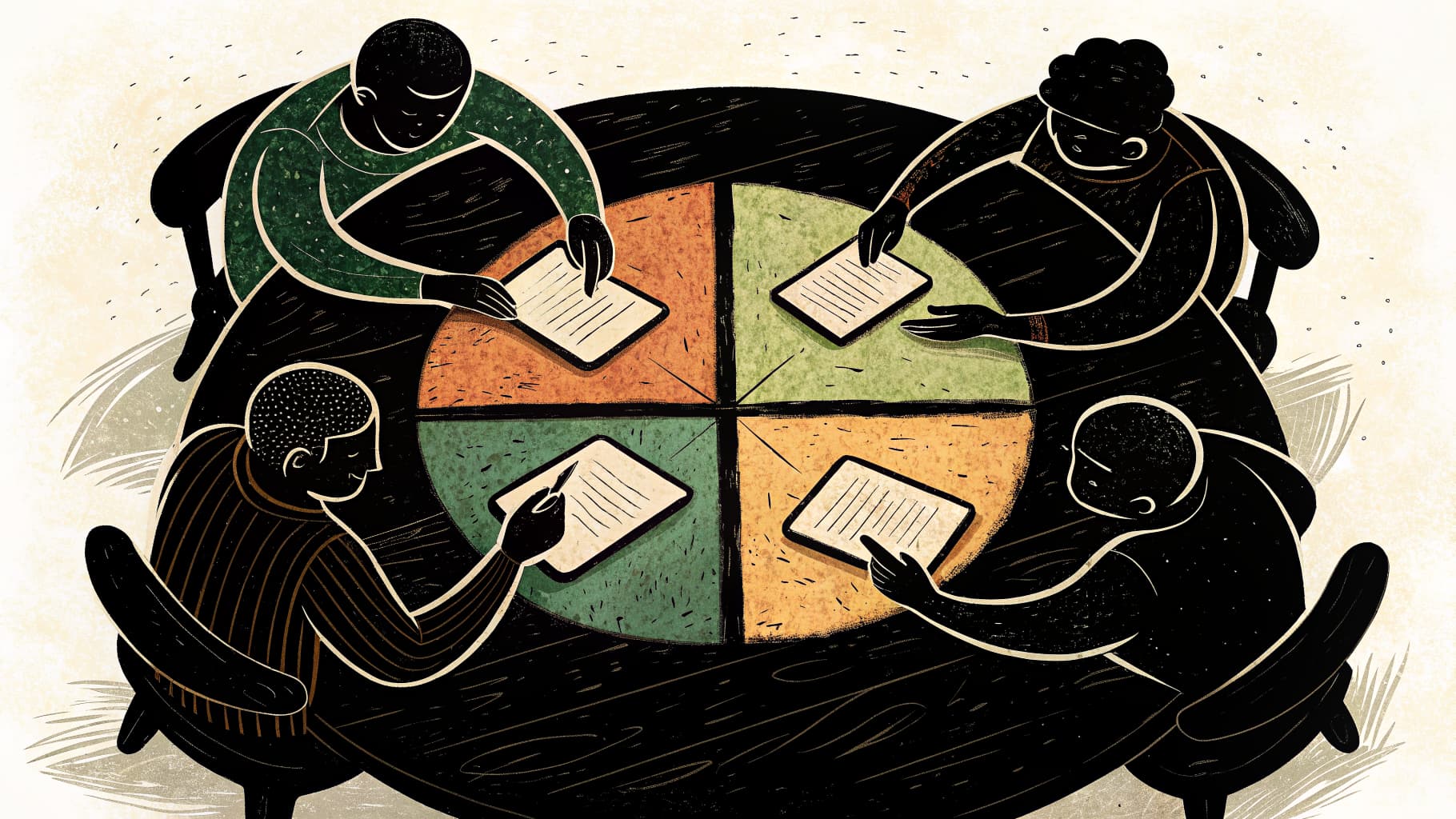
A world café is a structured conversational protocol that distributes discussion across multiple simultaneous small groups, typically four to five students each. Instead of one conversation happening at the front of the room while others listen, four or five conversations run in parallel, each inheriting and extending the thinking of the group before it.
The café metaphor is doing real pedagogical work. In a café, conversations are informal but serious: people lean forward, sketch on napkins, interrupt each other productively. There's no podium and no designated speaker. Recreating that atmosphere in school, tablecloths on desks, markers, low background music, is a deliberate signal that this conversation will operate differently. Research published in the International Journal of Qualitative Methods by Fouché and Light found that the World Café creates a genuinely democratic space where participants co-construct meaning in ways that traditional discussion formats don't support, particularly for students who stay quiet in large-group settings.
What separates World Café from standard group work is the documentation layer. Students write, draw, and annotate the tablecloth throughout each round, and that accumulated thinking stays when the group rotates. The third group to sit at a table doesn't start fresh; they encounter the thought trails of two previous groups and build forward from there. That cross-pollination is where the method earns its reputation for handling complexity.
The strategy sits squarely within constructivist learning theory: knowledge isn't delivered, it's co-created through social interaction. Each rotation is designed to complicate and deepen, not reset.
How It Works
Step 1: Set the Environment
Arrange your classroom into clusters of four or five chairs around each table. Cover each surface with a large sheet of butcher paper or a paper tablecloth, and place a handful of markers in different colors at the center. A small plant or simple centerpiece is worth adding; this isn't decoration. According to the University of Glasgow's Active Learning Hub, the physical environment is central to the method's success because it signals informality and shifts student expectations about whose ideas count before anyone says a word.
Print each discussion question on a card and place it at every table before students arrive.
Step 2: Design Your Questions
The quality of your questions determines everything else. Design two or three that build progressively:
- Round 1 opens the inquiry: What conditions allowed the Civil Rights Movement to gain traction when it did?
- Round 2 pushes analysis: Where did the movement's strategies succeed, and where did they fall short?
- Round 3 asks for synthesis: What does the movement's history suggest about how change actually happens?
Each question must be genuinely open-ended. If there's a correct answer students are working toward, you're not writing a World Café question. The format rewards complexity; give it complex material.
Step 3: Conduct the Discussion Rounds
Each round runs ten to fifteen minutes. Students discuss the question and are encouraged to write, draw, and annotate throughout, not at the end. The tablecloth should look like a running record of thinking in progress, not a polished summary.
Your job during rounds is to circulate and listen. Resist the urge to redirect content. If a group goes quiet, a process prompt works better than a content one: "What would someone who disagrees with that say?" usually restarts the conversation without narrowing it.
Step 4: Assign Table Hosts and Rotate
Before the first rotation, ask one student at each table to volunteer as the table host. That student stays through all three rounds while everyone else moves. WorldWise Global Schools recommends randomizing movement so students end up with different classmates each time rather than traveling together as a unit.
Give students thirty seconds of quiet before they stand. That brief pause helps them mentally note the thread they want to carry to the next table.
Step 5: Brief the Incoming Group
This is where most World Cafés succeed or stall. The table host's job is to welcome the new group and connect the incoming conversation to what's already on the tablecloth. Not a recap: a connection.
Train hosts with a specific frame before the session begins: "Your job isn't to report what the last group said. It's to find what was left unresolved or surprising and put that in front of the new group as something worth pushing on."
A strong host opens with: "The last group landed here (points to an idea) and felt uncertain about this part. What do you see that they might have missed?" That framing invites the new group into an active inquiry rather than a passive reception of someone else's conclusions.
Step 6: Harvest the Insights
The harvest is the whole-class phase that closes the final round. It's also the most cognitively demanding part to run well, and the most commonly skipped.
A harvest fails when it becomes a reporting session: each table summarizes, everyone nods, class ends. A harvest succeeds when it becomes genuine synthesis. Ask two or three students from different tables to share the most surprising or generative idea they encountered during the session. Write these on the board as they surface. Then ask the class: "Where do these overlap? Where do they conflict? What question did nobody fully answer?"
That final unanswered question is often your best entry point into the next lesson.
Tips for Success
Design Questions as a Progression, Not a Buffet
The most common structural mistake is treating each table as a separate topic station. When rounds explore completely separate subjects, students can't carry and build ideas across rotations. The cross-pollination effect requires cumulative questions: exploration first, analysis second, synthesis third. Without that sequence, you have simultaneous group work, which is fine but not what World Café is for.
Keep Tables at Four or Five Students
Tables of six or more slide toward audience-and-speaker dynamics, where one or two students hold the floor while others listen. Four students is the sweet spot: everyone speaks, nobody dominates, and the physical arrangement keeps conversation lateral rather than hierarchical.
Give the Tablecloth a Specific Task
"Write your ideas here" produces chaos and shallow annotation. Give each table a structured visual task: "Map the connections you're seeing," "Mark each claim with a plus if you agree or a question mark if you're uncertain," or "List the evidence that would need to exist for this claim to be true." Structure on the documentation surface produces richer thinking, not less.
Never Skip the Harvest
Build fifteen minutes into your lesson plan for the harvest and protect it. The World Café's learning lives in the synthesis phase. Without it, students leave with a collection of table-level conversations that never cohere into shared understanding. The distributed structure of the method creates fragmentation on purpose; the harvest is what resolves it.
Distinguish Connecting from Summarizing
If hosts are summarizing ("the last group discussed industrialization and labor rights"), new groups receive a report. If hosts are connecting ("the last group saw a contradiction between economic freedom and worker safety; what do you make of that tension?"), new groups enter an active inquiry. Cardiff University's guidance on World Café implementation identifies this connective facilitation role as the key variable separating effective implementations from ineffective ones. Brief it explicitly; don't assume students will figure it out on their own.
, Juanita Brown and David Isaacs, The World Café (2005)"Strategic conversation can foster collective intelligence by connecting diverse perspectives through iterative rounds of dialogue."
FAQ
Putting It Together
The world café works because it solves a structural problem most classroom discussions can't overcome. In a large-group conversation, not everyone can speak, and even when students try, ideas rarely build on each other the way they do in a well-run small-group exchange. By distributing the conversation, keeping a running record of thinking at every table, and moving ideas around the room via rotation, World Café creates conditions where thirty students can genuinely think together rather than waiting for their turn.
The method requires more upfront design than a standard discussion, especially in question sequencing and host preparation. Once a class has run a World Café once or twice, students take ownership of the roles quickly and the logistics recede.
Flip Education generates complete World Café session materials from your topic, grade level, and standards: progressive question sets for each round, printable table host guides, a facilitation script for the harvest, and individual exit tickets tied to your learning objectives. If you want to move from "I want to try this" to a room full of students writing on tablecloths faster, that's the place to start.