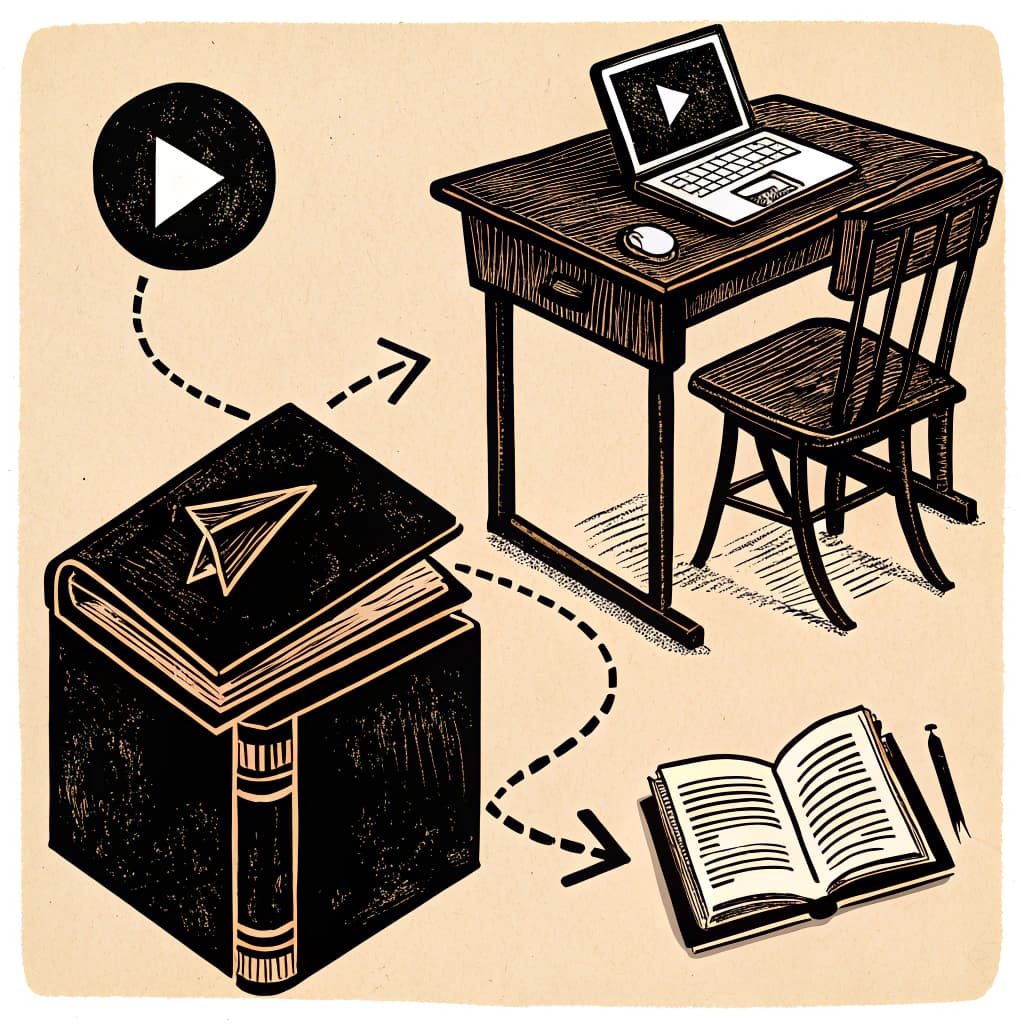
Pre-learn at home, apply and deepen in class
Flipped Classroom
Students engage with new content before class (via video, reading, or interactive media). Class time is then devoted entirely to application, discussion, and deeper exploration, the work that benefits most from teacher support and peer collaboration. Flips the traditional model: lecture at home, "homework" in class.
What is Flipped Classroom?
The Flipped Classroom model inverts the traditional homework-lecture relationship: instruction that would typically happen in class (watching a lecture, receiving direct instruction on new content) is moved to outside class time, and the practice and application work that would typically be done as homework is brought into the classroom where the teacher is present. The logic is compelling: you need a teacher most when you're struggling with something you don't understand yet, not when you're reviewing something you've already been taught. The flip puts teacher presence at the moment of maximum need.
The model was popularized in the early 2010s by Colorado chemistry teachers Jonathan Bergmann and Aaron Sams, who began recording their lectures so students who missed class could catch up. They discovered that their in-class time became more productive when they could use it for application and problem-solving rather than content delivery, and that students who watched the lecture at home had processed the content at their own pace, pausing and rewinding when needed, arriving in class ready to work with the material rather than hearing it for the first time.
The pre-class learning component, typically a short video lecture, podcast, or reading with embedded questions, is where the flip's promise is tested. Simply watching a 20-minute lecture video at home is not meaningfully different from sitting in a classroom watching the same lecture. The pre-class component becomes genuinely valuable when it's designed for active engagement: embedded comprehension questions that students must answer, note-taking guides that direct attention to key ideas, brief quizzes submitted before class that show the teacher where confusion lies before the in-class session begins.
The in-class time, freed from content delivery, is where the flipped model delivers its most distinctive value. Class time in a flipped classroom can be used for: small-group problem-solving with teacher facilitation, differentiated practice where the teacher works intensively with students who need more support while others work independently, collaborative projects that require face-to-face coordination, peer teaching, lab activities, and rich discussions about the implications of content rather than the content itself. These are all activities that genuinely require teacher presence and peer interaction, activities that homework cannot replace.
The equity challenge of the flipped classroom is real and deserves direct attention rather than dismissal. Students without reliable internet access, quiet home environments, or parental support for independent learning at home face barriers that the flipped model can exacerbate if not deliberately addressed. Providing in-school alternatives, such as library time, downloaded content, or printed equivalents, is not an optional add-on but a prerequisite for equitable implementation. Schools that have implemented flipped classrooms without addressing equity have sometimes widened achievement gaps rather than narrowing them.
The research on flipped classrooms is genuinely mixed, which is instructive. Studies that find positive effects typically examine implementations where the in-class time is used for active, collaborative, and higher-order learning, not where it's used for more seat work with a different content delivery medium. The flip is a format, not a method: its educational value depends entirely on what is done with the class time that the format frees. A flipped classroom where in-class time is used well produces better outcomes than traditional instruction; a flipped classroom where in-class time is used for low-quality practice does not.
How to Run Flipped Classroom: Step-by-Step
Identify Key Concepts
7 min
Select a specific unit or lesson where students often struggle with application and would benefit from more in-class support.
Curate or Create Content
7 min
Develop short (5-10 minute) instructional videos or select targeted readings that cover the foundational 'remembering' and 'understanding' phases.
Establish an Accountability Mechanism
7 min
Create a brief pre-class assessment, such as a 3-question Google Form or a guided notes sheet, to verify students engaged with the material.
Design Active Learning Activities
8 min
Plan in-class tasks like Socratic seminars, lab experiments, or collaborative problem sets that require students to apply the pre-learned concepts.
Facilitate Small Group Support
7 min
Use class time to circulate among groups, providing targeted interventions for students who struggled with the pre-class content.
Synthesize and Review
7 min
Conclude the lesson with a brief whole-group reflection or 'exit ticket' to solidify the connections between the home study and class application.
BEFORE YOU TEACH THIS
Read the Teacher's Guide first.
Flip Education's Teacher's Guide walks you through how to facilitate any active learning lesson: mindset, pre-class checklist, phase-by-phase facilitation, and a Quick Reference Card you can print and bring to class.
Read the Teacher's Guide →Common variants
Video-pre-class flip
Content delivered by short video before class; class time is application and discussion. The most common flip, and the easiest to start.
Reading-pre-class flip
Pre-reading with guiding questions replaces the video. Works better for text-heavy subjects and students with strong literacy.
Task-pre-class flip
Students attempt a small problem or exploration before class. Class opens by diagnosing what went wrong, then teaches into the gap. Higher cognitive load, more diagnostic value.
Research Evidence for Flipped Classroom
Akçayır, G., Akçayır, M. (2018, Computers & Education, 126, 334-345)
The study found that the flipped model significantly improves student learning performance and satisfaction compared to traditional lecture-based formats.
Hew, K. F., Lo, C. K. (2018, BMC Medical Education, 18(1), 38)
A meta-analysis revealed that flipped classrooms are more effective than traditional classrooms for achieving higher-level learning outcomes across various disciplines.
Cheng, L., Ritzhaupt, A. D., Antonenko, P. (2019, Educational Technology Research and Development, 67(4), 793-824)
This research confirms that the flipped classroom strategy has a moderate positive effect on student learning outcomes across diverse educational levels and subjects.
Common Flipped Classroom Mistakes and How to Avoid Them
Assuming all students will complete the pre-work
Flipped classroom breaks down if a significant portion of students arrive without having done the pre-work. Build in a 5-minute class-opening activity that confirms essential understanding before launching into in-class work. Have a backup brief summary for students who didn't complete the video.
Passive video content with no engagement requirement
Students who watch a lecture video passively retain very little. Require a specific output from every video: a note-taking guide with key questions, a '3-2-1' response, or a brief quiz submitted before class. The engagement requirement transforms watching into learning.
In-class time that looks like traditional class
If class time is spent reviewing the video content as a lecture, the flip has accomplished nothing. In-class time should be spent on application, analysis, problem-solving, and creation: activities that require both teacher presence and peer collaboration.
Equity issues around technology and home access
Not every student has reliable internet or a quiet space to watch videos at home. Prepare for this: provide school library computer time, allow video downloads, or offer an offline alternative. The flip model should increase equity, not compound existing disadvantages.
Students who feel the video is 'the real lesson' and class is extra
If students treat in-class work as optional or secondary, they've misunderstood the model. Explicitly frame from day one: the video is preparation; class time is where the actual learning happens. Grade in-class engagement, not just the out-of-class submission.
How Flip Education Helps
Printable in-class application activity cards
Flip generates printable activity cards designed for the in-class application phase of a flipped lesson. These materials provide the hands-on tasks students need to deepen their understanding of the topic they've already been introduced to. Everything is ready to print and use for a single-session activity.
Curriculum-aligned tasks for any lesson topic
The AI creates application tasks that are directly tied to your curriculum standards and lesson topic, ensuring students apply their knowledge in a meaningful way. The activity is designed for a 20-60 minute period, focusing on active learning. This alignment keeps the focus on your goals.
Facilitation script and numbered application steps
Follow the generated script to brief students on the activity and use numbered action steps to manage the work and sharing phases. The plan includes teacher tips for guiding student work and intervention tips for groups that struggle to apply the concepts they learned. This guide ensures a structured environment.
Reflection debrief and exit tickets for closure
Wrap up the session with debrief questions that help students connect the in-class activity back to the core curriculum concepts. A printable exit ticket is included to assess individual understanding of the topic. The generation ends with a bridge to your next curriculum objective.
Tools and Materials Checklist for Flipped Classroom
- Video recording device (smartphone, webcam)
- Video editing software (e.g., DaVinci Resolve, iMovie) (optional)
- Learning Management System (LMS) (e.g., Canvas, Google Classroom)
- Interactive video platform (e.g., Edpuzzle, PlayPosit) (optional)
- Online quiz/assessment tool (e.g., Google Forms, Kahoot!)
- Whiteboard or projector
- Student devices (laptops, tablets) (optional)
- Collaborative workspace tools (e.g., Jamboard, Miro) (optional)
- Physical manipulatives or lab equipment (subject-specific)
- Textbooks or supplementary readings
Frequently Asked Questions About Flipped Classroom
What is the Flipped Classroom model?
The Flipped Classroom is an instructional strategy where students learn foundational content at home through videos or readings and use class time for active problem-solving. This reversal ensures that teachers are present when students are performing the most difficult tasks. It prioritizes active learning over passive listening.
What are the benefits of Flipped Classroom for students?
The primary benefit is increased student agency, as learners can pause, rewind, and review instructional content at their own pace. It also provides more opportunities for peer collaboration and immediate teacher feedback during class. This leads to deeper conceptual understanding and higher engagement levels.
How do I start a Flipped Classroom with no technology?
While often associated with video, a 'flip' can be achieved using physical readings, guided workbooks, or observation tasks completed before class. The core requirement is that the 'input' happens independently so the 'output' can happen collaboratively. Teachers can use printed packets or textbook sections as the primary pre-class material.
How do I ensure students do the pre-class work?
Incentivize completion by using low-stakes entrance tickets, online quizzes, or required note-taking templates that are checked at the door. If students realize class activities are impossible to complete without the background knowledge, compliance naturally increases. Consistency in the routine is key to building student accountability.
Is the Flipped Classroom effective for all subjects?
The model is highly effective for subjects requiring procedural knowledge or heavy analysis, such as Math, Science, and Social Studies. In ELA or Arts, it allows for more time dedicated to writing workshops and creative critiques. However, it requires careful adaptation for younger students (K-2) who may lack the independent study skills required.
Classroom Resources for Flipped Classroom
Free printable resources designed for Flipped Classroom. Download, print, and use in your classroom.
Flipped Classroom Preparation Tracker
Students track what they watched or read at home, key concepts they identified, and questions they still have before in-class work begins.
Download PDFPost-Flip Reflection
Students reflect on the self-paced learning experience at home and how the in-class application deepened their understanding.
Download PDFIn-Class Collaboration Role Cards
Assign roles for the active learning portion of a flipped classroom session so every student contributes meaningfully.
Download PDFFlipped Classroom Discussion Prompts
Ready-to-use prompts that connect pre-class content to in-class activities, organized from check-in through extension.
Download PDFSEL Focus: Self-Management
A card focused on the self-directed learning skills students need to succeed in a flipped classroom environment.
Download PDFRelated
Methodologies Similar to Flipped Classroom
Ready to try this?
- Read the Teacher's Guide →
- Generate a mission with Flipped Classroom →
- Print the toolkit after generating
Generate a Mission with Flipped Classroom
A complete lesson plan, aligned to your curriculum.