United States · Common Core State Standards
10th Grade World History II
The Age of Revolution through the Modern World (1750–Present). US 10th Grade Social Studies covering revolutions, imperialism, world wars, the Cold War, and contemporary global challenges.
01The Age of Revolutions
Political and economic transformations that ended the early modern era and birthed the modern state system.
Examine the intellectual and scientific precursors that laid the groundwork for Enlightenment thought.
Explore the core ideas of key Enlightenment thinkers like Locke, Rousseau, Montesquieu, and Voltaire.
Investigate how Enlightenment concepts directly inspired the American and French Revolutions.
Analyze the social, economic, and political factors leading to the collapse of the Ancien Régime.
Trace the key events and shifts in power from the storming of the Bastille to the Reign of Terror.
Examine Napoleon Bonaparte's military campaigns and political ascent, culminating in his emperorship.
Investigate the expansion of Napoleon's empire, his military defeats, and the Congress of Vienna.
Explore the causes, key figures, and global implications of the only successful slave revolt.
Study the lives and strategies of key figures like Simón Bolívar and José de San Martín.
Examine the lasting social hierarchies and political instability following independence.
Focus on key inventions (steam engine, textile machinery) and their impact on production.
Examine the growth of cities, factory conditions, and the emergence of a new working class.
Investigate early attempts at social reform, including child labor laws and public health initiatives.
Explore Adam Smith's ideas on free markets, division of labor, and the 'invisible hand'.
Examine the critiques of capitalism by Utopian Socialists, Marx, and Engels.
02Nationalism and Imperialism
The consolidation of nation-states and the competitive expansion of European power across the globe.
Explore the concept of nationalism and its role in shaping political identities and movements.
Examine the key figures (Mazzini, Cavour, Garibaldi) and events in Italy's unification.
Investigate Bismarck's Realpolitik and the wars that led to German unification.
Explore the economic, political, religious, and ideological drivers of late 19th-century imperialism.
Examine how technological advancements facilitated European colonial expansion.
Investigate the rapid partition of Africa by European powers and its long-term consequences.
Trace the evolution of British control in India, from corporate influence to direct imperial rule.
Examine the social, cultural, and political changes brought by British rule in India.
Investigate the British opium trade, its impact on China, and the resulting treaties.
Explore the Taiping Rebellion, Boxer Rebellion, and the carving up of China into spheres of influence.
Examine Japan's rapid transformation from an isolated feudal society to a modern industrial power.
Investigate Japan's expansionist policies in Korea, Taiwan, and Manchuria.
Study examples of African resistance, including the Zulu War and Ethiopia's victory at Adwa.
Examine resistance movements in Asia, such as the Boxer Rebellion and early nationalist movements.
03The Great War and Its Aftermath
The collapse of the 19th-century order and the emergence of global instability.
Analyze the long-term factors: Militarism, Alliances, Imperialism, and Nationalism.
Examine the assassination of Archduke Franz Ferdinand and the diplomatic failures that followed.
Explore the brutal realities of trench warfare and the impact of new weapons on the Western Front.
Investigate how WWI transformed civilian life, economies, and gender roles.
Examine the long-term grievances and immediate triggers leading to the fall of the Romanovs.
Trace the events of 1917, Lenin's rise, and the subsequent Russian Civil War.
Analyze the terms of the peace settlement and its role in shaping the interwar period.
Examine the post-WWI redrawing of borders and the application of self-determination.
Study the systematic destruction of the Armenian population during WWI by the Ottoman government.
Explore the cultural changes, social freedoms, and artistic movements of the 1920s.
Examine how new scientific theories (Einstein) and psychological insights (Freud) challenged traditional worldviews.
04The Rise of Totalitarianism and WWII
The failure of democracy in the face of economic collapse and the most destructive war in history.
Analyze the causes and worldwide impact of the 1929 stock market crash and economic downturn.
Define and compare the core features of totalitarian regimes in the 20th century.
Examine the origins of Fascist ideology and Mussolini's consolidation of power in Italy.
Investigate the causes, key players, and international implications of the Spanish Civil War.
Examine the collapse of the Weimar Republic and the factors leading to Hitler's appointment as Chancellor.
Explore the core tenets of Nazism, including racial purity, Lebensraum, and the establishment of a totalitarian state.
Investigate Stalin's rise to power, the Great Purge, and the establishment of a totalitarian regime.
Examine Stalin's economic policies, including forced collectivization and rapid industrialization.
Explore the rise of militarism in Japan and its aggressive expansionist policies in Asia.
Analyze the policy of appeasement, key events like the Munich Agreement, and the invasion of Poland.
Examine key battles and strategic shifts on the Eastern, Western, and Pacific Fronts.
Trace the systematic persecution and extermination of European Jews, from discrimination to the 'Final Solution'.
Examine the actions of bystanders, rescuers, and the international community during the Holocaust.
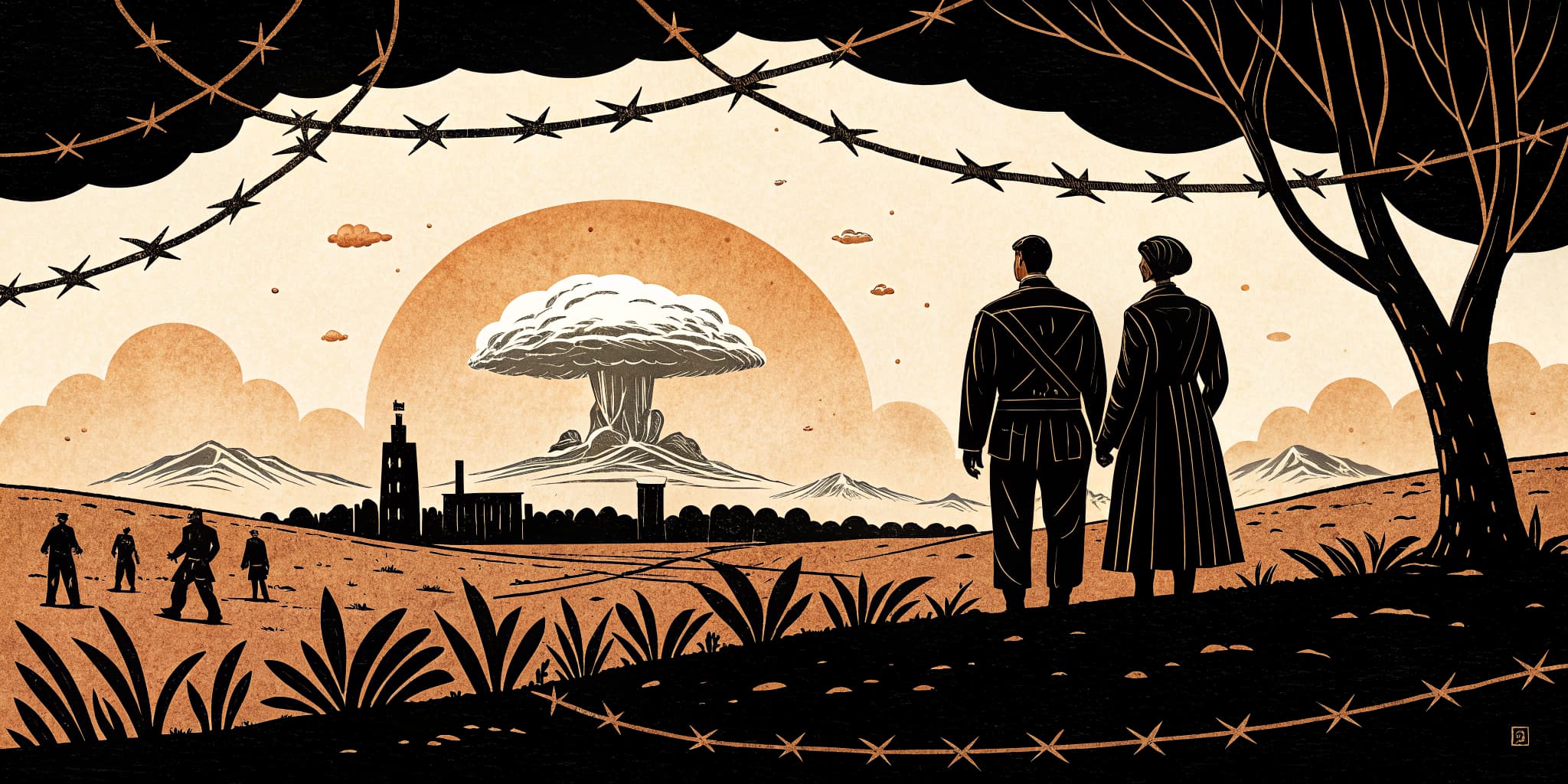
Analyze the decision to use atomic bombs on Hiroshima and Nagasaki and its immediate aftermath.
Examine the Yalta and Potsdam Conferences and the establishment of the United Nations.
05The Cold War World
A bipolar world defined by ideological struggle, nuclear brinkmanship, and proxy conflicts.
Explore the fundamental differences between capitalism/democracy and communism/totalitarianism.
Examine the Truman Doctrine, Marshall Plan, and the policy of containment.
Investigate the division of Germany, the Berlin Airlift, and the construction of the Berlin Wall.
Examine the formation and purpose of the two major military alliances of the Cold War.
Study the Chinese Civil War, Mao Zedong's victory, and the establishment of the PRC.
Investigate the causes, course, and consequences of the Korean War as a proxy conflict.
Explore the nuclear arms race between the US and USSR and the concept of Mutually Assured Destruction.
Examine the 1962 Cuban Missile Crisis, its causes, and its resolution.
Analyze the reasons for US intervention, the 'Domino Theory,' and the escalation of the Vietnam War.
Explore the domestic and international consequences of the Vietnam War.
Examine the policies of Glasnost and Perestroika and their role in the USSR's decline.
Investigate the events of 1989-1991, including the fall of the Berlin Wall and the dissolution of the Soviet Union.
Explore the non-violent movement led by Gandhi and the tragic partition of India and Pakistan.
Compare the paths to independence in Ghana (Nkrumah), Kenya (Kenyatta), and Algeria.
Examine the post-independence struggles with political instability, economic development, and ethnic conflict.
Explore the historical roots of the conflict, including Zionism, the Balfour Declaration, and the creation of Israel.
Study the system of institutionalized racial segregation and the struggle led by Nelson Mandela.
Examine the overthrow of the Shah and the establishment of an Islamic Theocracy.
Explore the impact of the internet, social media, and the digital divide on global society.
Examine the rise of multinational corporations, free trade agreements (WTO, NAFTA), and their consequences.
Study the genocides in Rwanda and Bosnia, focusing on causes, international response, and aftermath.
Examine Deng Xiaoping's reforms, China's economic growth, and its increasing global influence.
Explore the history of environmental movements and the challenges of global sustainability.
Analyze the impact of 9/11, the War on Terror, and the evolution of non-state actors.
Examine the causes and consequences of mass migration due to war, climate, and economic instability.
Explore the global struggle for gender equality, education, suffrage, and bodily autonomy.
Analyze the rise of populism, authoritarianism, and democratic backsliding in the 21st century.