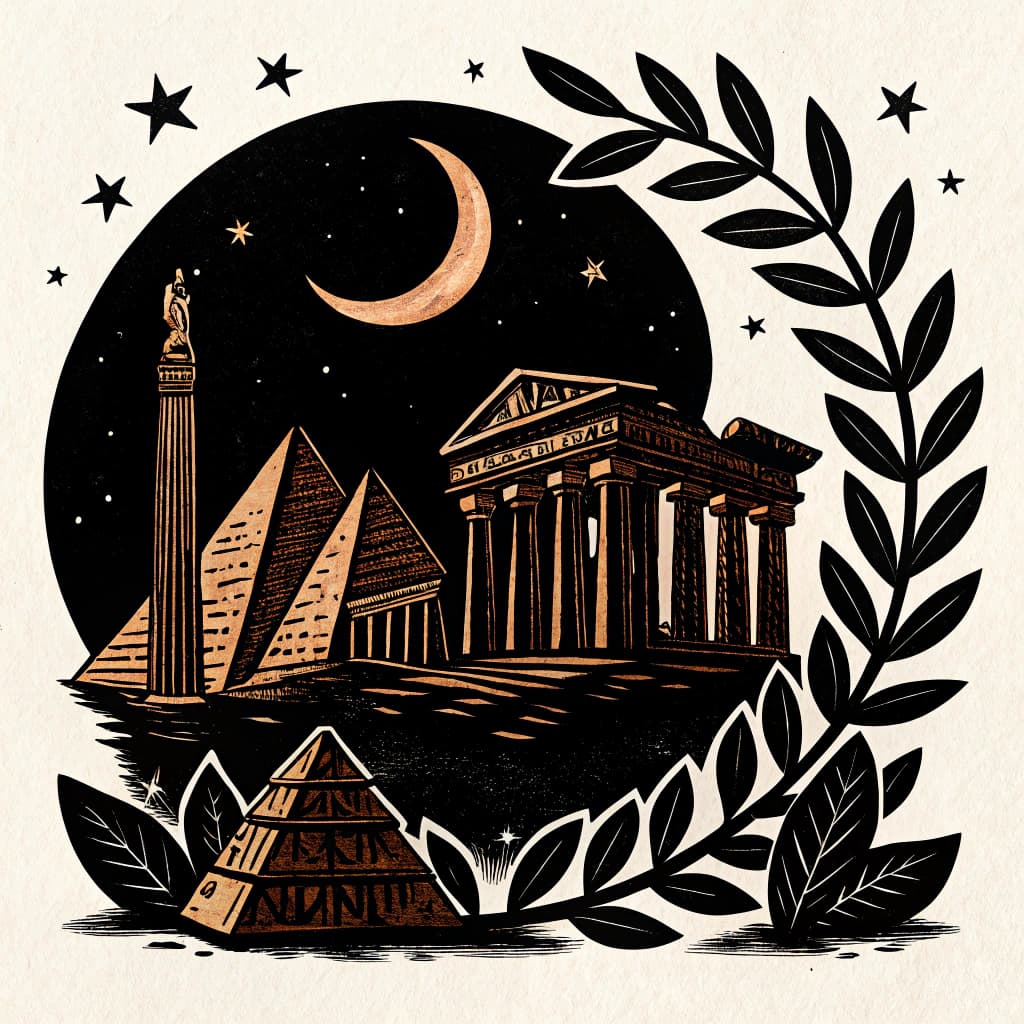
Architecture and Engineering Feats
Comparing the building techniques of the Pyramids, the Parthenon, and Maya temples.
About This Topic
Students compare the engineering and architectural achievements of ancient civilisations through the Egyptian pyramids, Greek Parthenon, and Maya temples. They examine construction techniques, such as the pyramids' massive limestone blocks moved with ramps and levers, the Parthenon's precise marble columns using post-and-lintel systems, and Maya stepped pyramids built with corbelled arches from stone and stucco. Key questions focus on challenges like quarrying, transporting materials without wheels, and aligning structures astronomically, alongside purposes as tombs, religious sites, or palaces.
This topic aligns with KS2 History on ancient civilisations and integrates science and technology by highlighting mathematics in proportions, geometry in designs, and societal organisation revealed through labour coordination. Students evaluate how these feats reflect cultural values, such as Egyptian beliefs in afterlife, Greek ideals of harmony, and Maya ritual calendars.
Active learning suits this topic well. When students construct scale models or simulate ramps with everyday materials, they grasp engineering constraints firsthand. Collaborative comparisons via jigsaws or debates foster critical analysis, making abstract history concrete and memorable.
Key Questions
- Analyze the engineering challenges faced by each civilisation in constructing their monumental buildings.
- Compare the architectural styles and purposes of the Egyptian pyramids, Greek temples, and Maya pyramids.
- Evaluate what these massive structures reveal about the technical skills and societal values of each culture.
Learning Objectives
- Analyze the primary engineering challenges faced by ancient Egyptians, Greeks, and Maya in constructing monumental structures.
- Compare and contrast the architectural styles, construction methods, and intended purposes of Egyptian pyramids, the Parthenon, and Maya temples.
- Evaluate how the scale, materials, and design of these ancient buildings reflect the technical skills and societal values of each civilization.
- Synthesize information to explain the astronomical alignments present in the construction of these ancient monuments.
Before You Start
Why: Students need a basic understanding of what ancient civilizations are and which major ones existed to contextualize this topic.
Why: Understanding concepts like length, height, and simple shapes is foundational for comparing architectural designs and construction methods.
Key Vocabulary
| Corbel Arch | An arch constructed by stepping successive courses of stone or brick inward until they meet at the top, used by the Maya. |
| Post-and-Lintel System | A basic architectural method where strong horizontal elements (lintels) are held up by strong vertical elements (posts), characteristic of Greek architecture. |
| Ramp and Lever System | Techniques believed to have been used by ancient Egyptians to move massive stone blocks for pyramid construction, utilizing inclined planes and simple machines. |
| Astronomical Alignment | The precise orientation of a structure with respect to celestial bodies, such as the sun or stars, often incorporated into ancient monumental architecture for religious or calendrical purposes. |
Watch Out for These Misconceptions
Common MisconceptionAll pyramids were built the same way.
What to Teach Instead
Egyptian pyramids used straight ramps and levers for smooth-sided tombs, while Maya pyramids were stepped with steeper internal stairs for rituals. Model-building activities let students test stability differences, correcting assumptions through hands-on trial.
Common MisconceptionAncient builders lacked advanced math or tools.
What to Teach Instead
Civilisations applied geometry for Parthenon curves and alignments, plus organised labour. Simulations like ramp challenges reveal planning needs, as peer discussions expose how societal values drove innovations.
Common MisconceptionStructures served only religious purposes.
What to Teach Instead
Pyramids were tombs, Parthenon a treasury-temple, Maya multifunctional palaces. Gallery walks with source analysis help students uncover multiple roles, building nuanced views via collaborative evidence weighing.
Active Learning Ideas
See all activities→Gallery Walk
Model Building: Mini Monuments
Provide clay, straws, cardboard, and toothpicks for groups to build scaled models of a pyramid, Parthenon column, and Maya temple. Discuss materials and techniques used by each civilisation before construction. Groups present their models, explaining engineering choices.
Gallery Walk
Feature Comparison
Display images and facts about each structure around the room. Pairs rotate to stations, noting similarities and differences in style, purpose, and challenges on sticky notes. Conclude with a whole-class chart synthesising findings.
Gallery Walk
Engineering Challenge: Ramp Relay
Teams design and test ramps from wood and books to move 'stone' blocks (foam bricks) uphill, mimicking pyramid construction. Measure efficiency and adjust designs. Relate results to ancient techniques through discussion.
Real-World Connections
- Structural engineers today still use principles of load bearing and material science, similar to how ancient builders understood stone and gravity, when designing skyscrapers like the Shard in London or bridges such as the Golden Gate.
- Archaeologists and historians meticulously study sites like Giza, Athens, and Chichen Itza, using advanced imaging and surveying techniques to understand the construction methods and cultural significance of these ancient marvels.
Assessment Ideas
Provide students with three images, one each of a pyramid, the Parthenon, and a Maya temple. Ask them to write one sentence for each, identifying the civilization and its primary construction method (e.g., 'This is an Egyptian pyramid, built using ramps and levers.').
Pose the question: 'If you were an engineer in ancient Egypt, Greece, or Maya times, what would be your biggest challenge in building these structures, and why?' Facilitate a class discussion where students share their ideas, referencing specific materials and techniques.
Students complete the sentence: 'The purpose of the Parthenon was ______, which is different from the purpose of the Egyptian pyramids because ______.'
Frequently Asked Questions
How do the pyramids, Parthenon, and Maya temples differ in engineering?
What do these structures reveal about ancient societies?
How can active learning help teach architecture feats?
How to assess understanding of building challenges?
Planning templates for History
5E Model
The 5E Model structures lessons through five phases (Engage, Explore, Explain, Elaborate, and Evaluate), guiding students from curiosity to deep understanding through inquiry-based learning.
Unit PlannerThematic Unit
Organize a multi-week unit around a central theme or essential question that cuts across topics, texts, and disciplines, helping students see connections and build deeper understanding.
RubricSingle-Point Rubric
Build a single-point rubric that defines only the "meets standard" level, leaving space for teachers to document what exceeded and what fell short. Simple to create, easy for students to understand.
More in The Big Picture: Comparing Civilisations
Defining Civilisation: Shared Features
Exploring what the great ancient civilisations had in common: writing, cities, religion, and social hierarchy.
3 methodologies
Religion and Belief Across Civilisations
Comparing how Egyptians, Greeks, and Maya understood their gods, death, and the meaning of life.
3 methodologies
Writing Systems and Knowledge
Comparing the development and use of hieroglyphs, alphabets, and logograms in ancient civilisations.
3 methodologies