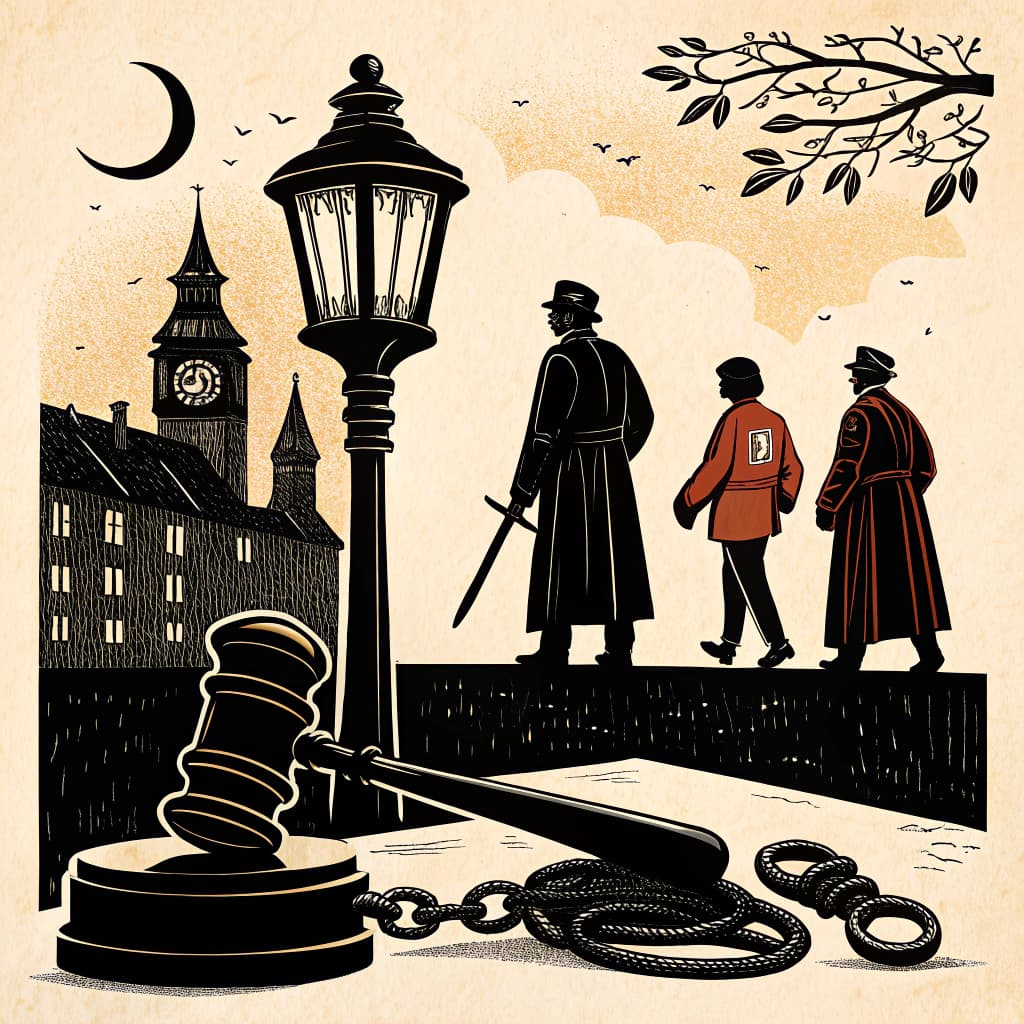
Later Medieval Justice: Justices of the Peace
The rise of Justices of the Peace and the shift towards professionalised local government.
TL;DR:Active learning helps students grasp the shift from communal to professional justice by letting them analyze primary sources and role-play historical figures. This topic benefits from hands-on tasks because the changes in legal authority were not abstract; they reshaped daily life for ordinary people.
About This Topic
As the Middle Ages progressed, the English legal system became more professionalised. This topic tracks the rise of the Justices of the Peace (JPs) and the decline of the old communal systems like the Sheriff and the tithing. It also examines how major events like the Black Death forced the government to introduce new 'Labour Laws' to control the surviving workforce, criminalising those who asked for higher wages.
This transition is a key part of the GCSE 'Crime and Punishment' narrative, showing the shift from local community responsibility to state-led enforcement. Students will see how the law was used to maintain social order during times of economic crisis. This topic benefits from station rotations where students can compare the roles of different officials, helping them grasp the increasing complexity of local government.
Key Questions
- Explain why the role of the Sheriff declined in the later Middle Ages.
- Analyze how the Black Death impacted the enforcement of Labour Laws.
- Evaluate if JPs were more effective than older communal systems.
Learning Objectives
- Analyze the reasons for the decline in the Sheriff's authority during the later Middle Ages.
- Evaluate the effectiveness of Justices of the Peace compared to earlier communal justice systems.
- Explain the impact of the Black Death on the enforcement and nature of Labour Laws.
- Classify the powers and responsibilities of Justices of the Peace in the context of medieval governance.
Before You Start
Why: Students need to understand the communal and decentralized nature of justice, including roles like the Sheriff and tithing, to appreciate the changes brought by JPs.
Why: Understanding the establishment of a more centralized monarchy and the feudal hierarchy provides context for the evolution of royal authority and local administration.
Key Vocabulary
| Justices of the Peace (JPs) | Local officials appointed to administer justice in a specific area, gradually taking over judicial and administrative roles from older bodies. |
| Tithing | A group of ten households responsible for the good conduct of its members; a communal system of social control that weakened with the rise of JPs. |
| Labour Laws | Legislation, such as the Statute of Labourers, enacted to control wages and the movement of workers, particularly after the labor shortages caused by the Black Death. |
| Statute of Labourers | A 1351 English statute that attempted to fix wages at pre-plague levels and restrict peasant mobility, a key example of government intervention in the economy. |
Watch Out for These Misconceptions
Common MisconceptionThe Black Death only caused medical problems.
What to Teach Instead
The plague caused a massive labour shortage, which led to the first major 'wage control' laws. Active analysis of the Statute of Labourers helps students see the link between economics and crime.
Common MisconceptionJustices of the Peace were professional lawyers.
What to Teach Instead
JPs were usually local landowners (gentry) who were not paid. They did it for social status and power. Comparing JPs to modern magistrates helps students understand this 'unpaid' tradition in British law.
Active Learning Ideas
See all activities→Stations Rotation
Medieval Officials
Set up stations for the Sheriff, the Constable, the Coroner, and the JP. Students collect 'job descriptions' and rank them by how much power they had over the local community.
Inquiry Circle
The Black Death and the Law
Provide students with the Statute of Labourers (1351). They must identify three 'new' crimes created by the law and explain why the government was so afraid of peasants moving around.
Think-Pair-Share
Professional vs Communal
Students discuss whether they would prefer to be judged by their neighbours (tithing) or a local landowner (JP). They share their reasoning, focusing on ideas of fairness and bias.
Real-World Connections
- Modern local government structures in the UK, such as magistrates' courts, have historical roots in the development and powers of the Justices of the Peace.
- The concept of labour laws and government intervention in wages and employment, seen in the Statute of Labourers, continues to be a feature of modern economic policy and industrial relations debates.
Assessment Ideas
Provide students with two scenarios: one describing a local justice issue in the early Middle Ages and another in the late Middle Ages. Ask them to write one sentence for each scenario identifying the primary authority responsible for resolving the issue and one sentence explaining why that authority changed.
Display a Venn diagram with 'Sheriff' on one side and 'Justices of the Peace' on the other. Ask students to call out or write down key responsibilities or characteristics for each, placing them in the correct section or the overlapping area if applicable.
Pose the question: 'Were the Justices of the Peace a sign of progress or a tool for social control in later medieval England?' Facilitate a class discussion where students must support their arguments with evidence about the JPs' powers and the context of the Black Death.
Frequently Asked Questions
Who were the Justices of the Peace?
How did the Black Death change the law?
What was the role of the Constable?
Why use active learning for later medieval developments?
Planning templates for History
5E Model
The 5E Model structures lessons through five phases (Engage, Explore, Explain, Elaborate, and Evaluate), guiding students from curiosity to deep understanding through inquiry-based learning.
Unit PlannerThematic Unit
Organize a multi-week unit around a central theme or essential question that cuts across topics, texts, and disciplines, helping students see connections and build deeper understanding.
RubricSingle-Point Rubric
Build a single-point rubric that defines only the "meets standard" level, leaving space for teachers to document what exceeded and what fell short. Simple to create, easy for students to understand.
More in Crime and Punishment in Medieval England
Anglo-Saxon Law: Tithings & Hue and Cry
Exploring tithings, hue and cry, and the role of the community in maintaining peace.
8 methodologies
Norman Conquest: Forest Laws & Murdrum
Analysing the introduction of Forest Laws, Murdrum fines, and the use of Norman-French in courts.
8 methodologies
Trial by Ordeal: Fire, Water, Combat
Investigating the religious basis for trials by fire, water, and combat, and why they ended in 1215.
8 methodologies
Church Influence: Benefit of Clergy & Sanctuary
Examining Benefit of Clergy, Sanctuary, and the conflict between King and Church.
8 methodologies
Anglo-Saxon Society: King, Earls, Thegns
The roles of the King, Earls, Thegns, and Ceorls in late Anglo-Saxon society.
8 methodologies
The House of Godwin: Rise to Power
The rise of the Godwins and the 1065 Northumbrian uprising.
8 methodologies