Construction and Impact of the Berlin Wall
Examine the reasons for the construction of the Berlin Wall and its immediate human and political impact.
TL;DR:Active learning works because the Berlin Wall’s construction and impact involve complex human decisions and immediate consequences that are best understood through multiple perspectives. Students need to see how political choices shaped daily life, and active methods let them explore cause and effect in ways that static texts cannot.
About This Topic
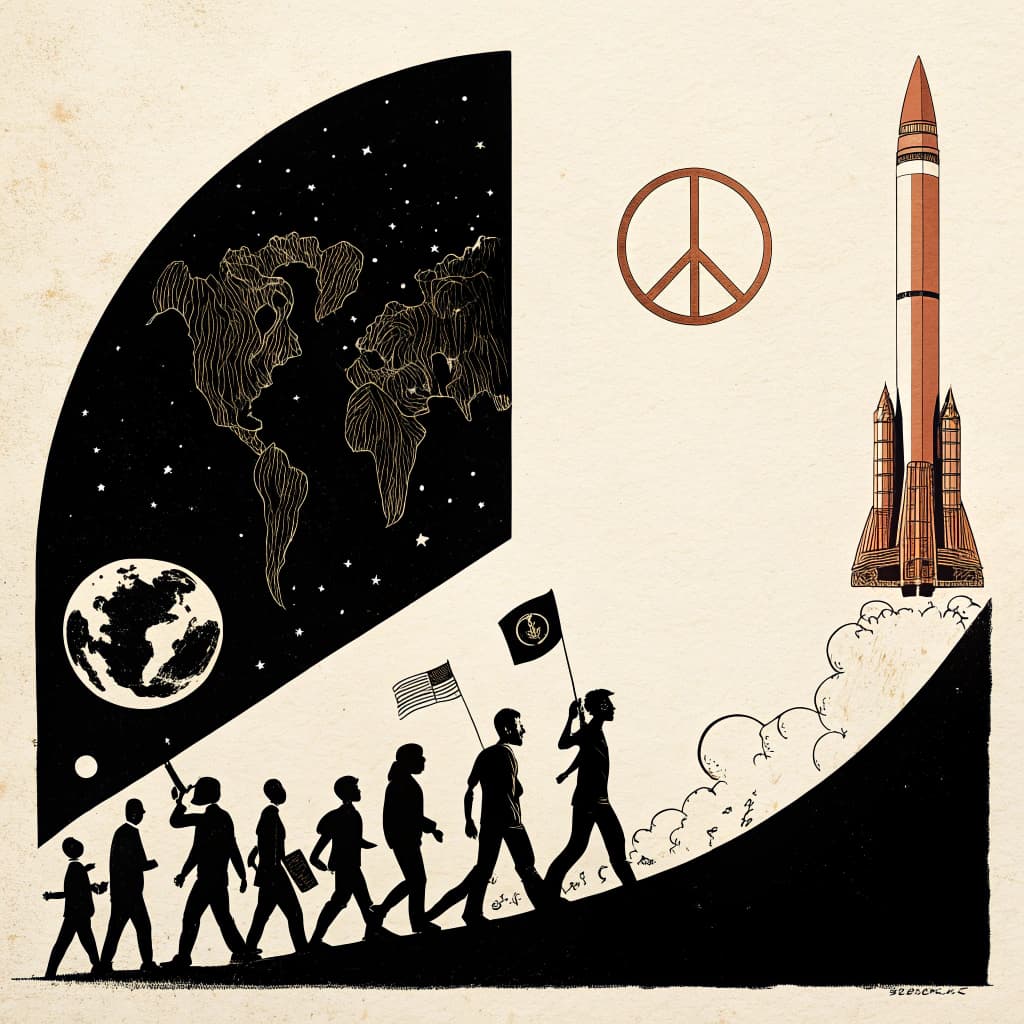
The Space Race explores the competition between the US and USSR for technological and ideological dominance beyond Earth's atmosphere. Starting with the 1957 launch of Sputnik, this topic traces the race through the first human in space, Yuri Gagarin, to the 1969 Apollo 11 Moon landing. Students examine how space achievements were used as powerful propaganda to prove the superiority of either Capitalism or Communism.
For Year 12 Modern History, the Space Race is a key example of how the Cold War drove rapid scientific advancement. It connects to the curriculum's focus on the role of propaganda and the way global rivalries impacted national identity and education. Students also consider the legacy of the race, including the development of satellite technology and the eventual move toward international cooperation in space.
This topic comes alive when students can physically model the propaganda battle through a collaborative media-creation project.
Key Questions
- Justify the Soviet decision to construct the Berlin Wall from their perspective.
- Analyze the immediate social and economic impacts on the citizens of divided Berlin.
- Evaluate the Berlin Wall's effectiveness as a symbol of Cold War division.
Learning Objectives
- Analyze the primary political and economic factors that led to the construction of the Berlin Wall in 1961.
- Evaluate the immediate social and economic consequences of the Berlin Wall's construction on the residents of East and West Berlin.
- Justify the Soviet Union's perspective on the necessity of the Berlin Wall as a measure to prevent emigration and stabilize East Germany.
- Compare the symbolic representation of the Berlin Wall as a physical manifestation of Cold War ideological division.
Before You Start
Why: Students need to understand the post-WWII geopolitical landscape and the emergence of Soviet-American rivalry to grasp the context for the Berlin Wall.
Why: Knowledge of the Allied occupation zones and the formation of East and West Germany is essential for understanding why Berlin became a focal point of division.
Key Vocabulary
| Iron Curtain | A metaphorical division between communist Eastern Europe and capitalist Western Europe, which the Berlin Wall became a physical part of. |
| German Democratic Republic (GDR) | The official name for East Germany, a Soviet-aligned state whose government authorized the construction of the Wall. |
| Federal Republic of Germany (FRG) | The official name for West Germany, a democratic state aligned with the Western powers, which bordered East Berlin. |
| Brain Drain | The emigration of skilled and educated people from one country or region to another, a problem the Wall was intended to stop. |
| Checkpoint Charlie | The most famous crossing point between East and West Berlin, symbolizing the stark division and frequent tensions. |
Watch Out for These Misconceptions
Common MisconceptionThe Space Race was purely about scientific discovery.
What to Teach Instead
While science was a byproduct, the primary drivers were military capability (missile technology) and ideological prestige. Peer discussion of the link between rockets and ICBMs helps students understand the dual-use nature of space technology.
Common MisconceptionThe US was ahead for the entire race.
What to Teach Instead
The Soviet Union actually led for most of the race, achieving the first satellite, first animal, first man, and first woman in space. A collaborative timeline activity helps students see the Moon landing as a 'come from behind' victory for the US.
Active Learning Ideas
See all activities→Gallery Walk
Space Race Propaganda
Display US and Soviet posters celebrating space milestones. Students move in pairs to identify how each nation used space to promote their specific ideology (e.g., Soviet focus on collective achievement vs. US focus on individual heroism).
Inquiry Circle
The 'Sputnik Moment'
Groups analyze primary source reactions to Sputnik from US newspapers and government memos. They must create a 'news report' explaining why a simple beeping satellite caused such a massive crisis of confidence in the West.
Formal Debate
Was the Moon Landing Worth It?
Students are divided into three groups: Pro-Space (national pride/science), Anti-Space (poverty/civil rights at home), and the Soviet Perspective. They debate whether the billions spent on the Apollo program were a justifiable use of resources during the Cold War.
Real-World Connections
- Historians specializing in Cold War studies at institutions like the Wilson Center in Washington D.C. analyze primary source documents and oral histories to understand the human cost of the Wall.
- Urban planners in cities like Seoul, South Korea, study the legacy of divided cities, including Berlin, to inform strategies for reunification and reconciliation in areas affected by past conflicts.
Assessment Ideas
Pose the question: 'From the perspective of the Soviet Union and the GDR, what were the most compelling reasons to build the Berlin Wall?' Allow students to discuss in small groups, then share key arguments with the class, referencing specific historical context.
Ask students to write two sentences describing one immediate social impact and one immediate economic impact of the Berlin Wall on the citizens of divided Berlin. Collect and review for understanding of direct consequences.
Present students with a map of divided Berlin. Ask them to identify two key locations (e.g., Checkpoint Charlie, Brandenburg Gate) and explain their significance in relation to the Wall's construction and impact.
Frequently Asked Questions
Why was Sputnik so significant?
What was the role of NASA in the Cold War?
How did the Space Race end?
What are the best hands-on strategies for teaching the Space Race?
More in The Cold War and Global Rivalries
Post-War Power Vacuum & Ideological Clash
Examine the immediate post-WWII landscape and the fundamental ideological differences between capitalism and communism.
8 methodologies
The Iron Curtain and Containment Doctrine
Investigate Churchill's 'Iron Curtain' speech and the US policy of containment, including the Truman Doctrine and Marshall Plan.
8 methodologies
Formation of NATO and Warsaw Pact
Explore the creation of opposing military alliances and their role in solidifying the bipolar world order.
8 methodologies
The Berlin Blockade and Airlift
Study the first major Cold War crisis in Berlin and the Western response.
8 methodologies
Life in Divided Germany
Explore the daily lives, propaganda, and surveillance in East and West Germany.
8 methodologies
Early Nuclear Development and Deterrence
Examine the development of the atomic bomb by both superpowers and the initial theories of nuclear deterrence.
8 methodologies