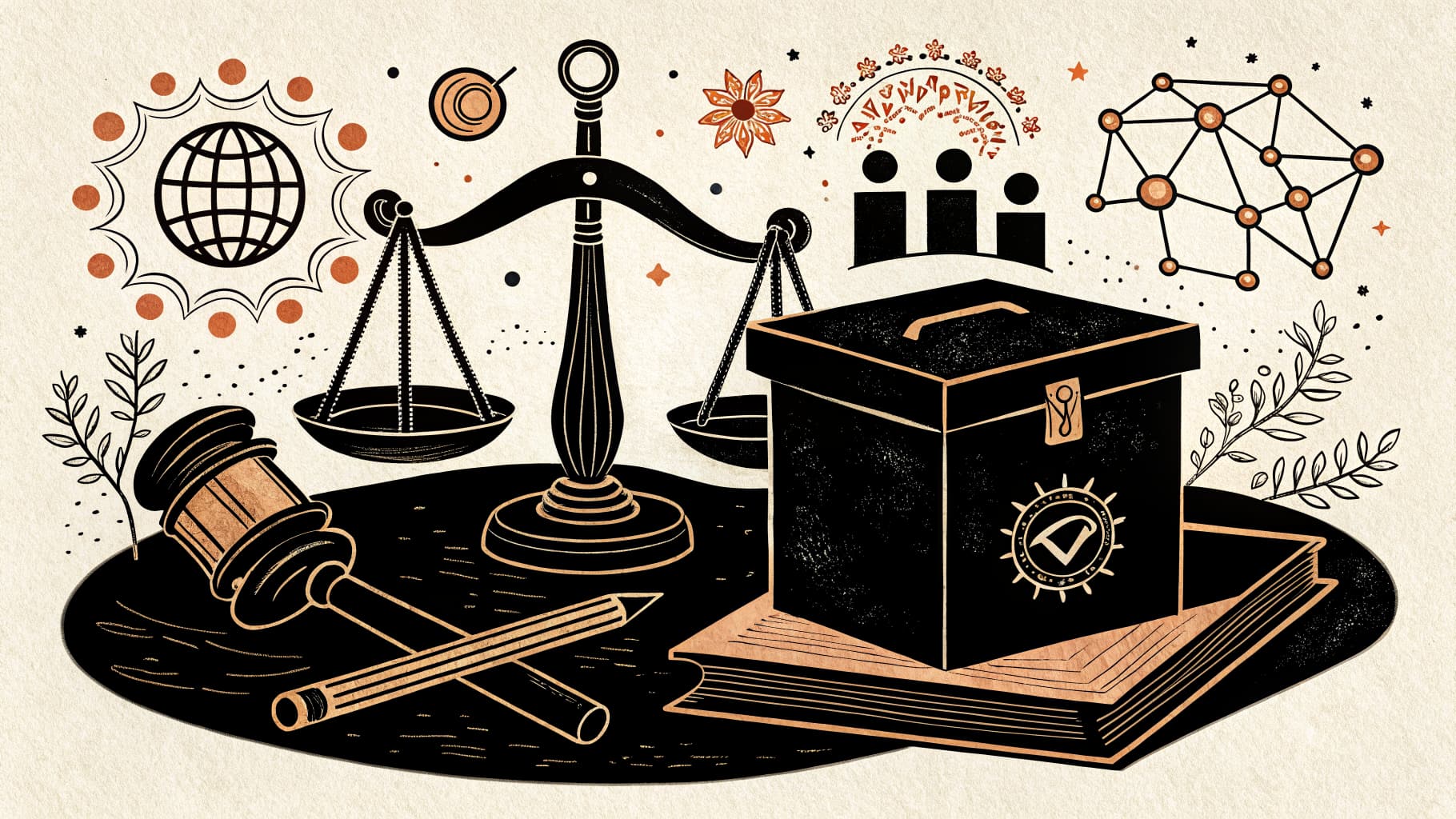
The Future of Democracy
Reflecting on the challenges facing modern democracies and imagining new ways for citizens to participate.
About This Topic
The Future of Democracy guides Year 10 students to analyse challenges in contemporary democratic systems, including declining voter turnout, misinformation on social media, and unequal access to participation. They predict how technologies such as online petitions and blockchain voting could boost direct citizen involvement, while weighing risks like digital divides. This content directly supports AC9C10K05, which requires evaluating citizen participation methods, and AC9C10S01, focusing on justified responses to civic challenges.
Within the Australian Curriculum's Civics and Citizenship strand, students connect these ideas to local contexts like compulsory voting and parliamentary reforms. They design visions for more inclusive systems and debate who holds authority over changes, such as politicians, citizens, or experts. These activities sharpen critical thinking and ethical reasoning essential for active citizenship.
Active learning excels with this topic because forward-looking concepts gain traction through student-led simulations and prototypes. When groups pitch reform ideas or role-play digital referendums, abstract possibilities become concrete, motivating engagement and revealing diverse perspectives in real time.
Key Questions
- Predict how technology can enhance direct citizen participation.
- Design a vision for a more inclusive democracy in the future.
- Justify who should decide reforms to voting and political systems.
Learning Objectives
- Critique current methods of citizen participation in Australian democracy, identifying their strengths and weaknesses.
- Predict specific ways emerging technologies could enable new forms of direct citizen engagement in policy-making.
- Design a model for a future democratic process that enhances inclusivity and participation for diverse groups.
- Justify proposed reforms to voting systems or political structures, considering potential impacts on different stakeholders.
Before You Start
Why: Students need to understand the basic structures and principles of different government types, including democracy, to analyze its future.
Why: Understanding existing civic duties and rights provides a foundation for discussing how participation can be enhanced or changed.
Key Vocabulary
| Direct Democracy | A system where citizens vote directly on laws and policies, rather than through elected representatives. |
| Representative Democracy | A system where citizens elect officials to make decisions and pass laws on their behalf. |
| Digital Divide | The gap between those who have access to modern information and communication technology and those who do not. |
| Civic Technology | Technology used to improve government services, increase citizen engagement, and promote transparency. |
| Deliberative Democracy | A form of democracy where citizens participate in reasoned public discussion and debate to reach collective decisions. |
Watch Out for These Misconceptions
Common MisconceptionModern democracies face no serious challenges and work perfectly.
What to Teach Instead
Students often overlook issues like apathy or inequality; group brainstorming of real Australian examples, such as youth disengagement data, reveals gaps. Active sharing corrects this by building collective awareness through peer evidence.
Common MisconceptionTechnology alone will fix democratic problems without risks.
What to Teach Instead
Debates on pros and cons, like cyber threats to e-voting, help students balance optimism with caution. Rotational discussions expose flaws in overly simplistic views, fostering nuanced analysis.
Common MisconceptionOnly elected officials should control reforms to voting systems.
What to Teach Instead
Role-plays assigning citizen voices show broader input's value, aligning with deliberative democracy. Collaborative justification tasks clarify why excluding groups undermines legitimacy.
Active Learning Ideas
See all activities→World Café
Design Challenge: Participation Platform
In small groups, students identify a democratic challenge like low youth turnout and sketch a digital platform to address it, including features and safeguards. Groups pitch prototypes to the class for feedback. Conclude with a class vote on the most feasible idea.
World Café
Debate Carousel: Tech Reforms
Prepare four stations with statements on tech in democracy, such as 'Blockchain voting replaces booths.' Pairs rotate, arguing for or against each in 5-minute bursts. Debrief whole class on strongest justifications.
Gallery Walk
Future Visions
Individuals create posters depicting an inclusive democracy in 2050, noting reforms and participants. Students gallery walk, adding sticky-note comments. Discuss common themes and surprises as a class.
Real-World Connections
- Estonia's i-Voting system allows citizens to cast ballots online for national elections, demonstrating a real-world application of technology in voting.
- The Australian Electoral Commission (AEC) continually reviews electoral processes, considering reforms like options for early voting or mobile polling stations to address participation challenges.
Assessment Ideas
Pose the question: 'Imagine a new app that allows citizens to vote on local council decisions daily. What are two benefits and two risks of this technology for our community?' Facilitate a class discussion, noting student reasoning on participation and potential inequalities.
Ask students to write down one specific technological tool (e.g., secure online forum, AI-powered policy simulator) that could improve citizen participation in Australia. Have them briefly explain how it would work and who might be excluded.
On a slip of paper, have students answer: 'What is one change you would make to Australia's voting system to make it more inclusive, and why is this change important?' Collect and review responses to gauge understanding of reform justification.
Frequently Asked Questions
What challenges do modern democracies face?
How can technology enhance citizen participation?
How can active learning help students with the future of democracy?
Activity ideas for Year 10 future democracy unit?
More in Active Citizenship and Social Change
Protest and Civil Disobedience
Examining the history and effectiveness of protest as a tool for achieving social and political change.
2 methodologies
Advocacy and Lobbying Skills
Developing practical skills for effective advocacy, including writing submissions, public speaking, and engaging with elected representatives.
2 methodologies
Designing a Civic Campaign
Students apply their knowledge to plan a campaign for a social or political issue they are passionate about.
2 methodologies
Community Organising
Exploring the principles and strategies of community organising to empower local groups and achieve collective goals.
2 methodologies
Ethical Decision-Making in Civics
Applying ethical frameworks to analyze complex civic dilemmas and justify reasoned courses of action.
2 methodologies
Media Literacy for Citizens
Developing critical media literacy skills to evaluate information, identify bias, and navigate misinformation in the digital age.
2 methodologies