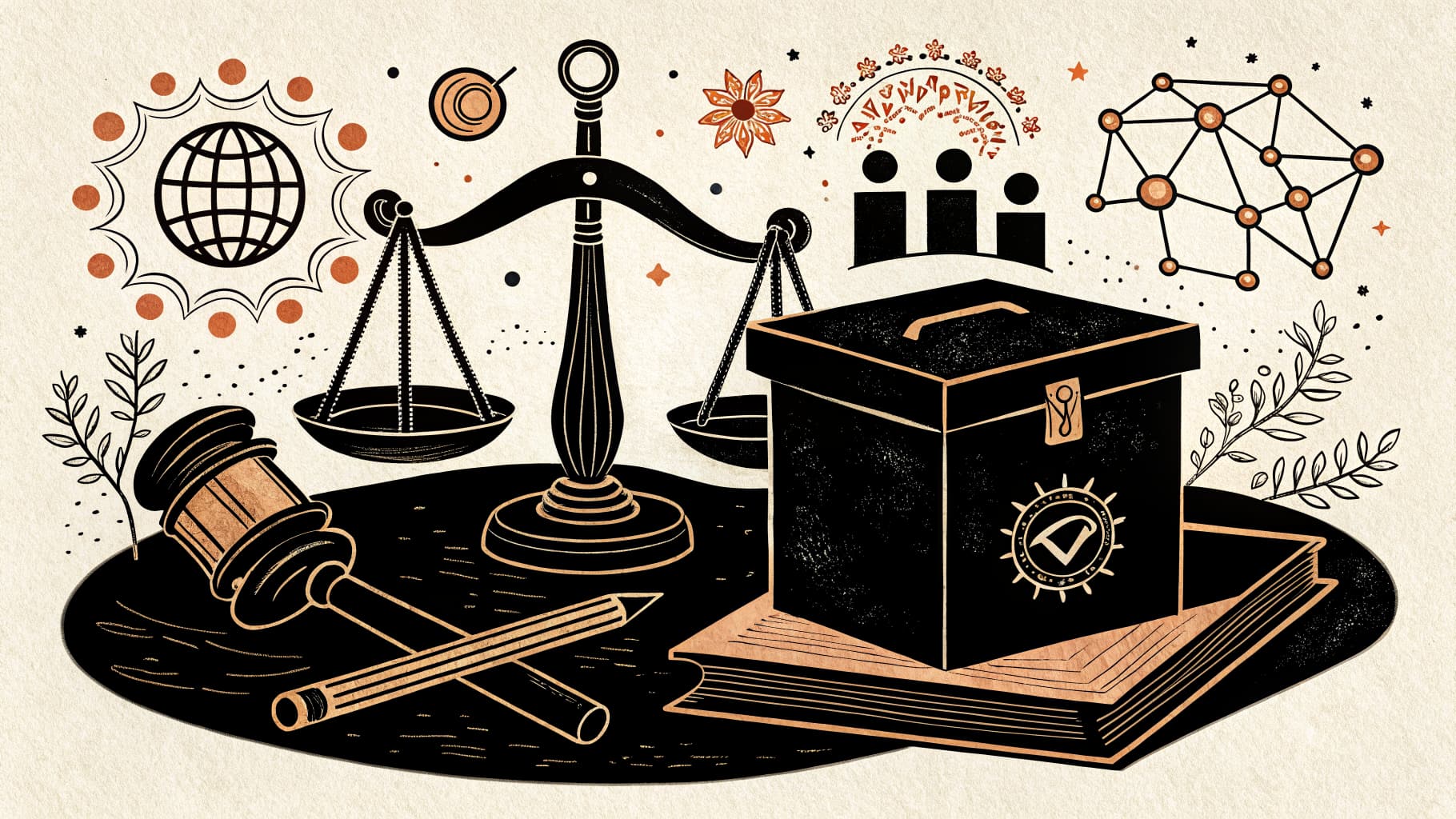
International Human Rights Law
Exploring key international human rights documents and their influence on global and domestic policy.
TL;DR:Active learning helps students grasp the complexity of international human rights law by moving beyond abstract treaties to real-world negotiations and dilemmas. When students take on roles, debate formulas, and connect local actions to global impacts, they see how human rights principles shape policy and practice.
About This Topic
Global environmental governance is one of the most pressing challenges of the 21st century, requiring unprecedented cooperation between nations. In Year 10, students explore how Australia engages with international agreements like the Paris Agreement to address climate change and biodiversity loss. This topic examines the ethical dilemma of 'burden sharing', how to divide the responsibility for reducing emissions between wealthy developed nations and developing ones.
Students analyze the role of international summits (COPs) and the influence of global environmental movements on Australian policy. This study connects to ACARA's focus on global citizenship and the interconnectedness of nations. Because environmental issues are often polarized, this topic benefits from 'Perspective-Taking' activities where students must argue for the environmental needs of a Pacific Island nation compared to the economic needs of a major industrial power.
Key Questions
- Analyze the impact of the Universal Declaration of Human Rights.
- Compare the enforcement mechanisms of international human rights treaties.
- Evaluate Australia's compliance with international human rights standards.
Learning Objectives
- Analyze the historical context and philosophical underpinnings of the Universal Declaration of Human Rights.
- Compare the enforcement mechanisms and effectiveness of various international human rights treaties.
- Evaluate Australia's legislative and policy frameworks for compliance with international human rights standards.
- Synthesize arguments regarding the challenges and opportunities for strengthening global human rights protections.
Before You Start
Why: Students need to understand how laws are made and implemented within Australia to evaluate the nation's compliance with international standards.
Why: Understanding Australia's engagement with international organizations and agreements provides context for its participation in international human rights law.
Key Vocabulary
| Universal Declaration of Human Rights (UDHR) | A foundational document adopted by the United Nations General Assembly in 1948, outlining fundamental human rights to be universally protected. |
| International Covenant on Civil and Political Rights (ICCPR) | A key UN treaty that commits states parties to protecting the civil and political rights of individuals, including freedom of speech and fair trial. |
| International Covenant on Economic, Social and Cultural Rights (ICESCR) | A UN treaty that commits states parties to protecting economic, social, and cultural rights, such as the right to work and education. |
| Enforcement Mechanism | The processes and bodies established by international law to monitor compliance with treaties and address violations, such as reporting requirements or international courts. |
| Sovereignty | The supreme authority of a state to govern itself or another state, which can sometimes create tension with international human rights obligations. |
Watch Out for These Misconceptions
Common MisconceptionAustralia's emissions are too small to matter globally.
What to Teach Instead
While Australia's total emissions are around 1%, our per-capita emissions are among the highest in the world. As a major exporter of coal and gas, Australia's policy decisions have a significant global 'footprint.' Comparing 'total' vs 'per capita' data helps students see the full picture.
Common MisconceptionInternational environmental agreements are just 'talk' with no impact.
What to Teach Instead
While they lack a global police force, these agreements set targets that influence national laws, investor behavior, and technological shifts. Tracking how the Paris Agreement led to changes in Australian state-level renewable energy targets can demonstrate this impact.
Active Learning Ideas
See all activities→Simulation Game
The Climate Summit
Students represent different stakeholders: Australia, a developing nation, a Pacific Island nation, and a major fossil fuel company. They must negotiate a set of emissions targets that everyone can agree to sign.
Collaborative Problem-Solving
The Burden-Sharing Formula
Groups are given data on different countries' historical emissions and current wealth. They must design a 'fair' formula for who should pay the most for global environmental protection and present their logic to the class.
Think-Pair-Share
Local Action, Global Impact
Students discuss whether an individual's actions in Australia (like recycling or protesting) actually matter for a global problem like climate change. They reflect on the concept of 'global citizenship.'
Real-World Connections
- Human rights lawyers working for organizations like the Australian Human Rights Commission or the UN Human Rights Office advocate for individuals and groups whose rights have been violated, using international law as a basis for their arguments.
- Diplomats at the United Nations engage in debates and negotiations to create new human rights treaties or to hold member states accountable for their commitments, influencing global policy on issues from refugee rights to freedom of the press.
- Journalists investigate and report on human rights abuses in countries around the world, bringing attention to violations and pressuring governments and international bodies to take action, as seen in coverage of conflicts or oppressive regimes.
Assessment Ideas
Pose the question: 'To what extent can international human rights law effectively protect individuals when national governments are unwilling to comply?' Facilitate a class debate, asking students to cite specific examples of treaties, countries, and enforcement challenges.
Provide students with a brief case study of a human rights issue in a specific country. Ask them to identify which articles of the UDHR or relevant covenants might be violated and to suggest one potential avenue for international recourse.
On a slip of paper, have students write the name of one international human rights treaty and one specific mechanism used to enforce it. Then, ask them to write one sentence explaining why Australia's compliance with this treaty is important.
Frequently Asked Questions
What is the Paris Agreement?
Why are Pacific Island nations so vocal in environmental governance?
How does global governance affect Australian businesses?
How can active learning help students understand environmental governance?
More in Global Citizenship and Identity
Australia and the United Nations
Evaluating Australia's engagement with the UN and its commitment to international cooperation and peace.
8 methodologies
Global Environmental Governance
Exploring how nations collaborate to address the ethical and political challenges of climate change.
8 methodologies
Refugees and Migration Policy
Analyzing the ethical and legal complexities of Australia's borders and its treatment of asylum seekers.
8 methodologies
Globalisation and its Impacts
Investigating the economic, cultural, and political effects of globalisation on Australia and the world.
8 methodologies
International Aid and Development
Examining Australia's role in providing international aid, its motivations, and effectiveness.
8 methodologies
Conflict and Peacekeeping
Exploring the causes of international conflict and Australia's involvement in peacekeeping and diplomatic efforts.
8 methodologies